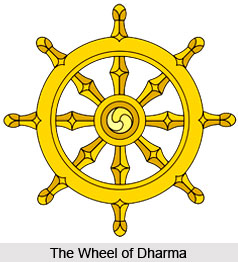
 The role of Vajrayana in understanding the classification and further action of the concept of dharma is quite significant. It has been seen that Tantric Buddhism profits much from the constructive philosophy of the Abhidharmika, the Madhyamika and the idealism of Yogacara. All these various elements have been absorbed and have served towards casting Buddhism in a new key. The role of the Vajrayana school of Buddhism is that it recognizes the systematic and meticulous classification of the dharmas (elements of existence) into skandas, ayatanas and dhatus. Since dharmas form the structural elements of existence, they cannot be further reduced. However, the contribution of Vajrayana goes beyond this. It does not just make this speculation and stop there, but looks at how this knowledge can be put into action.
In Vajrayana, the dharmas are objects of meditation. . For this purpose they are visualised as deities inhabiting the mandala and finally as residing within the body of the sadhaka, since the body is viewed as the microcosm. In Vajrayana, through the deityyoga, the non-reality of the dharmas is experienced. The Vajrayana sees the dharmas as the appearances of consciousness and the deities as the creations of the mind.
The most fundamental creation of the mind, according to Yogacara, is the subject-object duality (grahya-grahaka dvaya). According to Yogacara, when nirvana is realised, the object is negated and the subject lapses and non-dual consciousness alone remains. Consciousness as Absolute is not subject to pratityasamutpada, but consciousness as subject (i.e., the creative mind) and its creations are. Vajrayana also admits that the subject-object duality is avidya and that the Ultimate Reality is non-dual consciousness experienced as Great Bliss. Vajrayana admits that the knowledge of the Ultimate Reality as something svasariwedya (directly experienced within one`s body), lies beyond the ken of perception and ratiocination. In Yogacara, multiplicity is reduced to the fundamental duality of subject-object. In Vajrayana, all distinctions are reduced to a fundamental bi-polarity. It must be noted that there is no duality within the Ultimate Reality, though Vajrayana concedes a basic bi-polarity experienced at the penultimate state, which is ultimately bridged by the coalescence of polarities. In Yogacara, the object is negated and the subject lapses; but in Vajrayana there is no negation or cancellation of any of the polarities but the union of the two.
Vajrayana regards the two fundamental Mahayana principles, sunyata and karuna, as constituting the bi-polarity, and in the true spirit of tantra, ascribes gender to them as female and male and their union as the non-dual reality. Vajrayana is fundamentally a `gender-specific experience of reality`. For the male `the gender experience of empirical reality is feminine` while for the female it is masculine. This perception helps the practitioner to get in touch with his or her masculinity or femininity. The Vajra praxis helps the yogi to unite with the feminine within him and the yogini to unite with the masculine within her, and thus experience completeness.
The analytical skills of the mind employed by the Abhidharmika in creating the matrix of dharmas are down played in Vajrayana, in favour of imaginative thinking, which enables the sadhaka to visualise the dharmas in the form of deities within the confines of a mandala, both external and internal. Hitherto Buddhism depended on terms and concepts to express its findings, but Vajrayana employs colours, sounds, symbols and figures to express its meditative realisations. To demonstrate that reality is beyond concepts and categories, paradoxes and the language of negation are generally employed; but in addition to these, Vajrayana employs, sandhyabhasa, sign language, song and dance as well as iconography in its grotesque form. In Vajrayana, iconography is at the service of metaphysics. It is deliberately made incongruous to our trite frame of mind in an attempt to reformat our mental make up.
Further, the Vajrayanic employment of sandhyabhasa signifies that, a word could be chosen to represent a particular reality. In that sense, there is no strict adherence between a word and the reality it conveys; because a word is only a symbol of an entity and reality stands free of the tyranny of language.
Thus concepts of dharma have been systematically expounded and explained by the Vajrayanic theories and concepts.