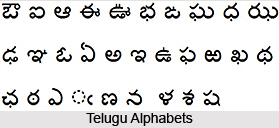
 Telugu language is India`s native Dravidian language. The government of India has given it the status of a popular Classical language as well. Moreover, it is one of the 22 scheduled languages of India. Telugu is the only language other than Hindi, English and Bengali that is predominantly spoken in more than one Indian state, being the primary language in Andhra Pradesh and Telangana, as well as in the town of Yanam where it is also an official language. Apart from Andhra Pradesh, it is also spoken in neighbouring states like Andaman and Nicobar, Tamil Nadu, Puducherry, Karnataka, Chhattisgarh, Maharashtra and Odisha. It is the principal language of Andhra Pradesh. In cities like Chennai and Bengaluru, it is widely used.
Etymology of Telugu
The Etymology of Telugu traces its linguistic evolution through historical accounts and scholarly investigations. According to poet Appakavi of the 17th century, the word `telugu` comes from the phrase "trilinga". It represents three temples at Kaleshwaram, Draksharamam and Srisailam. It has a close association with Kannada alphabet. Telugu language forms India`s largest linguistic unit. Telugu retains some features of Sanskrit that have subsequently been lost in some of Sanskrit`s daughter languages such as Hindi and Bengali, especially in the pronunciation of some vowels and consonants.
Telugu speakers, known as Telugu Varu, have referred to their language using various names over time. In earlier forms, it was called Tenungu or Telinga. Notably, in the 13th century, Atharvana Acharya coined the term "Trilinga Shabadanushasana" or "Trilinga grammar" to describe Telugu`s grammar.
An alternative theory posits that the term Tenugu derives from the Proto-Dravidian word "then," which denoted "south" and was associated with the people inhabiting the southern region. This notion holds relevance to the Sanskrit and Prakrit-speaking population of ancient times. Notably, the name "Telugu" evolved through a linguistic substitution, where the "la" sound replaced the "na," leading to the present-day nomenclature.
Official Status of Telugu Language
Telugu is one of the 22 official languages of India. In the year 1953, Telugu was affirmed as the official language of Andhra Pradesh, after the formation of the state. It was declared completely on linguistic basis. In Yanam district of Puducherry also, Telugu has the status of official language. According to 2001 census report, more than 74 million people speak this language. Telugu ranks third by the number of native speakers in India and is the most widely spoken Dravidian language. In the Ethnologue list of the most used languages of the world, Telugu ranks in the top 14.
History of Telugu Language
Telugu alphabet is closely connected with Kannada alphabets and it is a successor of ancient India`s Brahmi script. Telugu inscriptions containing some words were found on coins in Andhra Pradesh. It dates back to almost 400 BC to 100 BC and was actually discovered in Guntur district of Andhra Pradesh. Some Telugu words appear in the Prakrit collection of poems collected during the Satavahana dynasty. Telugu literature was initially found in inscriptions and poetry in the courts of the rulers, and later in written works such as Nannayya`s "Mahabharatam" (1022 AD). The Telugu language was written in an archaic style until the 20th century, which was very different from the language used today. It was during 20th century`s second half, the new written standard of Telugu emerged and it was completely based upon today`s modern spoken language. This language experienced huge changes just like the other languages of India in between the medieval and modern era. In the present decade, with the introduction of mass media the literary form of Telugu language has spread in the society.
Literary Evidence of Telugu
In the vast landscape of Dravidian languages, the quest for the precise origin of Telugu remains an enigmatic pursuit, lacking definitive and conclusive evidence. However, amidst this puzzle, intriguing traces emerge from literary sources that shed light on the language`s early existence.
The first glimmers of Telugu`s presence can be found in the esteemed Maharashtrian Prakrit poetry anthology known as "Gathasaptasati," thought to be crafted by the Satavahana rulers during the first century AD. This momentous revelation indicates that Telugu words were already in circulation and employed by the inhabitants living between the Krishna and Godavari rivers even before the onset of the Satavahana dynasty.
As more historical artifacts were revealed, the earliest clear ancient epitaph inscribed in Telugu was discovered, stretching back to the 7th century. Among the inscriptions, the word "Nagabu" emerges as the oldest Telugu term, providing a glimpse into the language`s linguistic landscape during that era.
The literary journey of Telugu gains more firm footing from the 11th century of the common era onwards, where scriptures and writings in the language began to emerge, leaving behind a trail of profound cultural and literary significance.
Despite the lack of a definitive origin, the literary evidence of Telugu weaves a captivating narrative of its ancient roots, evoking a sense of wonder and appreciation for the enduring legacy of this Dravidian language.
Influence of Muslim Rule on Telugu Language
With the exception of Coastal Andhra, a distinct dialect developed in the Telangana State and the Rayalaseema region due to Muslim influence. Sultanate rule under the Tughlaq dynasty had been established earlier in the northern Deccan during the 14th century. This heralded an era of Persian/Arabic influence on the Telugu language, especially among the people of Hyderabad. The effect is also evident in the prose of the early 19th century, as in the Kaifiyats.
In the princely state of Nizam, Andhra Jana Sangham was started in 1921 with the main intention of promoting Telugu language, literature, its books and historical researches.
Dialects of Telugu Language
Berad, Dommara, Komati, Golari, Dasari, Kamathi, Vadaga, Godavari, Toorpu, Salewari, Telangana, Vadari, Paschima, Srikakula, Guntooru, Nellooru, Rayalaseema, Prakasam, Yanadi are some of the main dialects of Telugu language. The ancient dialects of Telugu language are:
Chenchu: This Dravidian language belongs to South Central family`s Telugu branch. It is widely spoken in Andhra Pradesh. Other names of this language are Chenswar, Chenchukulam, Choncharu and Chenchwar.
Savara: This South-Central Dravidian language is mostly spoken in eastern India.
Other dialects include Sagarandhra, Rayalaseema, Telangana, and Kalingandhra. Costa Dialect or Sagarandhra Language spans across the districts of Krishna, Guntur, Prakasam, Nellore, and Ubhaya Godavari.
Rayalaseema Dialect thrives in the Rayalaseema region, nestled in the southern part of Andhra Pradesh. It is distinguished by its unique linguistic expressions that mirror the rich heritage and history of this land. Encompassing the Telangana region, Telangana dialect resonates with the vibrant cultural heritage of its people. The language of Telangana showcases a distinctive identity that sets it apart from other dialects in the state.
Extending over the districts of Visakhapatnam, Vizianagaram, and Srikakulam, the Kalingandhra dialect, also known as Uttarandhra dialect, takes its name from the ancient connections to the Kalinga region. Its unique linguistic flavors mirror the historical ties and geographical diversity of this coastal belt.
Geographic Distribution of Telugu Language
Telugu language is mostly spoken in the states of Andhra Pradesh and Telangana. Yanam district of Puducherry too largely uses this language. It is also used in neighbouring states of Karnataka, Tamil Nadu, Chhattisgarh, Puducherry, Orissa and Maharashtra. In some parts of Kharagpur, West Bengal and Jharkhand too, this language is spoken. Telugu language is also spoken in countries like Canada, New Zealand, Australia, Singapore, Malaysia, Bahrain, South Africa, United States, United Kingdom, Fiji, United Arab Emirates and Ireland. In India, Telugu is the third most used language after the languages Hindi and Bengali.
Script of Telugu Language
The Telugu script, a member of the ancient Brahmi script family that underpins several Indian languages, has a fascinating historical lineage. Its roots can be traced back to the time of the Satavahanas, vassals of the Mauryan Empire during the reign of Ashoka. These early rulers introduced the Brahmi script to South India, becoming the foundation for the scripts of various Dravidian languages in the region. Among them, the Telugu script emerged from the Bhattiprolu variant of Ashoka`s Brahmi and the `Halegannada` script of ancient Kannada.
Beyond its homeland, the Telugu script embarked on a remarkable journey, carried by Buddhists and traders to Southeast Asia. There, it played a pivotal role in shaping the scripts of languages such as Man, Burmese, Thai, Khmer, Kam, Javanese, and Balinese, displaying striking resemblances to its original form. Furthermore, the Telugu alphabet bears a strong resemblance to its close relative, the Kannada alphabet, attesting to their shared linguistic heritage.
In its structure, the Telugu script predominantly comprises pronounceable monosyllables, adhering to a left-to-right, simple-to-complex letter pattern. Distinguishing between "vowels" and "consonants," the script accommodates the abundance of pronounceable monosyllables. Consonants are considered pure when devoid of any vowel sound, though tradition dictates adding the vowel "a" for writing and reading consonants. When consonants combine with different vowels, special symbols known as "pills" with color segmentation are utilized to identify the vowel element. These "pills" exhibit distinct shapes from their respective consonants, allowing for clear differentiation.
A Telugu sentence concludes with a "full stop" but not with a "long stop." While the script incorporates dedicated symbols for numbers, Indo-Arabic numerals have become widely accepted and commonly used in Telugu writing. In total, the Telugu script comprises 60 signs, including 16 vowels, 3 special vowels, and 41 consonants.
Alphabet of Telugu Language
The Telugu alphabets consist of 60 symbols - 16 vowels, 3 vowel modifiers, and 41 consonants. Sanskrit and Telugu alphabets are similar and exhibit one-to-one correspondence. Telugu has complete set of letters which follows scientific system to express sounds.
Telugu Literature
Telugu literature, steeped in a rich and diverse cultural heritage, traverses through six distinct eras, each leaving an indelible mark on the language`s literary landscape.
Pre-Nannaya Period: The advent of Telugu literature is believed to date back to the 11th century when the great poet Nannaya authored the Mahabharata, considered the first significant literary poem in Telugu. Although evidence suggests the existence of earlier literature, it remains largely unrecorded or lost, possibly residing in the realm of oral folk traditions. The Chodula inscription of Renati in 575 AD stands as the first complete Telugu inscription, followed by the appearance of the word "Nagabu" in an earlier Amaravati inscription.
The Puranic Age or Nannayya Yuga: Nannaya`s pioneering work in translating the Mahabharata laid the foundation for the golden era of Telugu literature. Assisted by Narayana Bhattu, Nannaya achieved greatness as an eminent poet, while other luminaries like Krishnarjuna and Panditula Pamarula contributed to the development of Telugu poetic expression. Nannaya and Narayan`s influence on subsequent poets proved profound, shaping the trajectory of the Telugu language for generations to come.
Middle Ages or Era of Srinath: The translation of Sanskrit poems and dramas continued during this era, accompanied by the emergence of narrative poems and the poetic form known as "prabandhamu." Poets like Srinathudhu, Potana, Jakkana, Gaurana, Tallapaka Thimmakka, and Gona Buddhareddy rose to prominence, showcasing their talent and maturity in prosody. Works such as Srinath`s romantic Naishadham, Potana Bhagavatam, Jakkana Vikramarka Charitra, and Gona Buddha Reddy`s first Telugu Ranganatha Ramayana adorned this period with literary brilliance.
Prosperous Age: The period between 1510 and 1600 is termed as the golden age of Telugu literature. It was fostered by the patronage of Emperor Sri Krishna Deva Raya of the Vijayanagara historical era. Under his guidance, the form of poetry known as "prabandham" flourished, and prominent poets called Ashtadiggas graced his court with their exceptional literary contributions.
Southern Era: This period is believed to have began in 1600 and continued till 1820. Southern era witnessed the poetic prowess of many Carnatic music luminaries who chose Telugu as the medium for their lyrical compositions. Tyagaraja, Annamacharya, Ksetrayya Ramadasu, and Kancherla Gopanna, among others, added a musical charm to Telugu literature. Additionally, modern writers like Mysore Vasudevachar embraced Telugu as a means of artistic expression.
Modern Era: The period after 1820 marked the beginning of modern era in Telugu literature. While the first Telugu printed book appeared in 1796, the true revival of Telugu literature occurred in the early 19th century. Young poets, inspired by the likes of Shelley, Keats, and Wordsworth, ushered in a new form of romantic poetry known as "sentimental poetry."
Telugu language boasts of a rich linguistic heritage and cultural diversity of South India. From its ancient roots to the flourishing literary achievements, Telugu has evolved as a vibrant and influential language, leaving its mark on literature, art, and the hearts of millions of speakers worldwide.