Modern English poetry in India
 Modern English poetry in India is one of the many new literatures which began to emerge at the end of the Second World War, after the end of colonialism. Unlike Africa and Caribbean, creative writings, modern Indian poetry in English did not have an obvious direct relationship with the cultural movements that had led to national independence. The emergence of modern English poetry was a part of modernization which included urbanization, industrialization, mobility, independence, social change, increased in communication facilities (in the form of films, television, radio, journals and newspapers), national and international transportation networks, mass education and the resulting paradox that as an independent national culture emerged and it also participated in the internationally modern, usually westernized world.
Gradually with passing time the English language poetry became more Indianized in nature. The change that came about reflected the change in mentality that had ushered in among the Indian poets. Such Indianisation had been proceeding for several generations and is prominent in the poetry of Kamala Das and Pritish Nandy and present although more nuanced in the work of Keki N.Daruwalla it is more likely to be felt in the verse of Nissim Ezekiel and Jayanta Mahapatra or in the kind of rapidly expressed ironies found in the poetry of Ramanujan.
The modern poets as a group tended to be marginal to traditional Hindu society not only by being alienated by their English language education but also more significantly by coming from such communities as the Parsis, Jews and Christians or by being rebels from Hinduism and Islam or by living abroad. Many of the writers came from the families that had already been partly westernized or that moved extensively during their childhood.
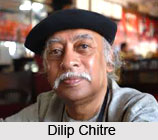 There are identifiable periods when Indian English poetry took new directions. In the early 1960s poets, like, Kamala Das and Ezkiel, focussed on the actuality of personal and family life; on the other hand, the experimental poetry of Mehrotra, Kolatkar, Nandy, Chitre and Mahapatra began to appear in the late 60s and early 70s. A renewed more detailed satirical and yet compassionate focus on communal and family heritage had become an important trend in the modern English poetry in India. It can be said about the modern Indian poetry in English that with every passing decade an increasing immediacy and heightened awareness of actual Indian experience is noticeable.
In the beginning it seemed that modern Indian verse was indebted to British as well as to a few European models but in the present age it reveals an awareness of most of world literature including contemporary American, South American and older Indian devotional verse in regional languages.
An important characteristic of modern Indian English poems is that they have an openness which is especially noticeable in the middle portions of the poems and the association that is created in the poems is very logical in nature. The narrative which is generally used in the poem has become an experience itself instead of an example in an argument. In modern Indian poetry in English there has always been a confessional tradition which was particularly noticeable in Ezekiel`s poetry.
Besides the immediacy, experimentation, openness and self revelation of modern Indian poetry in English there has been noticed an increasing interest in long poems as a means of going beyond the fragmented vision and isolation associated with the short lyric. Such long poems can be called closest modern culture which can come to the shared national and communal values and experience of the classical epic. In fact the distance between the modern sceptical individual and the traditional beliefs of a community is however the subject of this modern equivalent of the epic.
Early English Poetry in India
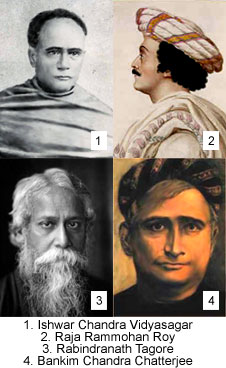
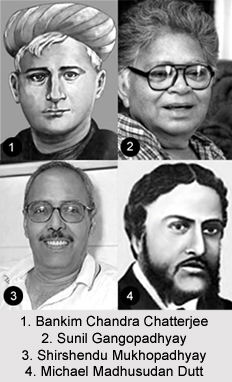
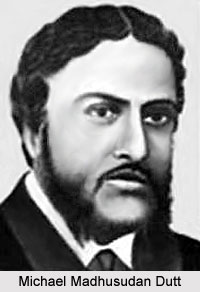 Early English poetry was the earliest writing of the Indians in the English language. The first literary texts in English emerged from Bengal, and Raja Ram Mohan Roy (1774-1833), the progressive advocate of English civilization and culture, wrote numerous essays and treatises, which were collected in a complete volume in 1906. But it seems that poetry was the genre that first took flight in the Indian imagination, the best-known nineteenth-century poets being Henry Louis Vivian Derozio (1809-31), Michael Madhusudan Dutt (1827-73), Toru Dutt (1856-77), her cousin Romesh Chunder Dutt (1848-1909), and Manmohun Ghose (7-1924).
All of these poets, in some degree, were influenced by the idealistic strain of romanticism. Their poets reflect Christian as well as lyrical sentiments. It has been noted that the first volume of poetry in English came out even before these poets made their mark, such as Shair and Other Poems (1830) by Kasiprasad Ghose. By the turn of the century and into the early twentieth century, three more poets were to join their ranks, outdoing them with a far greater success and fame. These were Rabindranath Tagore (1861-1941), Sri Aurobindo Ghose (1872-1950), and Sarojini Naidu (1879-1949).
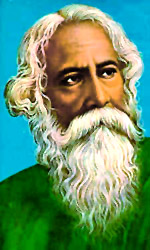
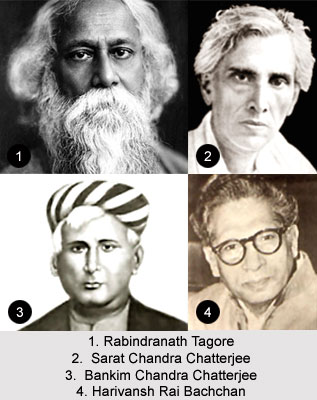
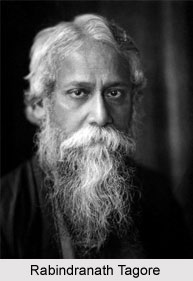
Rabindranath Tagore, maily a lyrical poet, came to the attention of the West by his 1912 English translation of his Bengali poems. This collection was called Gitanjali, meaning song offering, and this volume secured him international recognition. Though he went on to translate more of his poetry, Macmillan publishing the Collected Poems and Plays in 1936, Tagore is still best known for his first collection of poems and the creation of his experimental school, Santiniketan, in Bolpur. Unlike Tagore, Sri Aurobindo wrote originally in English, more justly deserving the title of mystic and visionary with such well-known works as Savitri (1936) and The Life Divine (1939-40). Initially, Sri Aurobindo embarked on a career in the Indian civil service with a degree in the classics from King`s College, Cambridge. The years of Anglicization came to an end when he rediscovered Indian religion and philosophy. After a period of nationalist activity, he established an ashram in Pondicherry, where he began to write his epic-style philosophical works and acquired a large religious following. Like Sri Aurobindo, Sarojini Naidu went to King`s College in England, returning eventually to India on the advice of Edmund Gosse, who found her early poems "too English". Her three volumes of poetry, The Golden Threshold (1905), The Bird of Time (1912), and The Broken Wing (1917), earned her much fame and popularity in England. At home, she became a well-known public figure.
One of the most remarkable things about the early poets is that they did not see any contradiction between the Indian and Anglicized identities. Henry Derozio, for instance, was a fervent nationalist; yet, his love of the romantics found him riding an Arab horse through the streets of Kolkata. Similarly, Toru Dutt went to Indian myth and legend for her themes in Ancient Ballads and Legends of Hindustan, freshly reinterpreting some of these; yet, she remained attached to France and French literature, even writing a novel in French and translating French poems into English. Thus these early writers did not did not merely reproduce the axioms of imperialism and mindlessly imitate Western literature. They were the mediators between the east and the west.