


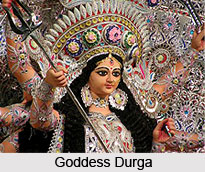
 Mahalaya is an integral occasion in the ethos of West Bengal as it marks the ushering of the festive spirit. It has two dimensions, namely, Devipaksha or the prayer which is offered to God and Pitripaksha or the worship and penance of one’s ancestor. Pitripaksha is also known as Shraddha or the ritual in which food is offered with a sense of affection and gratitude. On this day, Hindus pay their respect to their ancestors and this is known as Pindadana. On this very day Pitripaksha ends and the Devipaksha begins. Mahalaya is also the most suitable time for tantric practices and offering to the Goddess Chandi. Occurring every year in autumn or the 'sharot kaal', Mahalaya reminds every Bengali of Durga Puja that commences exactly after seven days. It is believed that the Goddess Durga pays a visit to the earth for a period of four days only and Mahalaya marks a kind of invitation to the mother goddess to descend on earth through chanting mantras and singing devotional songs. Mahalaya is an integral occasion in the ethos of West Bengal as it marks the ushering of the festive spirit. It has two dimensions, namely, Devipaksha or the prayer which is offered to God and Pitripaksha or the worship and penance of one’s ancestor. Pitripaksha is also known as Shraddha or the ritual in which food is offered with a sense of affection and gratitude. On this day, Hindus pay their respect to their ancestors and this is known as Pindadana. On this very day Pitripaksha ends and the Devipaksha begins. Mahalaya is also the most suitable time for tantric practices and offering to the Goddess Chandi. Occurring every year in autumn or the 'sharot kaal', Mahalaya reminds every Bengali of Durga Puja that commences exactly after seven days. It is believed that the Goddess Durga pays a visit to the earth for a period of four days only and Mahalaya marks a kind of invitation to the mother goddess to descend on earth through chanting mantras and singing devotional songs.
Legend of Mahalaya As per myth, Lord Rama hurriedly performed the Durga Puja shortly before he left for Lanka to save Sita from the clutches of the demon king Ravana. According to the Puranas, King Suratha worshipped the Goddess Durga in the spring season and it is for this reason that Durga Puja was also called as Basanti Puja. Since Rama organised the Puja and prayed the Goddess Durga in the season of autumn, it is known as ‘Akal Bodhon’ or untimely worship. The Puja of Lord Rama to Goddess Durga was regarded untimely since, according to the myths Puja is performed when the Goddesses and Gods are awake and this time is known as ‘Uttarayan’ and Puja is never offered when the Gods and Goddesses take rest and the time is called ‘Dakshinayan’. Mahalaya is thus the beginning of Devipaksha when the Gods and Goddesses wake up to prepare for Durga Puja.  There is another legend which speaks of the great hero Karna of the Mahabharata, one of the famous epics in Hinduism. When Karna left for his heavenly abode, he was provided with lots of Goldand Silver but no food since he had never practiced any food charity. He, thus, prayed to the God of death and was sent to the earth for only fourteen days to compensate for this deficiency. In all the fourteen days Karna fed the poor and Brahmin and presented oblations of water. Once he returned to the heaven, he was provided with a plenty of food. These fourteen days are observed in the Mahalaya Paksha. There is a belief that the oblation made in this period benefits every departed soul.
The Ritual of Torpon On the day of Mahalaya, many people visit the banks of River Ganga, dressed in dhotis, for offering prayers to their ancestors. Prayers are chanted in the pre-dawn hours for the deceased relatives and holy dips are taken in the holy river Ganges. The ritual is termed as Torpon. Shraddha and the associated rites are generally performed by the eldest son of the family or any male relatives. In some castes, the rituals are performed for only one generation while in many others it is done for many more generations, commonly for three. The foods offered to the forefathers are usually cooked in copper or silver vessels and they are offered on banana leaves. Although the food varies with different families, the main ingredients include rice, certain vegetables, yellow gourd, lapsi, kheer and dal. The person who performs the Shraddha takes the holy dip in the river and wears a dhoti afterwards. The offering during the Shraddha, also known as the Pindadana, are made bare-chested. Following this a cow and a dog is fed. Food is also offered to the Brahmins. 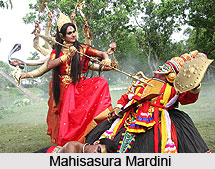 Mahisasura Mardini
An early morning program called Mahisasura Mardini is intricately associated with the spirit of Mahalaya. It has become synonymous with Mahalaya. It comprises a wonderful audio montage of recitation from the scriptural verses from Chandi Kavya, Bengali devotional songs, classical music and acoustic melodrama. The program was first broadcasted on the radio in Akashvani in the early 1930s and was organized by Raichand Boral, Nripendra Krishna Mukhopadhya, Premankur Aatorthi and Birendra Krishna Bhadra. The script was authored by Bani Kumar and music was composed by Pankaj Kumar Mallik. Noted singers like Supriti Ghosh, Shyamal Mitra, Utpala Sen, Arati Mukhopadhyay, Sandhya Mukhopadhyay, Manobendra Mukhopadhyay and Dwijen Mukhopadhyay have rendered their melodious voice to the songs. Back then it was broadcasted live. Later the recording was played. The enchanting voice of Birendra Krishna Bhadra has over years enthralled the listeners in the pre-dawn hours of Mahalaya who recites the holy verses and narrates the tale of the descent of Durga to earth in his unique style. Although the legend has passed away, his recorded voice and mesmerizing recitation still creates a divine aura on Mahalaya. The visual treat of Mahalaya can be obtained on Doordarshan and many other television channels in the morning. It has also been translated to Hindi and is broadcasted for non Bengali audiences.
Mahisasura Mardini
An early morning program called Mahisasura Mardini is intricately associated with the spirit of Mahalaya. It has become synonymous with Mahalaya. It comprises a wonderful audio montage of recitation from the scriptural verses from Chandi Kavya, Bengali devotional songs, classical music and acoustic melodrama. The program was first broadcasted on the radio in Akashvani in the early 1930s and was organized by Raichand Boral, Nripendra Krishna Mukhopadhya, Premankur Aatorthi and Birendra Krishna Bhadra. The script was authored by Bani Kumar and music was composed by Pankaj Kumar Mallik. Noted singers like Supriti Ghosh, Shyamal Mitra, Utpala Sen, Arati Mukhopadhyay, Sandhya Mukhopadhyay, Manobendra Mukhopadhyay and Dwijen Mukhopadhyay have rendered their melodious voice to the songs. Back then it was broadcasted live. Later the recording was played. The enchanting voice of Birendra Krishna Bhadra has over years enthralled the listeners in the pre-dawn hours of Mahalaya who recites the holy verses and narrates the tale of the descent of Durga to earth in his unique style. Although the legend has passed away, his recorded voice and mesmerizing recitation still creates a divine aura on Mahalaya. The visual treat of Mahalaya can be obtained on Doordarshan and many other television channels in the morning. It has also been translated to Hindi and is broadcasted for non Bengali audiences.
The Story of Mahisasura Mardini Mahisasura Mardini narrates a captivating story of the increasing cruelty of the demon king Mahishasura against the Gods. Dismayed by his tyranny the Gods pleaded to Lord Vishnu to destroy the demon king. The Trinity of Brahma, Vishnu and Maheswara thus unite to create a Goddess ‘Durga’, a powerful female form with ten arms, who is regarded as the Mother of the Universe embodying the primeval source of all power. This supreme creation is then bestowed with individual blessings and weapons by all the Gods. The Goddess then rides a lion, armed as a warrior, to fight with Mahisasura. A fierce combat is followed by the triumph of Goddess Durga and her victory is rejoiced by the heaven and the earth. 
Celebration of Mahalaya As the beginning of Devipaksha, it is believed that on the day of Mahalaya the Gods and Goddesses wake up to prepare them for Durga Puja. The day marks the arrival of festivities and nostalgia. On this auspicious day, the eye is given to the idol of Goddess Durga. It is an ancient custom which is followed till date. Mahalaya is a significant day in the lives of Bengalis and many offices and educational institutions remain close on this day. The day indicates the beginning of the biggest festival of the year. |
| |||



Home > Art & Culture > Indian Festivals > Indian State Festivals > Festivals of West Bengal > Mahalaya Festival
Mahalaya Festival
| Mahalaya, marking the beginning of Devipaksha, is celebrated seven days prior to Durga Puja in West Bengal. The day indicates the arrival of festive spirit encompassing grandest festival of the year. |
| ||||||||||||||||||||||||||||

