


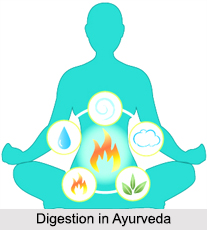
 Digestion plays a very important role in Ayurveda’s understanding of human health and illness. In Ayurveda, it is mentioned that all the diseases originate at first in the mind but on a physical level this invariably manifests as a breakdown in metabolic function. Digestion plays a very important role in Ayurveda’s understanding of human health and illness. In Ayurveda, it is mentioned that all the diseases originate at first in the mind but on a physical level this invariably manifests as a breakdown in metabolic function.
Concept of Digestion in Ayurveda One of the key concepts in the Ayurvedic understanding of digestion is ‘digestive fire’, the main process for metabolic conversion within the body. Everything that requires heat, light, conversion or transformation is under the control of the element of Agni. Agni’s role is really critical in the total process of digestion. In the context of digestive processes in Ayurveda, Agni Bhuta is called the Jathara Agni. It manifests more specifically in the body as the five sub-doshas of Pitta. Each has a specific metabolic function. Their main function is responsible for digestive ability and appetite. Function of Digestion in Ayurveda Ayurveda states that body’s metabolic functions have a close relationship with organ and tissue formation. Health requires proper removal of the natural by-products occurring from the digestive processes. If the metabolic conversion of food is incomplete, it can produce low energy and apathy. The undigested food particle also becomes the source for degenerative diseases.  In the proper digestion process of the body, the three main principles of Ayurveda that are Vayu (air), Agni (fire) and Jala (water) which act as the Vata, Pitta and Kapha Doshas of the body play a major role. They possess specific ability to accomplish the complex metabolic functions. According to Ayurveda, it has been stated that the disease process starts when the doshas natural relationship becomes impaired or imbalanced. In the proper digestion process of the body, the three main principles of Ayurveda that are Vayu (air), Agni (fire) and Jala (water) which act as the Vata, Pitta and Kapha Doshas of the body play a major role. They possess specific ability to accomplish the complex metabolic functions. According to Ayurveda, it has been stated that the disease process starts when the doshas natural relationship becomes impaired or imbalanced.
Process of Digestion in Ayurveda Ayurveda also explains that digestion occurs not only in the gastrointestinal tract but also in the dhatus as well. And it makes a clear distinction between the two different metabolic processes. The actual conversion takes place in the gastrointestinal tract, up to and including absorption through the intestinal walls. It is called the ‘Prapaka Digestion’. The initial stages of digestion prepare the food to be absorbed by the dhatus in the next seven metabolic stages, which are collectively known as ‘Vipaka Digestion’. It is the post-absorptive digestive processes. Role of Doshas in Digestion Digestion and the doshic action are locked in a functional interdependence in which an imbalance or impairment in one element necessarily involves an impairment in the other one. Indigestion results when one or more of the doshas becomes either deficient or excessive in their functioning. In Ayurveda, it is mentioned that each and every dosha displays a twice-daily cycle of predominance portraying the influence of its particular bhuta in the entire environment. However, the precise coordination of these three doshas is very critical for healthy digestion. When a dosha’s dominance continues outside the normal circle or time period, it generally becomes aggravated. An aggravated dosha no longer interacts in a balanced manner with the other two. It inhibits their ability to perform their respective operations and this causes indigestion. Apart from precise coordination among themselves, the doshas perform many functions within the body. The dhatus play an important role in the transformation of foodstuffs into nutrients required for the dhatus. In Ayurveda, digestion has a significant role in having a proper understanding of diseases, illness and of course good health. |
| |||



Digestion in Ayurveda
| Digestion in Ayurveda is an important concept. It is given prime importance as compared to the modern medicine. |
| ||||||||||||||||||||||||||||

