 British Monuments in India showcase some of the unbelievable work of artistic wonder created during the British rule in India. They are not just the masterpieces of art but also tell the story of the bygone ages. There are several monuments constructed by the British in India which still exist.
Some of the monuments present in India erected by the British include the British military monuments in India. With the aim to protect them from any possible hostile condition, the British constructed several forts and cantonments in India. Post-death military monuments were also an overriding factor during the rule of British in India. Built in 1810 AD, John Flaxman`s monument at St. Mary`s Church in Chennai, is dedicated to General Sir Barry Close (1756-1813), and exclusively includes the auxiliary use of a cast of Indian mourners. Later this theme appeared again in J.G. Lough`s monument of Sir William Hay MacNaghten (1793-1841) situated at St. Paul`s Cathedral in Kolkata.
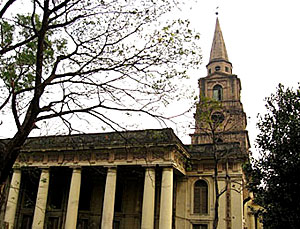
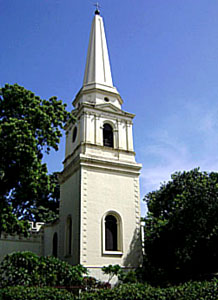
The first prominent church in India to utilize the Gibbs precedent was St John`s, Kolkata, constructed by Lieutenant James Agg in the year 1787 at the heart of the old city. Although the spire was not built as Agg wanted, it was widely admired and copied in other parts of India. The closely-located Scottish Kirk of St Andrew`s is a better rendition, and similar examples can be found in several cantonments and stations of upper India at Agra, Allahabad and Varanasi. The best monuments of British in India are the St Georges Cathedral and St Andrew`s Kirk at Chennai (Madras). Both St George`s and St Andrew`s are sophisticated essays in the Baroque style, distinguished designs which owe a great deal to the structural ingenuity of the military engineer who built them, Thomas Fiott de Havilland. St James`s Church in Delhi was designed by Colonel Robert Smith and constructed between 1828 and 1835 in memory of the famous Colonel James Skinner in fulfillment of a vow he made when he was wounded on the battlefield. The church was designed on a Greek cross plan and crowned by a Baroque dome, with each arm terminated by a Doric portico, but such exercises remained the exception rather than the rule.
A large number of churches contain splendid examples of funerary sculpture by leading sculptors of the day, like John Flaxman and John Bacon. Some of the spectacular British monuments in Indian include the St. Thomas` Cathedral, Mumbai (Bombay), St. Mary`s, and St George`s in Chennai (Madras) and St John`s in Kolkata (Calcutta), have spectacular collections of mural monuments which should not be missed. The cemeteries of British in India are one of the most poignant reminders of the price of British rule. There are more than two million European graves in India. Park Street Cemetery at Kolkata in the state of West Bengal is of outstanding interest, a fascinating repository of funerary architecture in the form of pavilions, pyramids and temples, resembling an Imperial city of the dead. Virtually every Indian town and city has its old European cemetery, where ancient Dutch, French, Portuguese and British tombs can be found.
Bungalows were another kind of British monuments that originated in the Indian state of Bengal. From this the bungalow developed. Due to British influence, bungalow suggests any single-storey building with a veranda. Large number of planters, soldiers and officials staying in up-country locations demanded a shelter which could be speedily constructed with the help of available local materials.
 A major change occurred in the form and pattern of European settlement and was evident from the construction of a gigantic new fort, based on Vauban`s 17th century concepts of fortification. The new Fort William was the most important symbol of British military power in entire Asia.
Maidan, formed in the year 1780, provided an opportunity for European merchants to express their newly found wealth in a more visible form. The old thatched bungalows were replaced by grand classical houses which reflected the aspirations and status of their European owners.
Gradually, the more central districts like Chowringhee and the Esplanade, acquired a continuous street frontage of boundary walls, screens and gates, which complemented the fine classical architecture of the houses. The consecutive construction of these houses over several decades was a process of continuous refinement and adjustment to local conditions. Although many of these fine houses have been demolished or submerged in the encroaching bazaars, a number of well-preserved examples can still be found in Chowringhec, Alipur and Garden Reach.
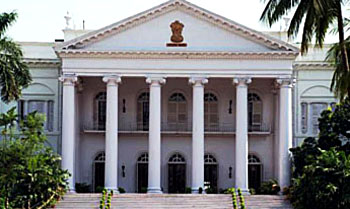
The Warren Hastings`s house at Alipore, described as a `perfect bijou` when constructed in the year 1777 and reputedly haunted by his ghost, is a notable example, together with nearby Belvedere, now housing the National Library. Some of the other British monuments are the Tollygunge Club or the Royal Calcutta Turf Club and Loretto Convent in Chowringhee; offer a rewarding insight into the `city of joy`.
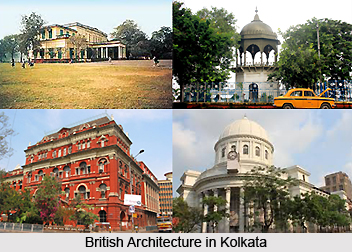
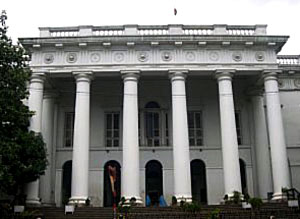
As the British centralized their power in Kolkata a whole series of classical perspectives was formed, with vistas terminated by prominent public buildings and monuments like the Town Hall, the Mint, Metcalfe Hall and the La Martiniere schools. In Mumbai (Bombay) also a spectacular New Greek town hall was commenced in the year 1820, the finest neo-classical building in India. In the district of Murshidabad a fine new palace was designed by General Duncan Macleod for the Nawab, based on Government House, Kolkata, while at Chennai (Madras), the shoreline boasted a range of classical buildings which provoked comparison with the Mediterranean in the age of Alexander.