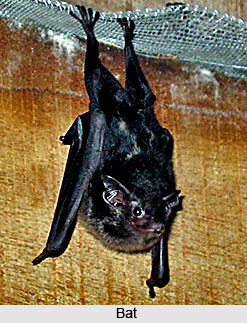
 Bats are classified in the mammalian order. Next to the rodents, bats are the most diverse and abundant order amongst mammals, with over 2000 different species having been described. The wing development is the unique characteristic shared by all bats, giving them the power of true flight and also distinguishing them from all other mammalian orders. The wing of a bat actually consists of two layers of very elastic skin stretched between the finger-bones (phalanges) with little or no interconnecting tissue. This membrane usually extends down to the ankle (carpal) joint of the hind leg and in most bats also encloses the tail to form an elastic pouch of skin, known as the inter femoral membrane or uropatagium.
At least 73 species of bats have been described from the Indo-Pak region. Bats are very difficult to classify. Broadly speaking however they can be divided in two main groups (sub-orders): the fruit bats or flying foxes known as Megachiroptera, and the insect-eating or smaller bats known as Microchiroptera. Some Megachiroptera are actually smaller in size than the insect-eating bats but they are all adapted to a diet of soft pulpy fruit or pollen and nectar from flowers and their wing-structure is different, retaining some independence of the second digit, often terminating in a separate claw to aid in clambering over fruiting branches.
In India seven species occur, from the relatively small Short-nosed Fruit Bat or Cynopterus Sphinx, which is quite a pest of fruit gardens around Mumbai, to the large Flying Fox Pteropus giganteus which is so familiar in many Indian villages. Another species named Pteropus has been recorded from Assam and the Andaman Islands, while there are two species of intermediate-sized fruit bats belonging to the genus Rousettus which roost in comparatively dark caves or similar man-made excavations such as cliff temples or deep open wells. Two other little-known fruit bats just come into the area from northeastern Assam, the Dawn Bal (Eonycteria spelaea), specialized to feed upon pollen and nectar, and Blanford`s Fruit Bat or (Sphaerias blan- ford), is unique among fruit bats because it has no tail and only has a vestigial inter femoral membrane.