 "Learn to make the whole world your own. No one is a stranger . . . the whole world is your own" - Sarada Devi
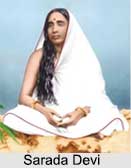
Sarada Devi, the consort of Ramakrishna Paramhansa, was a pious lady. Her original name was Saradamani Mukhopadhyay, but was popularly known as Holy Mother Shri Sarada Devi or the Holy Mother. In contemporary India, Sarada Devi is revered as one of the spiritual leaders who continued to devote her life for Ramakrishna and his disciples. She is paid greater importance in many of the scholarly analyses of the Ramakrishna Mission. She played a vital role in the growth of the Ramakrishna Movement.
Early Life of Sarada Devi
Sarada Devi was born in 1853 in a poor Brahmin family. Her mother worshipped Goddess Jagadhatri, a Hindu deity. Sarada Devi too spent her time worshipping the goddess according to custom. At the age of 5, Sarada Devi was married to Gadadhar Chattopadhyay who later became famous as "Ramakrishna Paramhansa". After her marriage, Sarada Devi learnt to read. Though born and brought up in a rural environment, yet Sarada Devi was well acquainted with the Hindu myths and religious concepts. In her later life she played a prominent role in the origin and development of the Ramakrishna Mission.
 Sarada Devi lived a secluded life at Dakshineshwar and used to serve Ramakrishna and his devotees. She was the first disciple of Ramakrishna as he trained her according to his philosophy. After Ramakrishna`s death Sarada Devi lived in Kamarpukur, his native village, or in Jayrambati, her own native village. She even spent her time in Calcutta (now Kolkata), in close contact with Ramakrishna"s disciples. Nevertheless, after Ramakrishna left for his heavenly abode she had to suffer from extreme poverty. Sarada Devi regained her economic position when the swamis and devotees took care of her. Eventually she even had her own devotees.
Teachings of Sarada Devi
Sarada Devi was engaged in giving darshan and initiation and possibly also sanyasa mantras. On the other hand, she had to tackle responsibility towards her relatives. In her later life, Sarada Devi encouraged members of the Ramakrishna Mission to get engaged in social service. According to Sarada Devi, there is no greater Dharma than the service of the needy. Thus, Sarada Devi, further interpreted Ramakrishna"s teachings.
Furthermore, she never differentiated among various caste and creed. Since the Divine is imminent in everybody, differences of caste or creed were not important to her. She gave initiation to her own set of disciples and her followers did not want to bring her in front of the society as they apprehended that people would not understand her. The members of the Ramakrishna movement have, however, always stressed her importance for the movement. She continued to encourage the Ramakrishna Math and brought Ramakrishna"s disciples together to stay at one place. With her motherly attitude she connected Ramakrishna`s disciples together into a permanent organization. The followers of the Sri Ramakrishna movement regard Sri Sarada Devi as an incarnation of the Divine Mother.
Social Works of Sarada Devi
Sarada Devi even participated with Sister Nivedita"s educational activities being close to the Nivedita Girls School. She stressed the necessity of education for girls, for self-development and to be able to help others. Sarada Devi"s role as a spiritual guide began increasingly to be recognized after 1890 by the disciples. Her affectionate nature and her compassion led the people to prefer her and consider her as their haven. Moreover, by her practical understanding of the Advaitic point of view she was able to lay stress on the unity of the world.