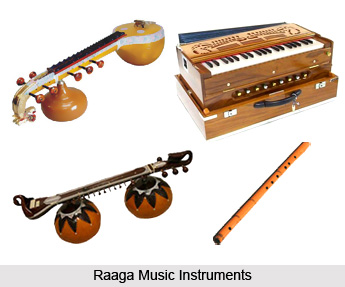
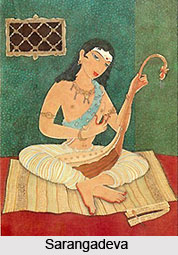
Indian Music in Medieval India carries an age long history that started from the dawn of thirteenth-century. The Muslim impact in the history of Indian music is one of the major occurrences that the medieval India had witnessed. During this time, `Sangita Ratnakara` was written in the Deccan, just before the Muslim conquest of this region by Ala-ud-din Khilji. The gradual differentiation between north and south Indian music had been observed since then. Although orthodox Islam frowned upon music, the acceptance of the Sufi doctrines (in which music was often an integral part) by Islam made it possible for many Muslim rulers and noblemen to extend their patronage to this art. The attitude expressed by Amir Khusrau, a poet and musician in the court of Ala ud-din Khilji, who commented that the music of India was the finest in the world, was fairly representative of the Muslim attitude to Indian music. Moreover the music of some other zones like Iran, Afghanistan, and Kashmir were accepted in the time of the Mughal Emperors Akbar , Jahangir , and Shah Jahan in the sixteenth and seventeenth centuries, it is quite evident that it was Indian music which captured the imagination of the Muslim rulers. Famous Indian musicians such as Svami Haridas, Tansen, and Baiju Bawra have left their impressions on the history of north Indian music as performers and innovators. Muslim musicians took to the performance of Indian music and added to the repertoire by inventing new raagas, taals, and musical forms, as well as Indian musical instruments. This Muslim influence was largely effective in the north of India and undoubtedly helped to further the differentiation between north and south Indian music, the two classical systems which are now generally referred to as Hindustani music and Carnatic (Karnatak) music, respectively.
 The Muslim patronage of music has had two main effects on the music of north India. The first was to de-emphasize the importance of the words of classical songs, which were originally composed in Sanskrit and were, in any case, incomprehensible to anyone less than a traditional Hindu scholar. Sanskrit songs were gradually replaced by compositions in various dialects such as Bhojpuri and Dakhani including the compositions in Urdu and Persian language. The textual themes of the songs were often based on Hindu mythology yet Muslim musicians sang these songs, with Hindu religious themes. It has also been observed that the Hindu musicians sometimes sing songs dedicated to Muslim saints. Perhaps the best example of this broad-minded attitude is to be seen in the poetry of the Muslim ruler Ibrahim Adil Shah II of the Deccan, who, in his Kitah-i-Nauras, composed at the beginning of the seventeenth century, wrote poems in praise of both Hindu deities and Muslim saints. These poems were sung in specified ragas by both Hindu and Muslim musicians.
The second effect of court patronage on Indian music was to produce an atmosphere of competition between musicians, which placed emphasis on display of virtuosity and technique. A great deal of importance was also placed on the creative imagination of the performing musician and gradually the emphasis shifted from what he was performing to how he was performing it. Traditional themes remain the basis of Indian music, but, in north India particularly, it is the performer`s interpretation, imagination, and skill in rendering these that provide the main substance of modern Indian music.
There have been significant changes in modern Indian music as compared to that of medieval India. The influence of the mass media, particularly cinema and radio are easily traceable in the contemporary Indian music and these have also worked as a means of development in Indian music.