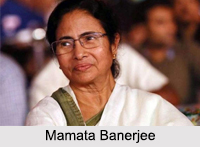
 Mamata Banerjee is the present Chief Minister of West Bengal and the founder of All India Trinamool Congress. She established her own party in the year 1997, after moving away from the Indian National Congress. Banerjee is renowned as a protester and is affectionately referred to as "Didi". Mamata Banerjee previously occupied the positions of "Minister of State for Human Resource Development", "Minister of Coal" and "Minister of Railways" twice. She is the first lady to be the Chief Minister of West Bengal. On 19th May 2016, she became the only women Chief Minister to win two consecutive terms.
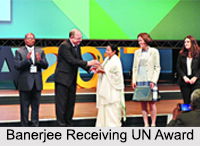
She has always maintained an austere and simple lifestyle. Mamata Banerjee is associated with several human and social rights organisations that promote welfare and development of poor children and women, provide the poor with free legal aid and organise health camps at different places for children and mothers. Banerjee is a painter and a poet too. Banerjee introduced the Banga Bibhushan Award to honour respected personas. She has been honoured with the UN Public Service Award by UN and DLitt Degree by University of Calcutta.
Early Life of Mamata Banerjee
Mamata Banerjee was born on 5th January 1955, in Kolkata, West Bengal, to the parents Promileswar and Gayetri Banerjee, in a lower middle-class Bengali family. In 1970, Banerjee completed the higher secondary from Deshbandhu Sishu Sikshalay. She did her Bachelor of Arts in History (with Honours) from Jogamaya Devi College in Kolkata. She continued her higher studies and did her master"s in Islamic History from University of Calcutta and a degree in Education from Shri Shikshayatan College. Mamata Banerjee also completed her degree in Law from Jogesh Chandra Chaudhuri Law College in Kolkata.
 Political Career of Mamata Banerjee
Although presently she is the chief executive of the Trinamool Congress, Mamata Banerjee began with her political career in 1970s with the Congress party. Her hard work earned her post of the General Secretary with the "Mohila Congress" in West Bengal from 1976 to 1980. In the General Elections of 1984, Banerjee beat her rival, Somnath Chatterjee, from Jadavpur constituency to win a seat in the Parliament and, thus, eventually becoming one of the youngest parliamentarian of that era. She also held the post of General Secretary of All India Youth Congress. However, she lost her seat in the year 1989 elections but managed to secure her position once again at 1991 General election from South Kolkata constituency. She retained the Kolkata South seat in the 1996, 1998, 1999, 2004 and 2009 general elections.
Under the P.V. Narasimha Rao Government, she was declared the Union Minister of State for "Human Resources Development", "Youth Affairs and Sports" and "Women and Child Development". Her differences with the Congress grew with passing time and finally on 22nd December, 1997 her association with All India Congress Party ended when she was expelled.
It was during this time that the All Indian Trinamool Congress (TMC) was founded with Mamata Banerjee at the helm. Soon Mamata Banerjee led TMC and became an apparent opposition in West Bengal that was largely communist. During the 1999 elections, Mamata Banerjee joined hands with the Bharatiya Janata Party (BJP) and was part of the National Democratic Alliance government. She was made the Minister of Railways. However, with BJP, too, she could not keep her allegiance for long.
In 2000, Mamata Banerjee presented her first Railway Budget. She also introduced a new bi-weekly "New Delhi-Sealdah Rajdhani Express" train and 4 other express trains namely; "Howrah-Purulia Rupasi Bangla Express", "Sealdah-New Jalpaiguri Express", "Shalimar-Bankura Arannyak Express" and the "Sealdah-Amritsar Superfast Express" (weekly). She also increased the frequency of the "Pune-Howrah Azad Hind Express". She also focused on developing tourism. She is also credited with introducing 19 new trains for the 2000-2001 fiscal years.
 In 2001, she walked out of the alliance and allied with Indian National Congress once again to fight the state elections in West Bengal. Mamata Banerjee was back in the Cabinet as the Minister of Coal and Mines after the 2004 elections.
The year 2009 saw another phase of General Elections in India. This time, owing to several reasons, Mamata Banerjee and her party won the majority of the seats in the state. Her party won 19 seats and entered into an alliance with the Congress party and SUCI. With an outstanding performance in the elections behind them the TMC supreme was handed the Ministry of Railways in 2009. In the 2010 Municipal Elections in West Bengal, TMC won Kolkata Municipal Corporation in a margin of 62 seats. TMC also won Bidhan Nagar Corporation in 16-9 seats margin.
However, post the 2011 West Bengal Assembly elections, Banerjee won the legislative assembly election against the incumbent Left Alliance by securing 227 seats. She resigned from Railway Ministry and was sworn in as the 11th Chief Minister of West Bengal as TMC won by large margins.
 West Bengal election results were announced along with other four assemblies on 19th May 2016. All India Trinamool Congress won 211 seats out of total 293. That is first time in history of West Bengal that a single party has won so much seats without any alliance.
Kanyashree Prakalpo Scheme by Mamata Banerjee
"Kanyashree Prakalpa" scheme has been introduced by Mamata Banerjee on 8th March 2013. This conditional cash transfer scheme is aimed to provide financial support to retain girls in schools and other educational and skill development institutions and especially to prevent child marriage. In this scheme, state government transfers a certain amount of sanctioned money to the beneficiary"s account. Currently, this scheme has enrolled almost four million adolescent girls to it. "Kanyashree" has been ranked the best among 552 social sector schemes across 62 countries. Mamata Banerjee has been awarded for this scheme at the World Public Service Forum by UN Assistant Secretary General at a ceremony in Hague in Netherlands.
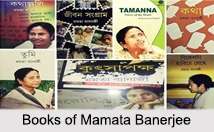
Bibliography of Mamata Banerjee
"Upalabdhi"
"Maa-Mati-Manush"
"Janatar Darbare"
"Manavik"
"Motherland"
"Anubhuti"
"Trinamool"
"Janmaini"
"Ashubho Shanket"
"Jago Banglaa"
"Ganotantre Lajja"
"Andolaner Katha"
"Smile"
"Slaughter of Democracy"
"Struggle for Existence"
"Dark Horizon"
Mamata Banerjee
Mamata Banerjee, the founder of All India Trinamool Congress party, is the 11th and current Chief Minister of West Bengal. Currently she controls nine key departments of West Bengal state government.