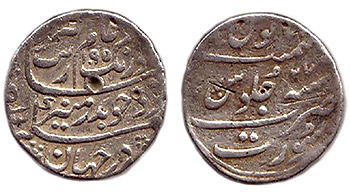
 the `Larins` and the Mughal `Rupees` of he Surat mint. They converted these coins into their own for their use in trade. The Dutch issued coins named as `Pagodas` and `Fanams` from Pulicat. Some of the coins of the Dutch also bore a female figure and Persian inscriptions. Some Mughal types of coins were issued by the Dutch including some copper, lead and tin coins. In the later period, the coins were issued showing a female deity on one side and Tamil legend on the other side of the coin.
During the French dominion, three denominations of silver coins like `Fanon`, double `Fanon` and half `Fanon` with a `fleur-de-lys` and a superscription were issued. Even `Pagodas` were also issued with a figure of Lakshmi on the obverse side of the coin and granulated surface with a crescent on the reverse side of the coin. Due to some objection from the Church, the `Pagodas` with Lakshmi were never re struck but three Swami `Pagodas` on the pattern of the `Fanons` were struck were issued. Apart from these, silver `Rupees` were issued with Mughal inscriptions on the coins. Some of the coins bore the Hijri year and the corresponding regnal year of the Mughal emperor. The `Doudo`, half Doudo` and `Cash` were the copper coins issued by the French. The later copper coins include `Biche` and half `Biche` hat contained `fleur-de-lys` on one side and the date in a beaded border on the other side of the coin.
The coins of Bengal were developed along the Mughal pattern under the reign of the European rulers; those of Madras were struck along South Indian lines both in design and metrology (Pagoda) as well as along Mughal designs. The English coins of Western India developed along Mughal as well as English patterns. It was only in 1717 AD that the English obtained permission from the Emperor Farrukhsiyar to coin Mughal money at the Bombay mint. English pattern coins were struck at the Bombay Mint.
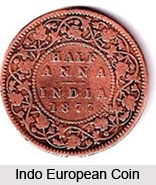
The coins issued during the British rule had a great impact on the currency of the then India. The British issued gold, silver, tin and copper coins for the local and commercial usage. The gold coins were termed Carolina, but were apparently never issued. Besides these there were the silver coins Anglina, the copper coins Cupperoon and tin coins Tinny. The rise of one dominant power after over a hundred years of turmoil enabled the enactment of the Coinage Act of 1835 and for uniform coinage to be issued. In the later period, in 1835, newly designed coins with the effigy of William IV on the obverse and the value on the reverse in English and Persian, were issued by the British Government. The coins issued after 1840 bore the portrait of Queen Victoria. The first coinage under the crown was issued in 1862 and in 1877 Queen Victoria assumed the title the Empress of India. Edward VII succeeded Queen Victoria and the coins issued bore his effigy. Acute shortage of silver on account of World War I, led the British Government to stop issuing silver coins. The usher of paper currency in India was the British. They issued paper currency of One Rupee and Two and a half Rupees during the ruling period. The silver coins of smaller denominations were issued in copra-nickel.
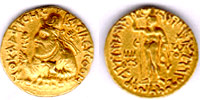
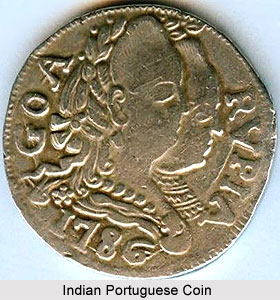
During the last quarter of the fifteenth century, the geographical discoveries gave way to a new turn to the European commercial relations with India. The Portuguese, the Dutch, the Danes, the English and the French settled trade relation with India and at the same time engaged themselves in the active local politics. New tradition, new culture and new patterns were introduced with different countries, and in varying degrees these countries issued coins for trading purpose. They sometimes included the Indian features on the coins that stand witness of Indo-European trading affair.