





 Television in India is diverse and produces thousands of programs in many of the Indian languages. More than half of all Indian households own a television. National channels operate in Hindi and English, in addition to channels in several other regional languages including Telugu, Tamil, Kannada, Malayalam, Bengali, Marathi, Odia, Punjabi, Assamese, Gujarati, Urdu, Bhojpuri, Kashmiri, Konkani and Haryanvi, among others. The Hindi, Telugu and Tamil language television industries are by far the largest television industries in India. Television in India is diverse and produces thousands of programs in many of the Indian languages. More than half of all Indian households own a television. National channels operate in Hindi and English, in addition to channels in several other regional languages including Telugu, Tamil, Kannada, Malayalam, Bengali, Marathi, Odia, Punjabi, Assamese, Gujarati, Urdu, Bhojpuri, Kashmiri, Konkani and Haryanvi, among others. The Hindi, Telugu and Tamil language television industries are by far the largest television industries in India.
National Television Broadcaster in India The national television broadcaster is Doordarshan, owned by Prasar Bharati. There are several commercial television broadcasters such as Disney Star, Zee Entertainment Enterprises, Culver Max Entertainment (Sony Pictures Networks) and Viacom18 (owned by Reliance Industries through Network18 Group) at the national level, and Sun TV Network and ETV Network at the regional level. Since 2019, free-to-air Hindi channels like Dangal and Goldmines have drastically increased in popularity due to their availability on DD Free Dish. Other language channels like Star Maa and Zee Telugu (Telugu), Sun TV and Star Vijay (Tamil), Asianet (Malayalam) and Star Pravah (Marathi) are also among the most popular television channels by viewership. History of Television in India The history of Indian television is marked by significant milestones and the gradual evolution of the medium. It all began in January 1950, when a student of electrical engineering named B. Sivakumaran showcased a television demonstration in Chennai (formerly Madras). This demonstration, which involved scanning and displaying a letter's image on a Cathode-ray tube screen, was considered a groundbreaking step towards television in India. The first TV transmitter was installed on October 24, 1951, at the Jabalpur Engineering College's Electronics and Telecommunications Engineering Department. This installation paved the way for the further development of television in India. Another significant milestone occurred when television was first used in the house of the Jan family in Srinagar, representing a crucial step towards industrialization. The journey of terrestrial television in India began with experimental telecasts in Delhi on September 15, 1959, using a small transmitter and a makeshift studio. Daily transmission officially commenced in 1965 as part of Akashvani (formerly All India Radio AIR). Television services were gradually extended to Mumbai and Amritsar in 1972. Initially, television was available in only seven Indian cities until 1975. In a remarkable initiative called the Satellite Instructional Television Experiment (SITE), India harnessed television for development purposes. Doordarshan (DD), which was then a part of AIR, produced most of the programs for this experiment. The telecasts occurred twice a day and covered various informative topics such as agriculture, health, and family planning. Additionally, entertainment segments featuring dance, music, drama, folk, and rural art forms were included. In 1976, television services were separated from radio, and in 1982, national telecasting was introduced. The same year also witnessed the introduction of color television in the Indian market. Foundation of Doordarshan During the early 1980s, Indian television programming took off with the establishment of Doordarshan as the sole national channel. Notably, the television series based on Indian epics, "Ramayana" and "Mahabharata," gained immense popularity and set world records for viewership. As television ownership increased in the late 1980s, the programming on a single channel reached saturation point. Consequently, the government introduced another channel, DD Metro (formerly DD 2), which offered a mix of national and regional programming. Both channels were broadcast terrestrially. American satellites PAS-1 and PAS-4 played a crucial role in transmitting and telecasting Doordarshan programs. DD International, an international channel, was launched in 1995 and offered programming for 19 hours a day to foreign countries, reaching Europe, Asia, Africa, and North America. Throughout the 1980s, Doordarshan dominated Indian television with iconic shows like "Hum Log" (1984-1985), "Wagle Ki Duniya" (1988), "Buniyaad" (1986–1987), and comedy programs like "Yeh Jo Hai Zindagi" (1984). The immensely popular dramas "Ramayan" (1987–1988) and "Mahabharat" (1989–1990) captivated millions of viewers. Other notable programs included Hindi film song-based shows like "Chitrahaar" and "Rangoli," as well as crime thrillers like "Karamchand" and "Byomkesh Bakshi." Several shows catered to children, such as "Divyanshu ki Kahaniyan," "Vikram Betal," "Malgudi Days," and "Tenali Rama." It is worth mentioning that Bengali filmmaker Prabir Roy introduced color television coverage in India during the Nehru Cup in February–March 1982, before Doordarshan's debut of color broadcasts during the Delhi Asian Games later that year. Foundation of Prasar Bharati In 1997, the government established Prasar Bharati, a statutory autonomous body, to oversee Doordarshan and AIR. This move aimed to grant greater autonomy to these broadcasting entities, allowing them to serve as the public service broadcaster of the country. However, Prasar Bharati struggled to shield Doordarshan from government control.  Evolution of Television Industry in India Evolution of Television Industry in India
In 1991, under the leadership of Prime Minister P V Narasimha Rao, the central government initiated economic and social reforms, allowing private and foreign broadcasters to engage in limited operations in India. This liberalization continued under subsequent administrations, leading to the introduction of foreign channels like CNN and STAR TV, as well as private domestic channels such as Zee TV, ETV, Sun TV, and Asianet. By 1995, television had reached more than 70 million Indian homes, with over 100 channels catering to a viewing population of over 400 million individuals. Types of Broadcast Media There are at least five basic types of television in India: • Broadcast or "over-the-air" television • Unencrypted satellite or "free-to-air" • Direct-to-Home (DTH) • Cable television • IPTV and OTT Over-the-air terrestrial and free-to-air TV is free with no monthly payments while Cable, DTH, and IPTV requires a subscription that varies depending on how many channels a subscriber chooses to pay for and how much the provider is charging for the packages. Channels are usually sold in groups or separately. All television service providers are required by law to provide specific selection of channels. Terrestrial television Cable and Satellite Television The growth of digital TV households has seen a remarkable increase since 2013, primarily driven by the transition from terrestrial and analog broadcasts. Presently, there are over 800 TV channels in India, catering to the diverse languages spoken across the nation, and approximately 200 million households own televisions. The substantial growth in digital broadcasting can be attributed to the multi-phase digitization policy implemented by the Indian government. A crucial step was the introduction of an ordinance mandating the digitization of cable services. This amendment made it mandatory for the viewers to access digital services through a set-top box (STB). The Indian broadcasting landscape experienced a significant shift in December 1991 when Star, a private company, introduced five major television channels, breaking the monopoly previously held by the government-owned Doordarshan. This was followed by the launch of Zee TV, the first privately owned Indian channel to broadcast over cable. Asia Television Network (ATN) also entered the market during this time. Subsequently other news and entertainment channels entered Indian broadcasting network. In 1993, Sun TV marked the birth of South India's first private television channel in the Tamil language. Sun TV network has since expanded its reach with over 20 channels in various South Indian languages and even launched a DTH service, making its channels available in several countries beyond India. In India, the broadcast of free-to-air television is governed through state-owned Prasar Bharati corporation, with the Doordarshan group of channels being the only broadcaster. As such, cable television is the primary source of TV programming in India. During the 1990s, alongside a plethora of Hindi-language channels, numerous regional and English-language channels flourished across India. By 2001, international channels such as HBO and History Channel began to provide their services. From 1999 to 2003, more international channels entered the Indian market. The early 2000s witnessed an explosion of news channels in various languages. Conditional Access System in India On 11 November 2011, the Ministry of Information and Broadcasting issued a notification, establishing 31 March 2015 as the deadline for a complete transition from analog to digital systems in India. To facilitate this transition, the Cable Television Networks (Regulation) Amendment Act was passed by Parliament in December 2011, aiming to digitize the cable television sector by 2014. CAS or conditional access system is a digital mode of transmitting TV channels through a set-top box (STB). The transmission signals are encrypted and viewers need to buy a set-top box to receive and decrypt the signal. The STB is required to watch only pay channels. It was decided by the government that CAS would be first introduced in the four metros. It has been in place in Chennai since September 2003, where until very recently it had managed to attract very few subscribers. It has been rolled out recently in the other three metros of Delhi, Mumbai and Kolkata. 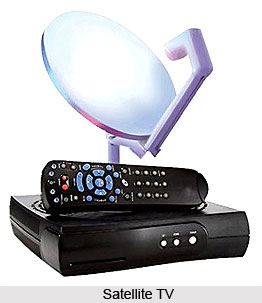 Satellite Television in India Satellite Television in India
The television broadcasting landscape is diverse, with over 1500 satellite television channels airing in India. These television services utilize both domestically developed satellites from the Indian Space Research Organisation (ISRO) and also private satellites. DTH refers to the reception of satellite programs through a personal dish installed in individual homes. India has millions of DTH subscribers. In 2012, India emerged as the world's largest Direct-broadcast satellite market with seven operators. Internet Protocol Television (IPTV) in India India offers various IPTV platforms for subscription, particularly in major cities and areas with broadband connectivity. These platforms provide a range of services including: iControl IPTV: A collaboration between MTNL, BSNL, and Aksh Optifiber, iControl IPTV is available in cities like Mumbai. It offers around 200 television channels with Time Shift TV, allowing viewers to catch up on missed programs. Airtel IPTV: Airtel offers IPTV services in cities such as New Delhi and Bangalore. Subscribers gain access to approximately 175 television channels with Time Shift TV. A variety of TV packages are available, and a few channels can be accessed through premium subscriptions. Smart TV Group: Smart TV Group operates an IPTV platform based on Sea-Change International and Cisco IPTV standards across many regions in India. The platform offers 185 TV channels in basic and premium packages. APSFL: APSFL is a provider of IPTV services launched in 2016. It operates in Andhra Pradesh and offers over 250 channels. Audience Metrics in Television Industry in India Audience metrics in the Indian television industry have evolved over the years, experiencing phases of fragmentation and consolidation. One notable distinction in Indian culture is the tendency for families to traditionally limit themselves to owning just one television screen. DART (Doordarshan Audience Research Team) emerged during the era of Doordarshan's monopoly as the sole metric available. Employing the notebook method of recordkeeping across 33 cities in India, DART continues to provide independent audience measurement information, particularly in rural India. In 1994, ORG-MARG (Operations Research Group - Multiple Action Research Group) introduced INTAM (Indian National Television Audience Measurement), claiming to address the heterogeneous and fragmenting television market. In 1997, TAM (Television Audience Measurement) was appointed as the official record-keeper of audience metrics by a joint industry body, backed by Nielsen Corporation. TAM and INTAM, with their differing methodologies and sample sizes, often yielded conflicting results for the same programs. In 2001, TAM and INTAM merged into TAM, which became the dominant player in audience metrics despite reservations about the process, sample, and other parameters. In 2004, a rival ratings service named Audience Measurement Analytics Limited (AMAP) was launched with funding from American NRI investors. Although initially met with caution from clients, AMAP successfully broke the TAM monopoly. Broadcast Audience Research Council (BARC) India was established as an industry body to develop, supervise, and own an accurate and reliable television audience measurement system. BARC currently measures the TV viewing habits of millions of households in India. BARC India aims to bring together key stakeholders in television audience measurement, including broadcasters, advertisers, advertising agencies, and media agencies, through their respective apex bodies. It is committed to establishing a robust, transparent, and accountable governance framework that provides essential data points for more effective media planning and spending. Threats to Television Industry in India The rise of online video streaming platforms, also known as Over-the-top (OTT) services gained significant popularity in India since 2015. These services posed a threat to the traditional Indian television industry, as they offered a more flexible and convenient viewing experience for audiences. Unlike traditional TV channels where viewers had to adhere to fixed schedules to watch their favorite programs, OTT service providers allowed users to access their desired content at their convenience. This on-demand nature of OTT platforms proved to be a game-changer, particularly among the young internet users in India. Furthermore, the increasing penetration of internet access across India played a crucial role in the success of OTT services. With easy access to the internet, users could stream content from anywhere, adding to the convenience and appeal of these platforms. As a result of this shift, people's spending on traditional TV services experienced a notable decline, as they allocated more of their viewing time to OTT platforms. The popularity of OTT services continued to grow, with audiences appreciating the vast content libraries, personalized recommendations, and the ability to binge-watch entire series at their own pace. |
| ||||||||||||||||||||||||||||

