 A short peep into the history of Indian art will lead one to a treasure house of stupendous architectural works, outstanding sculptures and mesmerising paintings. Being connoisseurs of art, the Indian emperors did their utmost to promote artistry. The aesthetic value of Indian art cannot be summed in words; one needs to catch a glimpse of those magnificent pieces of art. Whilst art in India is demonstrated in any and every form, its history can be categorised into ancient, medieval and modern. Agastya, the first Aryan missionary from north India to the Dravidian races of the south, in the 8th century BC, is reputed to have systematised the art of image-making in bronze. The rules laid down by Agastya are not mere matters of archaeological interest as they are still in use at the present day, as integral and identifiable as the Archimedean screw of the 3rd Century BC.
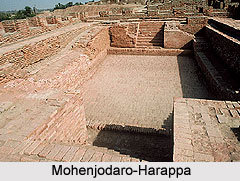
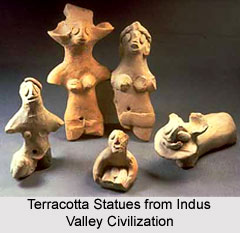 Art in Ancient India comprises the copper and terracotta statues from Indus valley civilization to the mammoth and grand temple architecture of the ancient south Indian kingdoms. In fact the legacy of art in India can be traced back to the prehistoric rock paintings, the kind of which can be seen in the Bhimbetaka paintings. Thereafter a highly developed architecture was perceived with the dramatic discovery of four thousand years old cities of Harappa and Mohenjodaro. This great urban civilisation was called the Indus valley civilisation. Though the buildings in the cities of this civilisation had an urban touch, it was the sculpture and the statuettes that exhibit the craftsmanship of the era. Some of the discoveries are a small male torso in limestone found in Harappa and the copper figurine of a dancing girl found in Mohenjodaro and the seals. These are amongst the several notable pieces of sculptures that have been brought to light in the Indus valley excavations. The decline of the Harappan culture was mainly due to the coming of the Aryans. The Aryans imposed their philosophical and social ideals on India and were inevitably absorbed into the Indian population and the main stream of Indian civilisation. The culture of India was a mixture of Aryan and Dravidian elements. The architecture of this time includes huts of square and round shape as well as tower like structure.
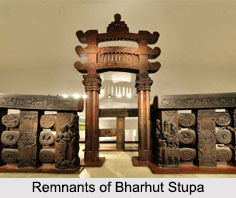
Ancient Indian art also witnessed the emergence of religious art forms. For instance, under the reign of the Mauryas Buddhist art gained prominence. The Buddhists chaityas and stupas are the prime architecture of this time. The end of the Mauryan period was marked by the commencing of the Sunga Empire. The sculpture of the Sunga Period consists in large part of the decoration of the stone railings and gateways that now surround the Buddhist stupa or relic mound. Most prominent in the decoration of the railing are the carvings of yakshas and yakshis on the uprights. Buddhist religious art also had huge impacts on the Gupta and Kushana empires. Often referred to as the Golden Age the Gupta period witnessed the construction of the Buddhist caves: Ajanta, Ellora and Elephanta. The Kushana Empire, on the other hand, showered its patronage on the Mathura and Gandhara schools of art and architecture. Indian religious art was, indeed, some degrees above Indian religious practice as a customary and world-wide phenomenon. The ancient shastric canons of temple art developed the characteristics of the images beyond those of the human form, while retaining a general form-relationship with humanity, and thus set the images beyond the range of realism. But apart from this consideration, the reliance of artistic impulse on religious impulse was not a reliance on something extraneous, as it is in the West, but on something integral.
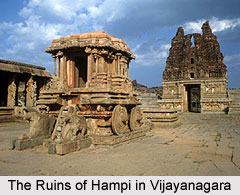
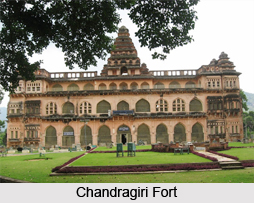
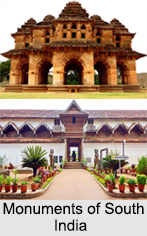
Down south, the picture was quite different. The ancient empires like Cholas and the Cheras contributed in the growth of temple architecture and sculpture. Hindu art received a new idiom under the patronage of such kingdoms. The gigantic rock cut temples stand tall even today to narrate the tales of the religion, society and the then contemporary craftsmanship as well. The fresco paintings are the hallmark of the Chola period. The ruins of Hampi in Vijayanagara kingdom also demonstrate the religious overtures. The earliest example of South Indian bronze work was found in the first century A.D., certainly before the Buddhist colonisation of the island in the fifth century. The example serves to prove the existence of artistic faculty of a very high order, but gives no idea as to how far the organisation of the image-makers had then developed. During fifth to eighth century revival of religion and crafts was characterised by mutual tolerance between the Saivites and Vaishnavites. A change came about in the tenth century. The Chola Dynasty had secured dominance, and in its lavish patronage of the worship of Lord Shiva led to an intense sectarian revival. This revival was accompanied by an equally intense artistic revival. The new revival stamped itself predominantly and ineradicably on the temple arts of South India. Architecture, mural sculpture, ceremonial image-making, car decoration, flourished as never before. Every battle won by the Chola kings, every territorial increase, meant new temples, new images in the temple corridors, new figured lamps, new demands on the artists who attained the highest degree of efficiency.
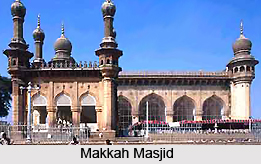
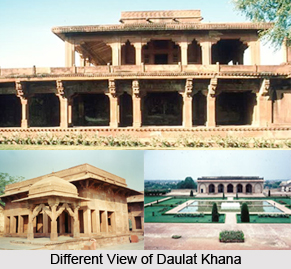
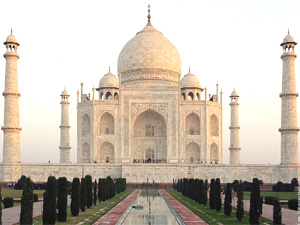 As art moved on to the medieval period the legacy of the South Indian art continued with the Hoysalas, Palas, Pratiharas, Chalukyas, Rashtrakutas Dynasty and the Pallavas. The Delhi Sultanate, however, brought with them new styles which bore similarity with the existing Indian art forms, for example both the temples and mosques had open courtyard. This similarity helped them to adapt to one another. The new architectural ideas of the Sultanates were the domes and pointed arch. The period of Delhi Sultanate was a time of great experimentation in terms of art and architecture. Thereafter north India was invaded by the Mughals who brought with them their own tradition and culture. The Mughal art was influenced by and was the amalgamation of Indian and Persian art forms. Mughal paintings reached its height of glory during the reign of Shah Jahan. Fatehpur Sikri and the Taj Mahal are among the architectural marvels of this period.
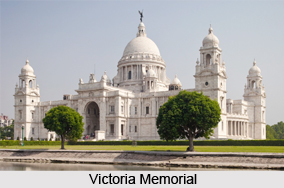
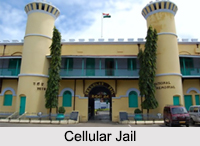
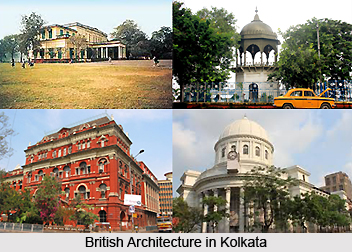
The British colonial rule had a great influence in the art forms of India. Art movements like Modernism gained impetus in the Indian scenario. The buildings reflected the Gothic, Imperial, Christian, English Renaissance and Victorian styles of art and architecture. Whilst India primarily witnessed constructions by the British regime but the contribution of the French and the Dutch cannot go unnoticed. Places like, Goa and Puducherry are dotted with colonial buildings.
While the colonial architecture gaining momentum, India was gearing up to fight for her independence. In the wake of nationalism, Indian art endeavoured to return to the roots. Thus the scenario in the field of art was metamorphosised once again. Art forms like paintings portrayed social issues instead of indulging in religion or romance. Art gradually became a medium to express the then contemporary circumstances. Besides these, art in modern India was also breaking away from its past. Artists were not running to myths and legends for inspiration. While some were experimenting with Cubism, others were resorting to expressionism and other art forms. Artists like Rabindranath Tagore, Gaganendranath Tagore and Jamini Roy revived art in modern India. The latter found his muse in the folk traditions of India.
With passing time, Indian art was influenced by the art movements that took place throughout the world. Contemporary India, thus, comprises an art that has essentially evolved from the impacts of globalisation. Indian art, today, is an amalgamation of various styles and themes. During the Indian renaissance the revival of Indian art-crafts emerged from the alleged buried treasures from hearts and minds of the artists quickened by religious zeal. Indian art does not hang to any great extent on history; it is, rather, perpetually capable of making history, because its inspirational source is close to the stratum of human nature in which the springs of action take their rise.
The history of Indian art, thus, demonstrates a gradual evolution of the art forms. Whilst religious influences cannot be overlooked, the influence of foreign kingdoms and social changes contributed equally in shaping art in India. Whether it was the themes, the materials or the mediums of expression, Indian art had developed considerably. The vast history of India traces the simultaneous development of art in the subcontinent as well.