


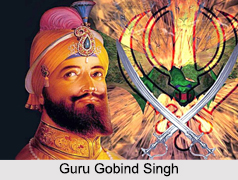
 Guru Gobind Singh was the 10th Guru of Gurus of Sikhism. He became Guru at the age of nine, following the footsteps of his father Guru Teg Bahadur Ji. He became a Guru when his father was beheaded at Delhi. He was a religious master, soldier, poet and philosopher. When his father, Guru Tegh Bahadur, was beheaded for refusing to adapt Islam religion, Guru Gobind Singh was officially fitted as the leader of the Sikhs at the age of nine. Guru Gobind Singh was the 10th Guru of Gurus of Sikhism. He became Guru at the age of nine, following the footsteps of his father Guru Teg Bahadur Ji. He became a Guru when his father was beheaded at Delhi. He was a religious master, soldier, poet and philosopher. When his father, Guru Tegh Bahadur, was beheaded for refusing to adapt Islam religion, Guru Gobind Singh was officially fitted as the leader of the Sikhs at the age of nine.
Early life of Guru Gobind Singh Guru Gobind Singh was the only son of Guru Tegh Bahadur who was the 9th Sikh guru and Mata Gujri. He was born in Patna, Bihar in a Sodhi family of Khatri social group. His birth name was Gobind Rai. The young Gobind Rai was to be identified as Gobind Singh after 1699 and he recommended his father that no one was more worthy to direct and surrender himself than him. Young Gobind Rai was fitted by the Sikhs as the 10th Sikh Guru on Baisakhi on 29 March 1676. Legends of Guru Gobind Singh Guru Gobind Singh initiated the Five K's tradition of the Khalsa, these are: 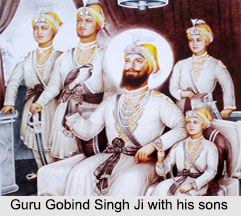 Guru Gobind Singh requested Sikhs to assemble at Anandpur on Baisakhi in 1699. According to the Sikh custom, he asked for a volunteer from those who were gathered and somebody who was willing to give up his head. One came forward, whom he took in a tent. He returned to the mass with no othe volunteer, but with a blood-spattered sword. He then asked for one more volunteer, and repeated the same procedure of returning from the tent without anyone and with a bloodied sword four more times. After the 5th volunteer went with him into the tent, then he returned with all five volunteers, all were safe. He called them the Panj Pyare and the 1st Khalsa in the Sikh tradition. Guru Gobind Singh then mixed water and sugar into an iron bowl, stirring it with a double-edged sword to arrange what he called the Amrit. He also proclaimed a policy of authority for Khalsa warriors. Tobacco and sex with Muslims were prohibited. He launched plans that ultimately challenged the biased taxes forced by the Islamic authorities. The Khalsa soldier community tradition started by Guru Gobind Singh has added to contemporary academic debate on pluralism within Sikhism. Guru Gobind Singh is praised for finalizing the Kartarpur Pothi into the Guru Granth Sahib in Bathinda and releasing it in 1706. Guru Gobind Singh also stated this text to be the never-ending Guru for Sikhs. Guru Gobind Singh wrote the other texts, mainly the Dasam Granth which is considered to be a scripture next in importance after the Guru Granth Sahib by many Sikhs. 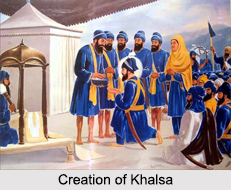 Guru Gobind Singh’s mother Mata Gujri and his two younger sons were detained by Wazir Khan, the Muslim ruler of Sirhind. According to Sikh tradition, his youngest sons, aged 5 and 8, were affected by burying them alive into a wall after they refused to convert to Islam, and Mata Gujri died soon after hearing of her grandsons' death. Both of his eldest sons, aged 13 and 17, also died in December 1704 in a fight against the Mughal army as they defended their father. Guru Gobind Singh’s mother Mata Gujri and his two younger sons were detained by Wazir Khan, the Muslim ruler of Sirhind. According to Sikh tradition, his youngest sons, aged 5 and 8, were affected by burying them alive into a wall after they refused to convert to Islam, and Mata Gujri died soon after hearing of her grandsons' death. Both of his eldest sons, aged 13 and 17, also died in December 1704 in a fight against the Mughal army as they defended their father.
Significant battles of Guru Gobind Singh He fought 14 wars. Battle of Bhangani, Battle of Nadaun, Battle of Guler, First Battle of Anandpur, Battle of Anandpur Sahib, Battle of Nirmohgarh, Battle of Basoli, Battle of Anandpur, Battle of Sarsa, Battle of Chamkaur, and Battle of Muktsar are the significant battles fought by Guru Gobind Singh. Death of Guru Gobind Singh Guru Gobind Singh died on 7 October 1708 from wounds imposed by a murderer. Guru Gobind Singh was the last of the living Sikh Gurus. |
| |||



Guru Gobind Singh
| Guru Gobind Singh was the 10th Guru of Sikhs who formed Khalsa fraternity and completed Guru Granth Sahib. Guru Gobind Singh was officially installed as the head of the Sikhs at age of nine. |
| ||||||||||||||||||||||||||||

