 Flora and Fauna of Ladakh are in keeping with the mountainous nature of the region variety. There are a number of species found here which is quite remarkable considering the height of the region and the rugged nature of its terrain. While some of the plant and animal species show behavioural characteristics which have helped them adapt to the high altitude, such as hibernation, or seasonal migration from higher to lower elevations in winter, there are also certain behavioural traits which enable them to adjust to the mountainous clime. These include enlargement of the nasal cavity, the development of thick fur etc. The flora and fauna of Ladakh closely resembles with that of Tibet.
Bird Species in Ladakh
A variety of bird species are found here mostly migratory in nature. The most conspicuous of the migratory birds is the hoopoe; and even more common is the Indian redstart. The brown-headed gull is a surprise of sorts in this region. It is seen along the Indus river in summer and the margins of the Star-tsapuk Tso, Rupshu`s freshwater lake. Other migratory birds which breed in Ladakh are the brahmini duck (ruddy sheldrake), the barheaded goose, and the great crested grebe. One of the rarest birds in the world, the Black Necked Crane, is also seen here. Among the other bird species seen are the Tibetan raven, the red-billed chough, the Bactrian or black-necked crane, the snow-cock, chukor or mountain partridge, sand grouse, sand plover, desert wheatear, horned lark and twite. Those on the endangered list include, besides the black-necked crane, the bar-headed goose, the golden eagle, the Tibetan sandgrouse, the Tibetan partridge, the Tibetan snow-cock, and the chukor.
Fauna in Ladakh
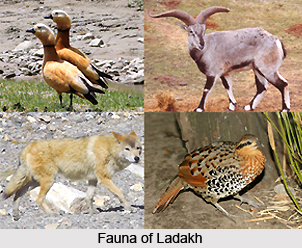 There are a number of Shapu (the Ladakh urial) and Bharal, the so-called blue sheep, and even a few Goa, or Tibetan gazelle. The Himalayan Ibex is also to be seen here. The Angali, with its enormous curved horns, a close relation of the Marco Polo sheep, is found in the Pamirs and parts of the western Karakoram. The Bharal, whish is quite rare now in the region, can be seen along almost the whole of the Great Himalaya, on both sides of the crest-line, from Ladakh to Sikkim. The ibex can be found from the Sutlej gorge westward along the Zanskar chain and the northern flank of the Great Himalaya, and on into the Hindu Kush, the Pamirs and the Tien-Shan. The shapu finds its place in rather lower terrain, especially along river valleys. The Nayan is found in south-east Ladakh and the adjoining part of Spiti. Apart from these mentioned, the Tibetan antelope or chiru, locally known as Stos, is also found here. This Stos produces excellent quality wool which is used for producing shawls known as toosh. The Wild Yak and the Kyang (wild ass) are also found here. The cats found in the region include the snow leopard and two separate categories of cat known as the lynx and Pallas` cat. Canines found in the region are the wild dog, the red fox, the Tibetan fox and the Tibetan wolf. The foxes, along with other small carnivores like marten, weasel and otter, are sought after for their fur. Apart from these, the brown bear is also found in Ladakh near Dras and the upper Suru Valley.
Among the smaller animals found in Ladakh are marmots, voles and hares and several varieties of pika, also known as the mouse-hare, a small animal common in the mountains of central Asia.
Flora in Ladakh
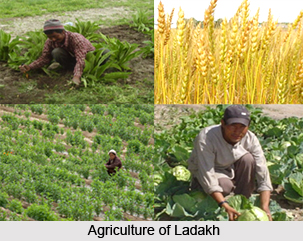
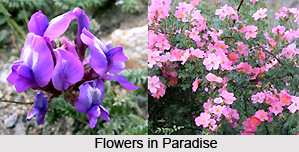
Ladakh is an extremely cold and dry desert with rocky and uneven terrain. The harsh climate and low temperatures limit the number and type of vegetation found here. There are certain narrow valleys in the region which are quite fertile. Here, certain plants and agricultural crops are grown. Apart from this, greenish patches of vegetation can be seen round the riverbanks and along the snow line, certain varieties of willow groves, wild roses and herbs are grown.
Flora and Fauna of Ladakh
Flora and Fauna is typical to t he kind of mountainous terrain which dominate the entire landscape of the region. Though some varieties of fauna are to be found here, the vegetation is very limited due to the dry and cold climate.