Economy of Ladakh, Jammu and Kashmir - Informative & researched article on Economy of Ladakh, Jammu and Kashmir
  Indianetzone: Largest Free Encyclopedia of India with thousand of articles Indian Cities


in  
Art & Culture | Entertainment | Health | Reference | Sports | Society | Travel
Forum  | RSS Feeds  | Free E-magazine
Indian Cities : Ancient Indian Cities l Metropolitan Cities in India l Indian hill stations l Indian Capital Cities l Indian Holy Cities l Port Cities in India l British Cathedrals in India l Indian Cities l Pilgrimages In India l Tourism in India
Home > Travel > Indian Cities > Indian Cities > Cities of Jammu and Kashmir > Ladakh > Economy of Ladakh
Economy of Ladakh, Jammu and Kashmir
Economy of Ladakh is based on agriculture and now tourism industry is developing the economy system.

The Ladakhi economy has traditionally been based on small farms and on herding. In recent times, some other sources of income like tourism since the 1970s have also bettered the economy system of Ladakh.

The economy of Ladakh is basically a stable and self-reliant agricultural economy which is based on growing barley, wheat and peas, and keeping livestock, especially yak, cows, dzos (yak-cow cross breed), sheep and goats. Ladakh is essentially a biomass-based economy. As far as agriculture is concerned, the main limitation is the extreme shortage of water for irrigation, and hence of cultivable land. The administration of Ladakh plays a useful role, planning and executing large-scale irrigation schemes which are beyond the resources of private enterprise. The scarcity of rainfall makes Ladakhi agriculture totally dependent on irrigation. The people who live on agriculture concentrate in growing crops of vegetables and fruit, especially apricots. Right from the start the development process all over India has relied heavily on Western-style technological interventions. In spite of the established excellence of Ladakhi crop husbandry official policy has taken for granted that it could be improved by the use of chemical fertilizers and the introduction of high-yielding varieties of crops.

The Ladakhis developed a small-scale farming system adapted to this unique environment. This indeed gave the required boost to the economy of Ladakh. Apart from growing crops, the Ladakhis also grow fruit at lower elevations and the high altitude Rupshu region is basically preserved for nomadic herders. Earlier, surplus produce was traded for tea, sugar, salt and other items. Presently, the largest commercially sold agricultural product by Ladakh is vegetables. The Ladakhis have occupied a distinct market for selling agricultural products. Production remains mainly in the hands of small-landowners who work in their own land, often with the help of migrant labourers from Nepal. The principal crops produced in Ladakh are barley, wheat and rice. Though rice was previously a luxury in the Ladakhi diet, but, subsidized by the government and has now become a cheap staple. Apart from these, naked barley is traditionally a staple crop all over Ladakh. The extreme limit of cultivation is at Korzok, on the Tso-moriri Lake, at 4,600 m (15,100 ft), which are widely considered to be the highest fields in the world.

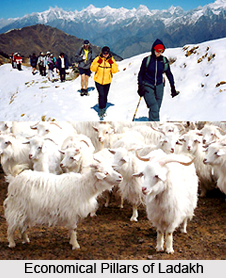
Pashm, Ladakh`s only export apart from dried apricots, is the Chang-thang herdspeople`s main source of cash income. This valuable product is the basis of the multi-crore shawl industry of Srinagar. From at least the seventeenth century the trade in `pashm` was controlled in favour of a caucus of Kashmiri middlemen, known as Tibet Baqals. Even in the post-Independence era, the State Government tried, by means of its Pashmina Control Order, to maintain the salient feature of the system established under the Treaty of Tingmosgang in 1684, namely that there should be no movement of `pashm` outside Jammu and Kashmir. Government did attempt to promote the economy of Ladakh by maintaining the price of pashmina while lifting a certain proportion of the production. Since 1986 the trade has been unfettered; and 1995 saw the formation of the All Chang-thang Pashmina Growers` Co-operative Marketing Society, which succeeded that year in negotiating an all-time high price for first quality `pashm`. With the closure of Tibet border, the trading of Ladakhi traders was hampered as they could not export `pashm` on a lower rate from any of the places under Tibet.

Due to the geographical position of Ladakh, the crossroads of some of the most important trade routes in Asia was exploited to the full. This indeed played a role in the development of the economy in Ladakh. Ladakhis collected tax on goods that crossed their kingdom from Turkestan, Tibet, Punjab, Kashmir and Baltistan. Some of the people of Ladakh were also engaged as merchants and caravan traders, facilitating trade in textiles, carpets, dyestuffs and narcotics between Punjab and Xinjiang. But after the closing of the borders with Tibet and Central Asia, this international trade has completely cramped.

With the development in the tourism sector, the economy of Ladakh has also improved. A huge number of tourists come to visit and cherish the heavenly splendour of Ladakh every year. The popular places of Ladakh like Leh, Drass valley, Suru valley, Kargil, Zangskar, Zangla, Rangdum, Padum, Phugthal, Sani, Stongdey, Shyok Valley, Sankoo, Salt Valley and several popular trek routes like Manali to Ladakh, the Nubra valley, the Indus valley etc. attract tourists from different parts of India and abroad as well, thus helping to ameliorating the economic standard of Ladakh. Some of the Ladakhis are employed in the tourism industry of Ladakh. Even the extended employment and large-scale infrastructure projects in addition to the crucially, road links have also helped merge the new economy of Ladakh. It has provided an urban alternative to farming. The reason behind the accelerated mass migration from the farms into Leh town remains subsidised food, government jobs, tourism industry, and new infrastructure of the region.

The economy of Ladakh has improved and is still improving for the various ways that are offered by different sectors of government and travel apart from agricultural sectors. The inhabitants of Ladakh have learned to cope up with the changing situations and are trying to keep pace with the new world.

(Last Updated on : 9/06/2009)
  More on Ladakh...
 
History of Ladakh Tourism in Ladakh Padum
Demographics of Ladakh Culture of Ladakh Education in Ladakh
Economy of Ladakh Mountain Passes in Ladakh Flora and Fauna of Ladakh
Agriculture of Ladakh Monasteries in Ladakh Geography of Ladakh
Costumes of Ladakh Religion of Ladakh Leh District
Architecture Of Ladakh    
Recently Updated Articles in Indian Cities
  • Panchgani
    Panchgani is one of the prominent hill stations located in the state of Maharashtra in India.
  •  
  • Panaji
    Panaji is the capital city of Goa and also one of the major tourist destinations in India.
  •  
  • Idukki
    Idukki is a prominent hill-station and one of the districts of the state of Kerala.
  •  
  • Urayur
    Urayur was the capital of the early Cholas until the dynasty was revived by Vijayalaya Chola in 850CE.
  •  
E-mail this Article | Post a Comment
Free E-magazine
Subscribe to Free
E-Magazine on Indian Cities

 
Economy of Ladakh, Jammu and Kashmir - Informative & researched article on Economy of Ladakh, Jammu and Kashmir
Sitemap
Contact Us   |   RSS Feeds
Copyright © 2008 Jupiter Infomedia Pvt. Ltd. All rights reserved including the right to reproduce the contents in whole or in part in any form or medium without the express written permission of Jupiter Infomedia Pvt. Ltd.
