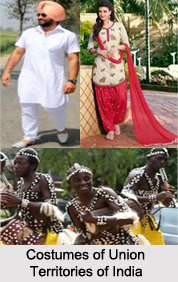
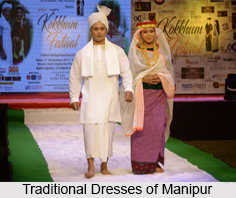
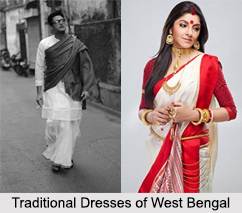
 Traditional Dresses of West Bengal depict the richness in tradition and culture of the region and its people. While Dhoti and Panjabi forms the classical men"s wear; Sarees are adorned by women. The styles and designs of the costumes are personification of the excellent craftsmanship of West Bengal weavers. The state has an exquisite tradition for weaving which has national as well as international appeal.
The traditional dresses of West Bengal can be broadly categorized into two groups, namely Traditional Dresses for Men and Traditional Dresses for Women.
Traditional Dresses of West Bengal for Men
Dhotis are lengthy pieces of fabric spun in cotton or silk worn by the Hindus. Dhoti along with Panjabi, form the traditional dress for all Bengali men. Previously, Dhotis were prevalent only in white however presently; coloured Dhotis are also in vogue. The Dhoti is tied at the waist and wrapped around like a loin cloth passing in between the legs. It is suitably matched by a Panjabi, worn atop, also made of silk or cotton. The Panjabis are loosely fitted garments, reaching close to the knees and are available in a wide variety of colours. It is same as Kurtas worn by people of North India. The Panjabi is usually made of silk or cotton.
 Over the years, the traditional Dhoti and Panjabi have lost much of their appeal and the Kurta-Pyajamas are in vogue. While western attire has overtaken the Dhoti"s popularity as regular wear, the combination of Dhoti and Panjabi is an irreplaceable ingredient during traditional festivals and occasions like the Durga Puja and wedding ceremonies.
The Lungi is another variation of the dhotis worn by men in West Bengal. It is usually worn on a daily basis. Though lungi is a popular dress among Bengali men, but it is not worn on formal gatherings.
Traditional Dresses of West Bengal for Women
The graceful icon of elegance that symbolises the quintessential Bengali woman is the Saree, which they prefer to drape in typical Bengali fashion. In West Bengal, Sarees are primarily woven in cotton and silk which have been named chiefly after their weaving techniques. The traditional weavers or Tantis of West Bengal are reputed worldwide because of the quality of fabric spun and their elaborate thread work. In various districts of West Bengal like Murshidabad, Malda, Nadia, Birbhum, Bankura and Hooghly, different varieties of Sarees are woven with supreme efficiency and dedication.
The Salwar-Kameez-Dupatta is nowadays in the same way popular among the Bengali women as the sarees. Salwars are loosely fitted trousers worn with a Kameez or long tunic. During wedding ceremonies however, the Bengali women usually resort to the traditional Banarasi Sarees in shades of red coupled with a golden veil to cover their heads.
Nowadays, most of the young generation and professionals, particularly in the urban areas, adorn western outfits like shirt, trouser, jeans, t-shirt, tops, skirts, etc. but during the festive season and other ceremonies, almost all the people tend to wear Traditional Dresses of West Bengal.
Traditional Dresses of West Bengal
Traditional Dresses of West Bengal, with their exquisite design and traditional outlook, are appealing. The men’s and women’s wear have their own identity and characteristic features.