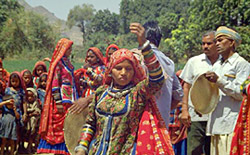
Bishnoi tribe are considered as the conservationist as preservation of anima and vegetable life is a religion to them. Bishnoi tribes are immigrants from northern part of India. It was formerly a Hindu sect founded in the state of Punjab. Later, it has developed into a caste. Bishnoi tribe inhabits the area around Barmer and traces their ancestry to a saint and ascetic named Jambhaji, regarded by them as an incarnation of Lord Vishnu, whom they worship. Bishnoi tribe has a sizeable population in the adjoining areas of Uttar Pradesh, Haryana, Punjab, Uttarakhand, Madhya Pradesh, Delhi, Maharashtra and Gujarat. The Bishnois are presently prevalent in the western parts of Rajasthan.
Origin of Bishnoi Tribe
Bishnoi sect was formed by Guru Jambheshwar after a drought in Marwar region. He created a community with 29 principles to be followed. He directed the worship of Lord Vishnu, while banning animal killing and cutting of trees. An interesting rationale for the name of Bishnoi is that the sect follows twenty-nine doctrines and Bishnoi in the local dialect translates to twenty-nine. The Bishnois are strict vegetarians and also ardent protectors of trees and wildlife. Ten doctrines among the twenty nine are directed towards personal hygiene and maintaining good basic health, seven for healthy social behaviour, and five tenets to worship God. Eight tenets have been prescribed to preserve bio-diversity and encourage good animal husbandry.
Society of Bishnoi Tribe
The villages where the Bishnoi tribes reside are easily distinguishable because of the abundance of trees and other vegetation. The herds of antelopes roaming freely near their homes. The people do their agricultural works with simple ploughs using bullocks or camels keeping in mind the eco-system of the desert land. They rear sheep and goats, which devour desert vegetation. They have strong love for animals which prevent them from slaughtering them or selling any of animal products. Animals are sacred and the protection of animals is part of the Bishnoi culture. The Bishnoi tribe has developed a unique blend of ecological sense and religious sensibility and strictly follows some customs that bar them from cutting trees and are also the advocates of peace and non-violence. During marriage ceremonies, the bridegroom is welcomed by the bride`s mother. After that both bride and bridegroom are made to seat on wooden boards. The wedding is performed in presence of a caste priest. Widow re-marriage is allowed in a Bishnoi society. In their community, dead are never burnt. They throw the bodies into a stream. They follow several birth and funeral rites.
Costumes of Bishnoi Tribe
The people of this community are teetotallers and wear white shirt, dhoti and turban which also enable them to stave off from the hot dry desert climate. Only one crop of bajra is grown during the monsoon season by the tribal people. The costumes of the Bishnoi tribe display their tribal customs including their sense of mores. The puthia, pada or pothdi and odhna make up the entire ensemble of unmarried girls. The `puthia` is white with full sleeves and the piping on the `puthia` is red. The lower garment of the women is called a `pada`. It is made from a blend of cotton and wool or in pure wool. The fabric is woven in black and white checks and the skirt is generally referred to as a `dhabla`. Bishnoi `odhnis` display a variety of prints, like the `rati-chunri`, a red printed `chunri`, the `sundri pakodi` in cotton and the `ludi`, which is black. The `ludi` is a woollen shawl made from sheep wool and is often embroidered. A married woman wears a kanchli with a kurti, a dhabla or ghaghra as her lower garment and an odhna. The neckline is generally decorated with a small frill and small bells are attached just below the tuki, drawing attention to the garment. Sleeves are worn longer than in other communities and are tight at the edge. Often two to three pleats are made at the border of the sleeve and are trimmed with piping.
The dresses are made with great dexterity for marriage purpose. For the marriage ceremony a kanchli made of mashru is preferred. The wedding lehenga is pink or red. A red chhint fabric in cotton, with white circles and black borders called jaleb chaap is most commonly used for this lehenga. The border designs at the two ends are brought to the front to form a vertical design down the centre of the ghagra. Sometimes, the ghagra is given a permanent pleat-effect with the use of natural glue, called morla. The Bishnoi women wear different varieties of odhni. Generally, during the marriage ceremony, the `pir ki chunri`, gifted by the bride`s mother, is worn. This is a draped garment, printed in `laung bhat`. A `kajli odhni` or `cha-pal chunri` is also used for the marriage ceremony. Another odhni is the kangrechi odhni, which has bandhej work on fine mulmul. The damini, an embroidered red odhna is also popular. The edging of an odhna is finished with double piping, generally blue and yellow. Women use the ludi and lunkar as shawls. A widow`s dress is similar in styling but lacks ornamentation and the colours used among them are either plain black for older women and red and black for younger widows.
The Bishnoi man`s attire comprises the chola, the dhoti and the pagadi. The chola is worn as an upper garment and is usually made of white cotton. A dhoti is worn as the lower garment and is made of white cotton fabric and is worn at ankle-length. The men of this tribal community prefer to wear headgears. The headgear of the Bishnoi men is known as the potiya. It is white and worn at all times. The fabric used is cotton and the men are fond of jewellery and wear murki in their ears.
The Bishnoi tribe worship the animals as god and maintain a healthy ecological balance of nature. Their main occupation is cultivation. They are the sheer followers of their customs.
Bishnoi Tribe
Bishnoi Tribes form the community of nature worshippers, residing in northern part of the country. Bishnoi Tribe displays ethnicity through their customs and religious beliefs and elegance by their costumes.