


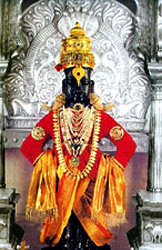
 The Bhakti movement in Maharashtra gained momentum due to the people of modest origin who visited from place to place singing devotional songs and praising the name of God. These saints had devoted themselves in prophesying the harmony of God and fraternity of man. They preached in simple and lucid language that could be perceived by the common people of India. The Bhakti movement in Maharashtra gained momentum due to the people of modest origin who visited from place to place singing devotional songs and praising the name of God. These saints had devoted themselves in prophesying the harmony of God and fraternity of man. They preached in simple and lucid language that could be perceived by the common people of India.
Among the Indo-Aryan vernaculars devotional bhakti first appeared in Marathi. It started in the thirteenth century with Jnanesvara, also known as Jnanadeva, who wrote a long Marathi commentary on the Bhagavad Gita, called Bhavartha Dipika, more commonly known as the Jnanesvari, the fountain-head of Maharashtrian devotionalism. More than a commentary, the text constitutes a religious sermon in the form of a song composed in a rhythmic prose which should be chanted. Jnanesvara was initiated in the Natha sect, which explains his leaning towards monism, but his bhakti was due to his connection with the Varkarx sect, which instituted the regular popular pilgrimages to the shrine of Vithoba in Pandharpur. The Jnanesvari forms a transitional stage in the development of devotional mysticism. It is still greatly influenced by the traditional commentary style of the theologians, but breaks new ground by using the vernacular. Thus was revived that contact with the masses that the great tradition of Hinduism had lost. It innovated also by using a form meant for kirtan chanting, by address¬ing itself to the mass of the people, and by drawing from the simple life of the village for examples and metaphors. The movement lasted till the seventeenth century, and we now describe its main personalities. Namdev (1270-1350) was a contemporary of Jnanesvara, but outlived him by over fifty years. A tailor by caste, he was surrounded by other low-caste hymnodist-saints: Gora the potter, Samvata the gardener, Chokha the un¬touchable, Sena the barber, Janabai the maid. The object of his devotion was Vithoba, the form of the great Lord Vishnu residing in the Pandharpur temple. This Vithoba was the god of the Varkarl-Panth, a sect that has an important place in the history of Maharashtrian devotionalism. It differs from most other sects in several ways. Its members are householders, and have a strong aver¬sion to asceticism. Their main cult is the twice-a-year pilgrimage to Pandhar¬pur, when thousands of Varkaris walk from village to village, from town to town, singing the praises of Vithoba. The membership cuts across the whole caste structure, and their most important aid to religion is the society of saints, by which term is meant their brothers and sisters in the faith and the saints who have died but left their immortal songs behind. The spread of this intensely devotional movement over the whole of Maharashtra was connected with the names of Jnanesvara and Namdev. 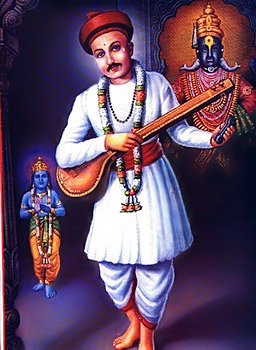 Namdev’s songs reflect a passionate nature, completely given to the love of Vithoba and the continuous invocation of his name. Often Namdev is troubled by the conflict between his all-absorbing bhakti and his everyday duties. Either his bhakti bears him away from the world and its demands, or his involvement in secular life makes him lose the presence of his Lord and thus have a foretaste of that ‘Dark Night of the Soul’, the bitter sweetness of which Tukaram will experience to the full.
After Namdev two centuries went by without leaving any names of great saints. The coming of the Turks and of Islam drove the movement under¬ground as it were. The temple at Pandharpur was razed, but the spirit did not die. It was Eknath (1533-1599) who revived the inspiration and the tradition. He was a Brahman, born in a family of celebrated saints. As a scholar, he published the first reliable edition of the Jnanesvari, and thus gave the Marathi Gita back to his people. By writing a commentary on the Ramayana, the Bhavartha-ramayana, he also presented the story of Lord Rama to them. His mystical teachings found their supreme expression in his famous commentary on the eleventh book of the Bhagavata Purana, in which he obviously modelled him¬self on the great master Jnanesvara. However, it was Eknath who invented a new form of deep religious life that needed no institutions or monasteries and no resignation from the world. He was a family man, devoted, austere, whose life was regulated around his hearth and his manuscripts, and yet he was a mystic. Every day he practiced kirtan, and his songs are part of the Marathi heritage. They have a strong moral basis, are concerned with the simplest aspects of life, and yet often soar to great heights of personal mysticism. Another persona of Bhakti movement was Tukaram (1598-1650) who was the greatest Bhakti poet of Maharashtra. He was born in a rural family of grain traders and a tragedy set him on the path of devotion. His hymns are considered the glory of devotional poetry, the favourites of the Varkari pilgrims, and they are woven into the very texture of the Pandharpur rites. More than any other of his fellow saints, Tukaram was a mystic overpowered by love, by the presence or the absence of his Lord. Again and again his songs describe the terrifying passage through the ‘Dark Night of the Soul’, where his feelings of sin and nothingness combine with the absence of the Lord to crush him down in the depths of despair. His burning desire for the Lord’s vision is frequently fulfilled, and in this fulfillment an ecstasy takes hold of his mind and his senses and transports him into visions, now cosmic, now intensely personal. All this is expressed in the concise, vigorous, sometimes brutally knotted style that is all his own. Another personality of the Bhakti movement was Ramdas (1608-81). From his life history it has been known that he was orphaned as a child, left home and, after long years of spiritual training and wandering, he settled down on the banks of the Krishna River where he built a temple to Lord Rama. This last of the great Maharashtrian hymnodists is in several ways quite different again. His main work, the Dasabodha is not written in the commentary form, but is rather a compilation of his writings and sermons produced over many years. The content though was new, but also a reformer concerned with the contemporary state of society, with the bad condition of the Brahmans, with the threat of Islam. Ramdas was a devotee of Rama whereas the others centred their devotion on Krishna and the Vishnu of Pandharpur. The devotees of Krishna and Vishnu have characteristics that set them apart from those of other regions: theologically there is a strong current of monism, and although mostly devotees of Krishna their works are devoid of erotic imagery. They revitalized Hinduism, estab¬lished the Maratha literary and cultural identity, and insisted on unifying social forces: these were to become important political factors in the building of the great Hindu kingdom of the Marathas, and later characterized the Maharashtrian nationalist reformist movement. |
| |||



Home > Reference > History of India > Medieval History of India > Bhakti Movement > Bhakti Movement in Maharashtra
Bhakti Movement in Maharashtra
| Bhakti Movement in Maharashtra prophesied the oneness of God and also to establish equality among all religion. |
| ||||||||||||||||||||||||||||

