


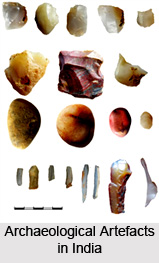
 The modern phase of Palaeolithic studies in archaeology in India began in the 1930s when there were attempts to go beyond the succession and distribution of artifacts and consider the issues of related environment and geochronology. The interrelationship between the stratigraphic profile of prehistoric tools and related environment was first highlighted in a major way in India by a study of tools collected in the Eastern Ghats of the Andhra region. The modern phase of Palaeolithic studies in archaeology in India began in the 1930s when there were attempts to go beyond the succession and distribution of artifacts and consider the issues of related environment and geochronology. The interrelationship between the stratigraphic profile of prehistoric tools and related environment was first highlighted in a major way in India by a study of tools collected in the Eastern Ghats of the Andhra region.
However, the works of certain geologists have got their significance because of the fact that they went beyond such palaeoclimatic correlations and introduced a geochronological scale on the European model. Moreover, having established a geochronological scale for its main study area between Kashmir and the Salt range, it extended the framework, through archaeological com¬parisons, to include the Narmada valley in central India and the area around Madras in the south. In the Narmada valley of central India, four terraces were recognised only in the tributary valleys but they were impossible to distin¬guish in the main valley where three different cycles of sedimentation were recognized. These cycles of sedimentation came to be known as the 'lower group', 'upper group' and 'regur or cotton soil group'. While the regur or black cotton soil is irrelevant, the lower and upper groups both show a gravel bed followed by a bed of clays and silts. The gravel bed or the boulder conglomerate of the lower group is more cemented than the gravel of the upper group. Similarly, the clay of the lower group is more intensely coloured and richer in concretions than the clay of the upper group. Thus, basically, it is a succession of cemented basal gravel, clay, finer gravel and clay, the whole being covered by regur or cotton soil. In south India, three terraces were observed in the Kortalayar plain near Chennai. These terraces were formed after a deposition of detrital laterite over a boulder conglomerate. The better known sites of this region are Vadamadurai and Attirampakkam. The evidences found from some books published by some scholars show that there was considerable progress in Indian Palaeolithic research between 1963 and 1974, especially in the areas of stratigraphy and typology. The stratigraphic and typological continuity between the three horizons of the Indian Palaeolithic could no longer be doubted, and there was certainly a better grip over the typological range of the tools themselves. At the same time, it has to be noted that within the range of the Indian lower Palaeolithic no acceptable evolutionary se¬quence of tool-types emerged.  Since the mid-seventies, Palaeolithic research in India has branched out in several directions beyond stratigraphical and typological considerations. First, a few traces of primary occupation of Palaeolithic people have been exposed through controlled excavations at Paisra in Bihar, Bhimbetka in Madhya Pradesh and Hunsgi in Karnataka. However, none of these ex¬cavations yielded any sign of organic material which could be used for a fuller reconstruction of the contemporary life. Second, there has been some emphasis on working out the geochronology of lower Palaeolithic and middle Palaeolithic horizons. Admittedly, the dates available are still very limited in number, and at least in one case the dates have not contributed to a clear picture. However, the availability of some absolute dates for the Indian lower Palaeolithic and a handful of non-radiocarbon dates from the middle and upper Palaeolithic as well, must be considered an important step forward. Along with this has developed a concern for geoarchaeology and a quest for precision in the typological analysis of tool assemblages. Both these developments have received warm welcome, but as far as geoarchaeology is concerned, the use of geological and geomorphological jargon and the presentation of archaeological data in various computer-derived forms do not necessarily announce the maturity of geoarchaeological approach to Palaeolithic studies in India.
Apart from these, rigorous multi-disciplinary investigations in the field of sediment deposits have been conducted in a rather limited area in Rajasthan. Some amount of sea-level studies has been conducted in Gujarat. In Kashmir, the archaeological correlates seem to be elusive before the upper Palaeolithic stage. A study of this kind was also undertaken in the context of the Son valley in Madhya Pradesh and the Belan valley of Uttar Pradesh. Under the circumstances, what has been really successful in the field of palaeolithic studies in modern India is the development of an eth¬nography-based settlement-subsistence approach. This has been applied with success in Andhra Pradesh and Karnataka, and may be pursued in other areas as well. The sources of information for the archaeology in the Paleolithic age are some books that are written by some scholars of this sector. Moreover, there are some other sources that stand evidences for the study of the archaeology of the Palaeolithic age, but due to the dearth of written documents in this particular division of archaeology, the detailed study of archaeology of the Palaeolithic age was hampered. |
| |||



Home > Reference > History of India > Sources of History of India > Archaeology of India > Archaeology of Palaeolithic Age
Archaeology of Palaeolithic Age
| Archaeology of Palaeolithic Age comprises the earlier evidences that help in the archeological study of India. |
| ||||||||||||||||||||||||||||

