


 Types of Indian carpets are numerous in number and they are classified based on several criteria. Ever since the first carpet was woven in India, the carpet weaving industry has grown remarkably. Today, carpets from India are woven by hand or in a power loom. Though silk carpets and Indian wool carpets are the most popular, cotton, jute, bamboo, grass and coir carpets are also types of carpets that are used to make these attractive Indian floor coverings. Types of Indian carpets are numerous in number and they are classified based on several criteria. Ever since the first carpet was woven in India, the carpet weaving industry has grown remarkably. Today, carpets from India are woven by hand or in a power loom. Though silk carpets and Indian wool carpets are the most popular, cotton, jute, bamboo, grass and coir carpets are also types of carpets that are used to make these attractive Indian floor coverings.
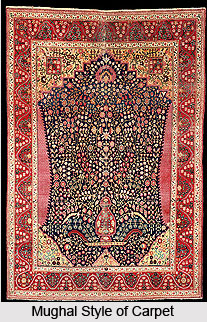
The Mughal style of carpet is a type of Indian carpet that is considered to be the oldest ones. Over the course of the 17th century, the local artists slowly replaced the Persian artists and artisans in the great workshops depended more specifically on Indian taste and preference. The Mughal style of carpet was influenced by the passion for botany of Akbar's son, the emperor Jahangir (reigned 1605-1627). Under his rule all the arts inclined toward representations of a floral character, which were delivered with such naturalism and presented such a variety of species that they competed with Western herbals. Under the reign of Shah Jahan (reigned 1628-1658), this type of carpets reached full expressive maturity, evident in the perfect realism of its renderings and close attention to detail. Indian dyers used the means of repeated dyeings to obtain singular shades and colours so intense that they seem enameled. Typical of Indian rugs is lac red, with its characteristic bluish reflections that are obtained from an insect of the cochineal family known as lac and used in grounds; against this colour stand out designs coloured light yellow, mustard yellow, light led, emerald green, pink, midnight blue, light blue, light green, orange, black, and brown. Another particularity of these types of carpets is the way colours are combined, for this is done without outlines, even when two different tones of the same tint are used side by side, such as red and pink or blue and light blue. The borders of these carpets are characterised by a dark ground, rendered using a strong green-blue, suitable for making contrasts with the lac red of the field. Antique type of carpets is priced at high rates in India. Almost all existing antique Indian rugs are held in great collections at museums; dating back to the 16th to 17th centuries, 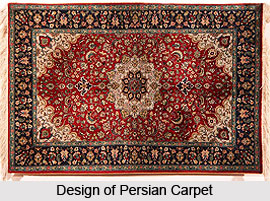 they can be grouped into decorative types that show varying degrees of liability to central or eastern Persia. Given their stylistic uniformity, the areas where they were made cannot be recognised with certainty. they can be grouped into decorative types that show varying degrees of liability to central or eastern Persia. Given their stylistic uniformity, the areas where they were made cannot be recognised with certainty.
Floral Rugs or Floral carpets are the most common type of Indian carpets. They are mostly attributed to Lahore. The flowering plants, often of many different species, are arranged in the entire body within a grid, the shape of which varies, or are arranged in the more typically Mughal style of horizontal rows. In one 18th-century layout, the flowers are made small and presented in thick arrangements, each flower joined to another by extensions of its stem, a scheme directly suggestive of Persian floral carpets. Also included in this type are the Indo-Esfahan carpets and certain exceptional examples with trees, which are often presented with flowering foliage. Prayer rugs are another type of Indian carpets. The Mughal prayer rugs are composed of a highly articulated mihrab, the interior field of which is coloured with lac red and displays Mughal flowering plants in large size to indicate the realistic transformation of the symbolic tree of life. In the so-called millefleurs prayer rugs dates back its origin in the 18th century, myriad tiny flowers of diverse species instead thickly cover the field and always growing from a single plant; the niche of these prayer rugs is often bordered by two typical cypresses. Portuguese carpets are quite similar to the Persian carpets and are variously attributed to northern or southern Persia or to the Portuguese colony in Goa. Besides, the people in European dress that appear on these carpets, the Indian origin hypothesis is supported by the particularly concentrated and mixture of brilliant colours. The subjects of figural carpets sometimes tell episodes from Indian epics but more often display hunting scenes. These carpets have greater vigor than Persian figural carpets in part because of the unbalanced creation of their elements but mainly because of the size and importance of illustrations portrayed through the figures with respect to the floral ground. Furthermore, the figures are usually displayed in movement. Typically Indian illustration on Indian carpets is the presence of an elephant, and feature of these carpets is the design of the border, often peculiarly enlivened by fantastic masks. Included within this group are examples decorated with the waq-waq tree. The various types of Indian carpets are showcased in stores all across the nation with diverse origins and designs. The colors and patterns of these carpets are unique and exquisite from the very next one and are still one of the best buys in the market. |
| |||



Home > Art & Culture > Indian Crafts > Types of Indian Crafts > Indian Carpets > Types of Indian Carpets
Types of Indian Carpets
| There are various types of Indian carpets that are categorised according to its origin, designs and methods of weaving. |
| ||||||||||||||||||||||||||||

