Soil Conservation in India - Informative & researched article on Soil Conservation in India
  Indianetzone: Largest Free Encyclopedia of India with thousand of articles Geography of India


in  
Art & Culture | Entertainment | Health | Reference | Sports | Society | Travel
Forum  | RSS Feeds  | Free E-magazine
Geography of India : Indian Climate l Indian Mountains l Indian Forests l Indian Soil l Indian Vegetation l Animal Husbandry in India l Resources in India l Indian Demography l Indian Industries l Indian Islands l Indian Airports l Zoos in India l Indian Mines & Minerals l Indian Physiography l Indian Transport l Indian Geology l Communication in India l Indian Trade l Indian Astronomers l Indian Telecommunications
Home > Reference > Geography of India > Indian Soil > Soil Conservation in India
Soil Conservation in India
In India it has become a vital activity after the severe damaged caused by soil erosion for the past decades.

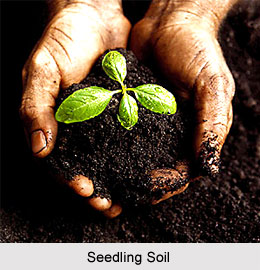
Hands Holding a Seedling and SoilSoil Conservation in India is a prime measure taken to check the ravages of soil erosion in the nation. Land and water are natural resources that are essential for the existence of life and are the two unpredictable factors for which soil management has become most essential.

Soil Conservation has become a necessary step to preserve the soil, which is getting eroded with time. Land provides food, fuel, fodder and shelter to the mankind besides supporting secondary and other economic life supporting system. However there has been a continuous exhaustion of land resources. As a result the quality of land is deteriorating with passing decades due soil erosion. Soil erosion is caused mainly due to activities like shifting cultivation, large scale deforestation, reckless mining activities, overgrazing, general mismanagement etc. Such soil erosion has lead to degradation of the physical property of the soil and loss of plant nutrients.

Soil Conservation is very important in India because, it takes nature almost 600 -1000 years to build 2.5 cm of topsoil but this very topsoil can get displaced in a year due to misuse, as a result it is becoming the harmful single factor in the deterioration of productive land. In a survey, it has been reported that 6000 million tones of productive soil is lost every year from about 80 million hectare of cultivated land in India .It has also been proved that soil lost from unprotected land is about 120 tonnes every year and may go as high as 300 tonnes annually.

Thus, a part from weakening of fertile soil erosion results in the loss of plant nutrients siltation of reservoirs and riverbeds thereby harmfully affecting irrigation and power potential; causing floods in plain and valley which damage crops, habitation, animals, communication and so on. But most of all it unfavorably affects agricultural production, forest production and availability of water both for irrigation purpose and drinking, other than bringing about a disturbance in the soil and water balance.

Soil Conservation is of great importance in the widespread regions of low and uncertain rainfall, in the Indian states of Punjab, Madhya Pradesh, Maharashtra, Andhra Pradesh and Karnataka. Scanty, unevenly distributed and highly erosive rains, surging topography, and high wind velocity adds to the soil erosion. Generally shallow soils are seen in these areas. The period of heavy rainfall from August to October is the period of the heaviest erosion in these regions. Wind erosion has been acutely responsible for destroying the precious topsoil in many Indian states. An extreme example of sand movement from the coast is to be seen in the Saurashtra region of Gujarat where the once-flourishing ports are now covered with advancing sand dunes.

afforestation Soil Conservation is especially important in rural India, where the erosion of the cultivated fields, ignored pastures and wastelands, considerable roadside erosion greatly takes place owing to the defective highway engineering. Defective drainage and water logging damage fertile areas and make them unfit for cultivation every year and indirectly increase the erosion hazards. Soil conservation in rural area in its widest sense includes not only control over erosion but all those measures like improvement of soil defects, application of manures and fertilizers, proper crop rotations, irrigation, drainage etc. In this sense, soil conservation is closely associated to the improvement of land use in general. Large areas in all parts of the country have been rendered useless as a result of soil erosion and areas which suffer from moderate or slight erosion and whose productivity is reduced as a result of soil losses are very much larger still.

Soil Conservation refers to retain extensive vegetation on the soil. Vegetation is the protective cover against the forces of wind and water, which protects the soil from being washed or blown away and preserving the physical and-hydrographic balance of nature. Forests-for instance, provide the most effective protection against erosion on hill slopes. They break the force of run-off by impeding the flow of rainwater down the slopes and by absorbing large quantities of it in their dense mat of undergrowth. This absorbed water, flows away slowly over a period of time; a large part goes into the soil, flows under-grounds, feeds springs and streams and is available for utilisation in the foothills and plains.

Trees are the prime medium of soil conservation; they act as windbreaks, reducing the force of the wind, and the grasses bind the sandy soils. Destruction of trees and natural grasses in dry areas has similar harmful effects. Large areas in the bordering areas of deserts are thus rendered infertile by the deposition of sand. It is believed that many deserts of the world have increased in area in historical times by this process. Soil Conservation measures are specially started in areas like the forests of Assam, Bihar, Orissa and Madhya Pradesh, shifting cultivation, which is practised by the tribal people living in these areas, is a major cause of destruction of forests.

Afforestation and preservation of forests by scientific forest management and improvement of land use practices on farm lands are some more ways of soil conservation practised in India. This includes such measures as ploughing along the contours and strip-cropping on sloping lands; proper crop rotations; application of adequate manures and fertilizers; taking care of fallows and other unfarmed lands. Certain engineering measures are also forms of soil conservation. Under this is included construction of bunds and terraces check dams, channels for drainage of surplus water, gully plugging and others. A comprehensive programme of soil conservation for an area would include all four types of above-mentioned measures, although the relative importance of the different measures would vary greatly in different areas depending upon the particular conditions of the eroded area.

Aufforstung mit Robinie Soil conservation work has to be mainly done by the farmers, proper understanding on their part of the nature of the erosion problem, and their active participation in soil conservation programmes are essential for the success of such programmes. Improvements in farming practices depend entirely upon the farmers. Convincing them of the need for such improvements and demonstrating the correct methods of adopting them is very important. Education for soil conservation, publicity and demonstration aimed at creating awareness among the general public and especially among the farmers the causes and effects of soil erosion and ways to control it, is a very important part of soil conservation programmes. Formation of associations of farmers for soil conservation work has also been proposed in order to provide a suitable medium through which soil conservation measures can be taken on a cooperative basis at the village level.

Steps for conservation of soil have been taken for the past few decades in states like Punjab (afforestation activities in the Sivalik Hills) and Bombay (binding and terracing work in the Deccan area). More recently, soil conservation work has been initiated in several other States also. But there has been no countrywide effort at an accelerated rate so far, and even in states where the work has been going on, this has been on a very limited scale.

Land Utilization and Soil Conservation Board control the programmes for soil conservation and improvement of land use. These programmes are based on an assessment of the erosion problem in the state after a rapid survey of the land investigation. A sum of around Rs. 2 Crores has been provided by the Central Government for soil conservation work in India. Soil Conservation Society of India is devoted to the cause of development and conservation of the soil, water and associated resources of plants and animals since foundation. It is an organization of scientists and professionals where membership is open to anyone who assures to work for the wise use of the precious and limited soil resource in India.

(Last Updated on : 21/05/2009)
  More on Indian Soil...
 
Mountain Soil Alluvial Soil Laterite Soil
Red Soil Regur Soil Land Use Pattern of India
Soil Erosion in India Soil Conservation in India  
Recently Updated Articles in Geography of India
  • Grand Trunk Road
    Grand Trunk Road is one of the oldest, longest and most important roads of South-Asia.
  •  
  • Types of Forests in India
    Elevation, topography, climate and soil type are the major factors which determine the type of forest.
  •  
  • Sispara Peak
    Sispara Peak is an Indian mountain peak, situated in the south Indian state of Tamil Nadu.
  •  
  • Indian Railway Zones
    Indian Railway network is classified into seventeen zones for administrative purposes.
  •  
E-mail this Article | Post a Comment
Free E-magazine
Subscribe to Free
E-Magazine on Geography of India

 
Soil Conservation in India - Informative & researched article on Soil Conservation in India
Sitemap
Contact Us   |   RSS Feeds
Copyright © 2008 Jupiter Infomedia Pvt. Ltd. All rights reserved including the right to reproduce the contents in whole or in part in any form or medium without the express written permission of Jupiter Infomedia Pvt. Ltd.
