


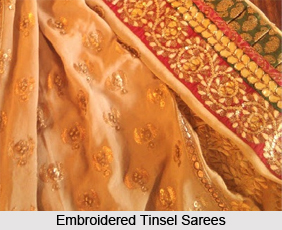
 Embroidered Tinsel Sarees are the pride of West India. More specifically, the production of this saree is prominent in districts like Surat and Varanasi. These sarees are also known as khari. In Saurashtra and Kutch, they are known as Roghan. The fabric used to make this saree is zari. These sarees are renowned for their metalic threads, texture and the three dimensional effect which amazes the customers. They were the identity of the ethnic groups, namely, Abaris and Sodha Rajputs. These ethnic groups popularized embroidered tinsel sarees throughout India. Embroidered Tinsel Sarees are the pride of West India. More specifically, the production of this saree is prominent in districts like Surat and Varanasi. These sarees are also known as khari. In Saurashtra and Kutch, they are known as Roghan. The fabric used to make this saree is zari. These sarees are renowned for their metalic threads, texture and the three dimensional effect which amazes the customers. They were the identity of the ethnic groups, namely, Abaris and Sodha Rajputs. These ethnic groups popularized embroidered tinsel sarees throughout India.
Zardozi Technique for Embroidered Tinsel Sarees There was a time when real gold and silver threads were used on silk, brocade and velvet fabrics. Nowadays, zari is used as a substitute. Brought in India by the Mughal invaders, zardozi is a type of Indian embroidery, known to exist since the late 16th century. The word zardozi comes from the two Persian words zar meaning gold and dozi meaning embroidery. Zari is a gold gilt thread, utilized in zardozi embroidery. During zardozi embroidery process, metal ingots are melted and pressed through perforated steel sheets to convert them into wires. They are then hammered to the required thinness. The plain wire is called badla. When this wire is wound round a thread, it is called kasav. Smaller spangles are called sita With the intention to enhance the beauty of these sarees and lure the potential customers, gold and silver dust is complimented by pearls, precious stones, gota and kinari. This kind of decoration makes these sarees expensive. To make them purchasable, the metal wires are roofed with gold or silver instead of using real gold or silver metal over the sarees. Balla tinsel and khari works are other cheaper variations in metallic embroidery. These sarees are created in vibrant colours and shades, like the bridal sarees from Rajasthan, which can be designed in ethnic or modern ways. Embroidered tinsel sarees manufacturers are expanding their boundaries. Synthetic gold-colored paints, mica and other shiny particles are used to create these sarees, giving a specimen of creativity. These sarees are used as festive clothing. Nowadays, the zardozi thread has a plastic core and a golden-colored exterior. This thread consists of coiled metal wires placed on the right side of the fabric and couched with a thinner thread. The embroidered tinsel sarees are technically block-printed or silk-screened. Instead of the pattern being a dye, transparent resinous glue is printed onto the fabric and then flakes of mica or gold dust are scattered over it. Related Articles: Indian Sarees Sarees of West India Bandhani Sarees Chanderi Sarees Patola Saris Gujarati Brocade Sarees |
| |||



Embroidered Tinsel Sarees
| Embroidered Tinsel Sarees are the mirror image of the extensive work of metal threads. |
| ||||||||||||||||||||||||||||

