 Akbar`s ruling period, from 1556 to 1605 A.D., was doubtless, the Golden Era in Mughal Dynasty, during which the country literally was ripened to peak status, with peace reigning supreme due to the emperor`s supreme intelligence, a sharp presence of mind and of course, his special and historic relation with his subjects. Akbar was so beneficial a man that every stone he had touched, prior to which the country was witnessing in a much darkened state, had turned to gold! As such, in terms of the prestigious `Mughal Architecture`, Akbar did not have ever to lag behind in filling up every detailed Indian corner, with masterpiece works of art and chiseling. As such, architecture of Narnaul in north India, under Akbar deserves special attention, as to its meticulousness and exquisiteness and elaboration. Akbar`s architectural prowess in a Mughal Narnaul, was, just like, in other non-imperial far-off states, commanded by one of his vassals.
In Narnaul, presently in the state of Haryana, not far from Rajasthan, several Akbari structures have been well preserved. Architecture of Narnaul during Akbar had taken the quaint and town of wilderness towards so much of central significance. During Akbar`s time, Narnaul had served as a district headquarters and mint town in Agra Province. Its location between Delhi and the Rajput state of Marwar, use to make Narnaul strategically much important. It was also a crucial place of pilgrimage for Hindus and for Muslims, who concluded their sojourn at the shrine of a thirteenth-century pir, Shaikh Muhammad Turk Narnauli. Akbar is known to have travelled to Narnaul to visit the esteemed contemporary Chishti Shaikh Nizam al-Din, one of the most learned men of the time. The Shaikh had expired in 1589 and was buried in a square stucco-covered tomb, adhering to the older Lodi (referring to the Lodi Dynasty from Delhi Sultanate) style; devotion to the Shaikh`s memory was so great that in 1622, Nimat Allah, otherwise unknown, had erected a single-aisled three-bayed mosque facing the tomb. It is skillfully covered with polychromed arabesques and Quranic inscriptions.
It is quite an awe-inspiring fact that no one had constructed more in Narnaul, than did Shah Quli Khan. Shah Quli Khan`s architecture in Narnaul during Akbar, was of a personal kind, rather different from the enclosure he had built at the Taragarh shrine. His patronage of the Narnaul monuments was considered remarkable enough by his contemporaries, that these works are indeed mentioned in Mughal-period texts. Shah Quli Khan`s first architectural project in Narnaul - his tomb, is dated 1574-75, three years after his enclosure at the Taragarh shrine. A multi-storied arched gateway, built fourteen years after the tomb, serves as the entrance to the tomb`s walled garden compound.
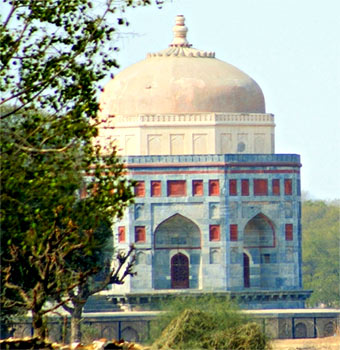
 The tomb by Shah Quli Khan, one of the earliest architectures in Narnaul during Akbar, bears a small octagonal structure, faced with red and grey contrasting stones and surmounted by a white dome. While the contrasting stones strongly resemble those utilised on the nearby tomb of Sher Shah Suri`s grandfather, the tomb`s octagonal plan is very different from the octagonal type constructed by the Lodi and Sur kings. That type had consisted of an eight-sided veranda, encircling a central chamber. Shah Quli Khan`s tomb, however, possesses no veranda and more closely resembles the cylindrical octagonal pavilion known as the Sher Mandal in Delhi`s Purana Qila and the so-called Hada Mahal, a pleasure pavilion situated near the lake at Fatehpur Sikri - both inspired by Iranian pleasure pavilions. That Shah Quli Khan`s tomb resembles a pleasure pavilion is very much appropriate to the changing times in Akbar`s period. The building, constructed some twenty-five years before Shah Quli Khan`s death, was situated in a large planned garden and was made use during his lifetime as part of his residential estate.
It thus comes as no huge a surprise that, Akbar`s `Mughal India` was so colossal in scope and range, that Akbar himself could not always be present in such then unknown places like Narnaul, the reason behind such intelligent placement of court chiefs and vassals to look after regal architecture. Just as with the various famed and not-much-famed areas, architecture in Narnaul during Akbar also was never mistreated for one moment, with due veneration being paid to each. Variations of this octagonal tomb-type, utilised in Shah Quli Khan`s tomb, was widely employed in north India. For instance, Shamsher Khan`s elegantly painted tomb in Batala constructed in 1589-90 is similar, as are the undated octagonal tombs in Bahlolpur, believed to be those of Bahadur Shah and Husain Shah`s. A similar structure, the tomb dated 1612-13, built in Nakodar for Mumin Husaini, a musician at the court of the Khan-i Khanan, a high-ranking noble under Akbar and Jahangir, suggests the continuing popularity of this type later in the Mughal period.
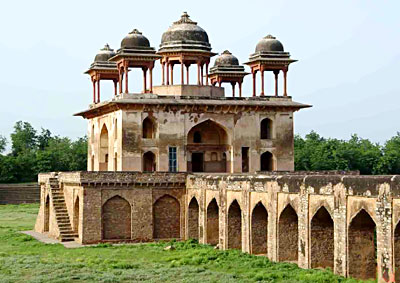
Some fifteen years after he had built his tomb, Shah Quli Khan also had constructed nearby a second gateway situated on the northern edge of a large square tank. It opens to an arched causeway, which leads to a pleasure pavilion situated in the tank`s centre. The tank and pavilion were commenced in 1590-91 and wrapped up two years later.
Inscriptions here demonstrate that paradisiacal imagery continues to be a trademark of Mughal architecture, as the tank in which the tomb sits, is called a "second Kausar" (a pool in paradise) and its water "the water of immortality"; in addition, both the pavilion itself and Shah Quli`s tomb are equated with paradise. Shah Quli Khan`s importance in the Mughal emperor`s court is very much evident from such connections to such building musings, for architecture of Narnaul during Akbar indeed never is arrogated to have been belittled by Emperor Akbar himself. His appreciation and dependence on his chiefs is still present in the erstwhile Mughal architecture that was established in Narnaul centuries back, with Akbari partonage. While such paradisiacal inscriptions often praise the patron, their flattery is usually of much generalised signification. Here, however, specific reference is made to the patron`s heroism of almost fifty years earlier, when he had defeated the Sur general Hemu, thus saving Mughal hegemony. Shah Quli Khan is titled as "the honour of the country . . . who carried away the ball of valour from his rivals."
Shah Quli Khan`s pavilion in Narnaul locally recognised as the Jal Mahal or Water Palace, resembles various imperial structures in its individual parts; in combination, it resembles no single one, but combines these features in a rather innovative fashion. For instance, the pavilion`s location in the midst of a tank harks back water pavilions in Fatehpur Sikri that sat on the edge of a lake, although both the Hada Mahal and Qush Khana there are octagonal in appearance. The chattris of the superstructure in the pavilion in Mughal Narnaul architecture under Akbar, recall another building in Fatehpur Sikri, the so-named and legendary, Diwan-i Khas. Such multiple chattris on flat roofs were typical of domestic architecture, as contemporary illustrations testify. This pavilion, then, probably had drawn inspiration from buildings in Fatehpur Sikri and in turn it served as a model for a similar pavilion in Bairat (Jaipur District). That pavilion in Bairat, dated approximately a decade later than the Jal Mahal and attributed to Raja Man Singh, was also coiffured in water.
Other tombs constructed by amirs ("commander" or "general", also "prince", amir was a high title of nobility or office, used throughout the Arab World and historically in 19th century Afghanistan and also in the medieval Muslim World) of Akbar`s time also adhere to no single architectural form, even though their individual components are commonly rendered in evident Mughal style. Such instances were very much visible in the Mughal capital of Delhi and major places elsewhere. But nowhere is such Mughal architecture during Akbar in such a patronising style more evident, as is in Narnaul, in Haryana.