





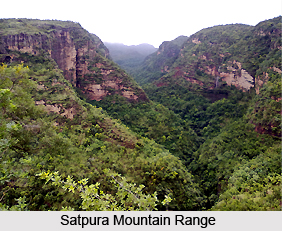
 Narmada Valley dry deciduous forests in India are mainly located along the Narmada River Valley. The forests are also located along the flanking Vindhya Mountain Range and the western part of the Satpura Mountain Range in the central Indian states of Madhya Pradesh and Maharashtra. The forests also extend into portions of the states like Chhattisgarh, and Uttar Pradesh. The forests cover a total area of 169,900 square kilometres. Narmada Valley dry deciduous forests in India are mainly located along the Narmada River Valley. The forests are also located along the flanking Vindhya Mountain Range and the western part of the Satpura Mountain Range in the central Indian states of Madhya Pradesh and Maharashtra. The forests also extend into portions of the states like Chhattisgarh, and Uttar Pradesh. The forests cover a total area of 169,900 square kilometres.
The Narmada Valley dry deciduous forests in India are neither exceptionally species-rich nor high in numbers of endemic species and they are divided into several large blocks. The blocks can exceed 5,000 square kilometers in area. The forests form an ecoregion that presents rare and important opportunities to conserve Asia's largest carnivore, the Tiger. The forests rise to more than 1,300 meters (m) and they mark the northern boundary of the Indian Peninsula. The Narmada Valley dry deciduous forests ecoregion traces its geological roots back to the ancient circumpolar continent Gondwanaland. The forests have a seven to eight month long dry season and they receive an annual rainfall of about 1,200-1,500 mm, brought by the southwest monsoon. The forests usually receive rainfall during the months of June to September. The natural vegetation in the Narmada Valley dry deciduous forests in India is influenced by its seasonality. The forests have a three-storied structure in which, the upper canopy reaches a height of 15-25 meters, the understory reaches a height of 10-15 meter understory, and the undergrowth of the forests reaches a height of 3-4 meter. The vegetation in the forests is mainly dominated by Teak and it is associated with the other plant species like Diospyros melanoxylon, Anogeissus latifolia, Lagerstroemia parviflora, Terminalia tomentosa, Lannea coromandelica, Hardwickia binata, and Boswellia serata. Many trees in these forests lose their leaves during the long dry season to conserve moisture. 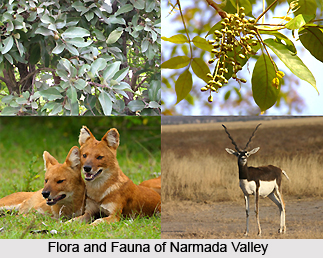 The Narmada Valley dry deciduous forests in India are not quite rich or exceptional in terms of endemism or diversity. However, they still retain important habitats for many of the Indian Subcontinent's large animals like the Tiger, Gaur, Wild Dog, Sloth Bear, Chousingha, and Blackbuck. These larger vertebrate species are being increasingly confined to small forest fragments throughout most of their ranges and the fragments do not offer much hope for long-term survival of declining populations. Most of the large blocks of remaining habitat in these forests have been included in TCUs. All these habitat landscapes present the best opportunities for long-term conservation of viable Tiger populations. The Narmada Valley dry deciduous forests in India are not quite rich or exceptional in terms of endemism or diversity. However, they still retain important habitats for many of the Indian Subcontinent's large animals like the Tiger, Gaur, Wild Dog, Sloth Bear, Chousingha, and Blackbuck. These larger vertebrate species are being increasingly confined to small forest fragments throughout most of their ranges and the fragments do not offer much hope for long-term survival of declining populations. Most of the large blocks of remaining habitat in these forests have been included in TCUs. All these habitat landscapes present the best opportunities for long-term conservation of viable Tiger populations.
The Narmada Valley dry deciduous forests in India are home to a variety of mammal fauna species. The total number of mammal species found in these forests is seventy-six and none of them is considered as endemic to this ecoregion. However, there are several threatened species found in these forests that include the Tiger, Gaur, Wild Dog, Sloth Bear, Chousingha, and Blackbuck. The forests are also home to a total of 276 bird species and none of them is considered as endemic to this ecoregion. However, the bird fauna in these forests includes the globally threatened Lesser Florican and the endangered Indian Bustard. |
| ||||||||||||||||||||||||||||

