


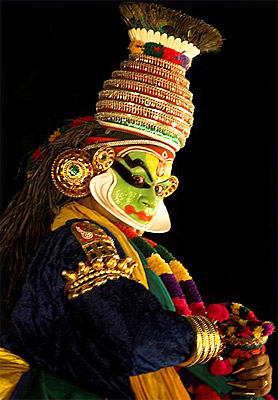
 Indian theatre craft boasts a plethora of brilliant costumes and masks among which 'Kiritams' play a vital role. 'Kiritams,' are the expressive headgears worn by Kathakali dancers of Kerala. Indian theatre craft boasts a plethora of brilliant costumes and masks among which 'Kiritams' play a vital role. 'Kiritams,' are the expressive headgears worn by Kathakali dancers of Kerala.
'Kiritams', an important part of the theatre craft in India, is especially a crown and is designed for the theatrical role played by the dancers. The 'Kiritams' is the most outstanding and universally used among traditional and folk theatre properties. They are made of wood, inlaid with mirror, glass and artificial stones. Further adornment appears in the form of gold threads, silver beads, peacock feathers and quill, woolen frills and various coloured foils. The Indian craftsmen take care of minute details while making such theatre crafts. For instance, the colours, sizes, girdle, designs etc are taken care of: 'pacha' (green) is for the benevolent and noble and 'kathi' (knife) symbolises evil and demon-like characters. Each 'Kiritams'comprises two coronets, superimposed with two bud shaped domes, a large circular disc behind it which is supported with a halo between the coronet and the disc. For making these 'Kiritams' , wood is put into use with each row decorated with closely knit silver beads on a red scarlet base. In order to beautify such theatre crafts further glass pieces are fixed on aluminium foils while large glass flower petals and small silver beads are in the centre. The top of the 'Kiritams' has rows of concentric circles which are embellished with pieces of jewellery, vines of golden stems and leaves, green buds, grapes with peacock feather stems, and a golden circle of foils converging on a round piece of glass in the centre and represents a fully blossomed flower. Apart from the designs, the colours of the 'Kiritams' matter as well. The players who adorn these particular headgears have beards of three colours. Each colour represents a particular side of the character. The colours of the beards that are incorporated in this particular folk dance are mainly of red, white and black. Red beards represent vicious and vile characters. The red fur-coat that envelops the body of red beard role-types is enormous and the skirt is more bulging. The adornments help in presenting him as a character of rather disproportionate body, untamed and bursting into physical prowess. The edge of this 'Kiritams' is decorated with woolen tufts of the same colour as that of the beard. The base of the peacock stem is rolled into oval shaped flowers and the vines are replaced by the grapes fixed on the disc. White bearded characters are strong, gentle, devoted, and loyal (like Hanuman). The character dons the white beard which is vast circular white, woolly beard of yak's wool and an enormous white fur-coat. Hanuman's headgear is much like a Chinese hat with two domes ending in a bud-like finial adorned with tassels. The rest is made of cane with the outer surface covered in white flannel. Long artificial locks also float down. On the other hand, the black bearded characters are the destroyers (like Kali), and include hunters and the like. The artists with the red and black beards have large head-gears with decorations. Separate 'Kiritams' are made for the 'rishis', hunters and religious figures. The headgear of sages or 'rishis', constitutes two domes. The lower of the dome is the larger. The usual decoration along with twisted coils and 'rudrakshamala' (rosary of several faceted seeds) encircles the dome. The hunter's headgear resembles an expanding lotus with the cane frame covering almost half the height. This is covered with a dark coloured cloth decked with silver petals much like the screw-pine blossoms. God Krishna has a special conical hemispherical shaped dome 'Kiritams' with a woolen garland of different bright colours encircling its tip. The artisans fix eyes of peacock feathers over this to create the form of an expanding lotus. An oval piece of blue or black cover duly ornamented hangs behind the coronet. |
| |||



Kiritams
| `Kiritams`, in theatre craft plays an authoritative role for staging distinct characters. |
| ||||||||||||||||||||||||||||

