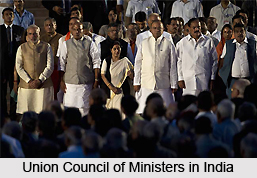
 Union Council of Ministers has been set up with the purpose of aiding the Indian President in the performance of his duties. Article 74 (1) of the Constitution of India states that there shall be a Council of Ministers with the Prime Minister at the head to aid and advise the President who shall, in the exercise of his functions, act in accordance with such advice. It is seen that the Council of Ministers is the real vestige of power in the Indian government.
Appointment and Tenure of Council of Ministers
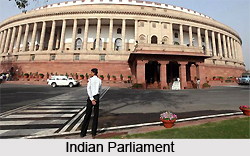
Indian Prime Minister is appointed by the President and the other Ministers are appointed by the President on the advice of the Prime Minister. The Prime Minister submits to the President a list of the members of his Council and the President simply endorses it. It is not necessary that at the time of being appointed as a Minister a person should be a member of either House of Parliament. The Constitution states that a Minister who for any period of six consecutive months is not a member of either House of Parliament, shall at the expiration of that period cease to be a Minister. It is also laid that the Ministers shall hold office during the pleasure of the President and the Council of Ministers shall be collectively responsible to the House of the People. Article 75 states that before a Minister enter upon his office, the President shall administer to him the oaths of office and of secrecy according to the forms set out for the purpose in the Third Schedule of the constitution. The salaries and allowances of Ministers shall be such as Parliament may from time to time by law determine and, until Indian Parliament so determines, shall be as specified in the Second Schedule of the Constitution.
Collective Responsibility of Council of Ministers
The Council is collectively responsible to the House of the People (Lok Sabha). The question of individual responsibility does not arise. The Council must come and go out as a team. The Council is responsible only to the House of the People and not to the Council of States (Rajya Sabha). The responsibility of the Ministers to the President is only formal, while their collective responsibility to the House of the People is real.
Composition of Council of Ministers
 It is stipulated by the Constitution of India that the total number of Ministers, including the Prime Minister, in the Council of Ministers of India shall not exceed fifteen percent of the total number of members of the House of the People. The Council of Ministers in India comprises three different categories that include the Cabinet Ministers, Minister of state and Deputy Ministers. The Indian Constitution does not mention anything about the Cabinet Ministers except in Article 352 where Cabinet is defined as the Council consisting of Ministers of Cabinet rank. However, in India it is the Cabinet which takes all the policy decisions and advises the President. Besides them, the Minister of State has an independent charge of a ministry. The Deputy Ministers, on the other hand, act as assistants to their chiefs and look after their work in their absence. The number of ministers may vary according to the volume and variety of work of the Central government.
Functions of Council of Ministers
The main functions of the council of ministers are mainly to aid and advise the President in the exercise of his functions. The Council is, in fact, charged with the duty of administering the affairs of the Union Government. Since the ministry is the highest organ of the Government of India, it determines all the policies relating to the country`s administration. It also has the responsibility of formulating internal and foreign policies. Peace and prosperity of the country depends largely on the policy formulated by the Ministry.
The ministers are not only the head of the executive departments, but are also important members of the majority party in the legislature or at least having majority support in the legislature. The Ministry also plays a key role in determining the economic activity of the state. Currency, banking, commerce, trade, insurance and formulation and implementation of other plans are regulated and controlled by the Ministry as well. In short the Council of Ministers plays an important role in the administrative machinery of Central Government.
After 2014 General Election, Narendra Modi formed a new government of NDA alliance on 26th May 2014. The list of ministers in Union Council of Ministry:
| Prime Minister of India | Narendra Modi |
| Minister of Home Affairs | Rajnath Singh |
| Minister of External Affairs | Sushma Swaraj |
| Minister of Overseas Indian Affairs | |
| Minister of Finance | Arun Jaitley |
| Minister of Corporate Affairs | |
| Minister of Defence | |
| Minister of Urban Development | Venkaiah Naidu |
| Minister of Housing and Urban Poverty Alleviation | |
| Minister of Parliamentary Affairs | |
| Minister of Road Transport and Highways | Nitin Gadkari |
| Minister of Shipping | |
| Minister of Railways | D. V. Sadananda Gowda |
| Minister of Water Resources, River Development and Ganga Rejuvenation | Uma Bharti |
| Minister of Minority Affairs | Najma Heptullah |
| Minister of Rural Development | Gopinath Munde |
| Minister of Consumer Affairs, Food and Public Distribution | Ram Vilas Paswan |
| Minister of Women and Child Development | Maneka Gandhi |
| Minister of Chemicals and Fertilizers | Ananth Kumar |
| Minister of Law and Justice | Ravi Shankar Prasad |
| Minister of Communications and Information Technology | |
| Minister of Civil Aviation | Pusapati Ashok Gajapati Raju |
| Minister of Heavy Industries and Public Enterprises | Anant Geete |
| Minister of Food Processing Industries | Harsimrat Kaur |
| Minister of Mines | Narendra Singh Tomar |
| Minister of Steel | |
| Minister of Labour and Employment | |
| Minister of Tribal Affairs | Jual Oram |
| Minister of Social Justice and Empowerment | Thawar Chand Gehlot |
| Minister of Human Resource Development | Smriti Irani |
| Minister of Agriculture | Radha Mohan Singh |
| Minister of Health and Family Welfare | Harsh Vardhan |
Other ministers of the independent charges and the ministers of state are V.K. Singh, Inderjit Singh Rao, Santosh Kumar Gangwar, Shripad Yesso Naik, Dharmendra Pradhan, Sarbananda Sonowal, Prakash Javadekar, Piyush Goyal, Jitendra Singh, Nirmala Sitharaman, G.M. Siddeshwara, Manoj Sinha, Nihalchand, Upendra Kushwaha, Radhakrishnan P, Kiren Rijiju, Krishan Pal,Sanjeev Kumar Balyan, Mansukhbhai Dhanjibhai Vasava, Raosaheb, Dadarao Danve, Vishnu Deo Sai and Sudarshan Bhagat