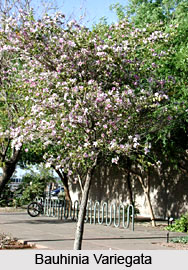
 The `Mountain Ebony` tree is very a nice tree that has a rich and stimulating perfume, which fills the air of the whole surrounding area. The sight of this tree can make a person nearly breathless. The tree is known as `Bauhinia Variegata` to the scientists. It belongs to the family of `Leguminosae` and the sub family of `Coesalpinieae`. The tree is named in various ways in different languages. It is known as `Kanchan` or `Rakta Kamhar` in Bengali. The Hindi speaking people call it as `Kachnar`, `Koliar`, `Padrian`, `Gurial`, `Gwiar`, `Kurai` or `Kandan`. In Tamil, the names of the tree are `Segapu-manchori` and `Manthari`. In Telugu, it is called as `Mandari`. In England, the people named it as the `Mountain Ebony`, `Variegated Bauhinia` or the `Orchid Tree`.
Description of Mountain Ebony Tree
There are many species of Bauhinia. Amongst them, a lot are native to India. The most common of them are B. variegata, B. purpurea, B. acuminaia, B. monandra, B. tomentosa and B. racemosa. All of them have two common points. They have a spray of colour on one or more of their petals and also they have a united and twin-kidney formation of the leaves. The `Mountain Ebony` is one of the most beautiful amongst the Indian trees. The height of the tree is around 9-10 meter and hence can be called as a medium-sized tree. However, in some of the tropical countries, it becomes mature at only 3.5 or 4.5 meter. The bark of the tree is dark brown in colour and quite smooth. During the cold season, the leaves fall and at the same time the large, sweetly scented flowers appear. Some trees have the ability to retain their leaves on a few of the branches but on the other trees, the flower sprays borne only on the leafless branches. The large flowers grow in short sprays and bear two or three blossoms. The blossoms can be both from the ends of the branches or from the axils of the leaves.
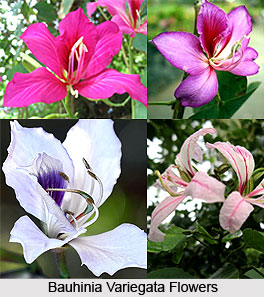 Each and every petal of the `Mountain Ebony` tree is veined precisely and one or two are soiled at the base with a deeper colour. The flowers of the tree can be of various colours like magenta, light purple, pink or white. Amongst them, the first three colours have some reddish markings and, the last colour contains a remarkable yellow splash on one or more of the petals. The pods are as much as 30 cm. in length and narrow. They also bear ten to fifteen seeds each. After the flowering season is over, in the month of May and June, the seeds develop. In dry season, the uneven tightening of the curvy edges force the pod to burst and spread out the seeds with a considerable power. The young pods, leaves and buds can be used as vegetables. The leaves of the tree are normally 7.5 to 15 cm in length and quite big in size. The streak scatter fan-wise from the base and the leaf remains folded along the centre rib.
Usage of Mountain Ebony Tree
The tree has some useful properties. A useful gum can be obtained from the tree and it can produce oil from its seeds as well. From the leaves of the tree, the wrappings paper can be made and the bark is used for tanning and collaring. It can be used as fibres also. The wood of the tree is of very good quality and reddish-brown in colour and is very strong. This is probably the reason behind the name of Mountain Ebony. This wood is used only for agricultural purposes and as firewood. In appearance, the `Purple Bauhinia` or `Geranium Tree` or `Butterfly Tree` is quite comparable with the `Mountain Ebony`. However, the flowers of this tree are usually lilac, deep rose or whitish in colour. Until the month of September, the flowers don`t appear and by the month of December, one can compare the greenish-purple long pods with the French beans. These flowers usually have five petals that are scraped or pointed. They are also smaller and narrower than those of the `Mountain Ebony`.
The dissident roots of the Purple Bauhinia are very poisonous. However, the bark of the stalks can be used as a cure for diarrhoea. They can be used for tanning and dying and in making fibres as well. Being a native of the Himalayan foothills, this tree more often grows wild than the `Variegated Bauhinia`, which is usually seen in gardens.