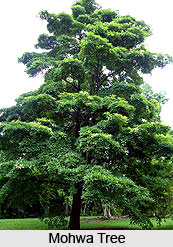
 The `Mohwa Tree` is considered to be one of the most important forest trees in India. This tree is famous to the scientists of the world as `Madhuca Latifolia`. It belongs to the family of `Sapotaceae` and posses quite a large number of names in various vernacular languages in India. The Bengali people named it as `Mohwa`, `Mahula`, `Banmahuwa` and `Maul`. In Hindi, it is called as `Mohwa`, `Mahua`, `Jangli-mona` or `Maul`. In Tamil language, the tree is known as `Kat-illipi` and `Illupai`. Its name in Telugu is `Ippa` and in Malayalam, people know it in the name of `Illupa`. Except the `Mohwa`, it is also called as the `Indian Butter Tree` in English.
The tree is capable of growing sufficiently. As people can store the flowers of this tree almost forever, the `Mohwa Tree` is very much popular in Central India. There, the flowers provide the inhabitants their most important article of food. The tree not only grows in the coastal districts but also prefers the dry, rocky hill-regions. In those regions, it is cultivated extensively and it also comes up self-sown. It is a large shaped tree and it shades its foliage at the end. It contains a thick and grey coloured bark. The bark is cracked and wrinkled vertically. From the months of February to April, most of the leaves of this tree fall down and the scented flowers appear during that time. The flowers hang in close bunches of a dozen or so from the end of the gnarled and grey coloured branchlets. When a bunch turns up, the flower stalks become adequately firm to maintain their position.
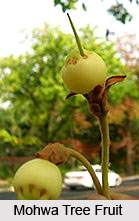
The stalks of the `Mohwa Tree` are green or pink in colour and hairy. They are about 5 cm in length. The plum-coloured calyx is also downy and it is divided into four or five lobes. The thick, juicy and creamy white circular corolla lies within the lobes. The yellow anthers of the tree can be seen through little eyelet holes at the top. The very short stamens remain stick to the inner surface of the corolla. The long pistil is like projecting a green coloured tongue. The tree usually blooms at night and at dawn all the short-lived flowers fall down to the ground. The fruit of the tree opens a couple of months after the flowering period. They are quite large in size and ample, green berries. They contain from one to four glossy and brown coloured seeds.
 The new leaves sprout at such a time when there are still flowers on the tree. They rise in close whorl from the tips of the branches. They add some gorgeous shades of rust and crimson above the flowers. The `Mohwa Tree` at this time looks exceptionally decorative. The young leaves are normally furnished with soft down, but within a short period of time, they become smooth and polished-looking. After some days, they turn dark green in colour. The assembly of the edible `Mohwa` flowers is an important business to the country people. The neighbouring families of the tree sweep up the blooms below the tree and put them out to dry on hard, flattened earth, near their shelters.
If the people can prepare the flowers properly, they taste very deliciously that is comparable to the pressed figs. People do often mix them with other food like the Sal seeds or leaves of other plants. They can also be used to make puddings and sweetmeats as well as Sugar. They can be purified into spirituous liquor also. This liquor is an awfully strong drink and has similarity with gin in taste, but spoilt by its strong and unpleasant odour. Both the ripe and unripe fruits of the `Mohwa Tree` are valuable. All parts of the fruits can be used. People eat the outer coat as a vegetable and dry the inner one and ground into meal. Yellowish thick oil obtained from the kernels gives the tree the name of `Butter Tree`. The tribal people of the jungle use this oil largely for cooking or else sold for making soap and candles. The rest can make good manure and is broadly used on lawns as worm eradicator. Amongst the animals, the deer and bears love the fallen flowers and they won`t mind of coming for miles to have the chance of getting past the alert night guards and making a meal. Birds, too, enjoy them and can often be seen around the trees at sunset and dawn.
A thick, milky sap can be exuded from the cut flowers, stems and branchlets and this sap is very sticky and astringent. People use them for curing rheumatism. There are many plants with a milky secretion that are poisonous. However, the `Mohwa Tree` certainly cannot be calculated amongst them. The wood of this tree is hard and heavy and works easily. People occasionally use this for furniture making. The tree has very valuable aspects in medicines as well. The bark is used to cure leprosy and to heal wounds and the flowers are prepared to relieve coughs, biliousness and heart-trouble. The fruit can also be used in the cases of blood diseases.