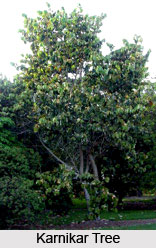
 Named as `Pterospermum Acerifolium` in science, the `Karnikar Tree` is normally a very nice and tall tree. The name `Pterospermum` derived from two Greek words, `Pteron` and `Sperma` that mean "winged seed". The name of its family is `Sterculiaceae`. Being very famous in the name of `Kanak Champa` in Bengali, the tree is known as `Kanak champa` or `Kaniar` or `Katha Champa` in Hindi. The tree is also known as `Bayun` in Malay. The origin of this beautiful tree is in the Northern parts of India, Assam and Burma. It remains a slim and high tree in those areas, but in further South, it fails to achieve a great height.
As the tree contains very large sized flowers and leaves, it looks outstanding and can become evergreen as well. The leaves of the `Karnikar Tree` are pale grey in colour underneath it. When the wind spins and twists them on their long stalks, they look most prominent. The bark of the tree is also grey in colour and soft. The twigs are feathery and are of rusty-brown colour. At the young age, the leaves also have this downy covering and when they develop, the covering drops on. A fully matured leaf can achieve the maximum length of 35 cm. They are almost the same in width as well. They have some margins in themselves and the margins are wavy or sometimes bear lobes. The lobes terminate in a point occasionally. They are rough and leathery and dark green at the top. They are silvery below the down gets dense clothing.
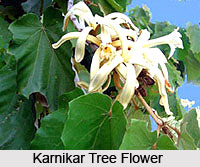 The velvety flower calices bear an ochre or khaki shade. At the beginning they are seen as long and uneven buds, but ultimately they crack into five slender sepals. The sepals curve elegantly back and release the creamy white petals. These petals curl and bend around the cluster that bears white and gold stamens. From the months of February to May, the flowers start to spread a delicate fragrance that remains for a long time even after they fall down and become dry. The fruit of the `Karnikar Tree` is like a hard capsule. They sometimes get the length of 15 cm. It has a covering of rough, brown hairs and it is also divided into five sections. The fruits take quite a very long period of about one year to get matured properly and after ripening, the sections of the fruits split open and release a large number of winged seeds.
The Indians consider The `Karnikar Tree` as a valuable tree as it has some important uses. The large, round leaves of this tree can make fine plates and can also be used to wrap up something. People lay down the leaves on roof boards under the thatch and thus make a strong `felt` and they also use the down from the under-surface in order to stop bleeding. The flowers of the tree have their respective medicinal uses as well. A good tonic can be prepared from them and can be used as a cure for inflammation, ulcers and tumours. Not only this, if you keep them among your clothes, they will impart a pleasant perfume and also keep away the insects. The Hindu people use them for their religious purposes. The timber of the `Karnikar Tree` is not very firm but is quite durable and people use this for planking, boxes, spars, etc.