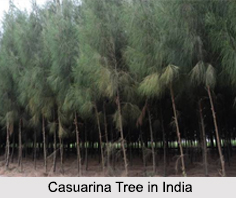
 Scientifically known as Casuarina Equisetifolia and the very term Equisetifolia suggests that leaves of the casuarina trees are like a horse`s mane or tail. The casuarina trees belong to the family of Casuaranaceae. In Hindi language, it is called as `Jungli Saru` or `Vilayati Saw` or `Jungli Jhao`. The Bengali people know it as `Belati Jhao`. In Tamil language, its name is `Chouk Sabuku` and in Telugu language, it`s `Serva`.
Description of Casuarina Tree in India
The Casuarina Tree is a large fast growing evergreen tree that has small cones and big, straight stem. This tree is a quick-growing one and attains a height of about 40 m and has a diameter of about 60 cm. The tree is short lived and its natural span of life seldom exceeds 50 years. The casuarina tree is a hardy tree and the sandy-soil of the sea-coast areas is most suitable for the tree. It grows well in both Southwest and North East monsoons.
Cultivation of Casuarina Tree in India
The casuarinas tree has been cultivated all through the South India to retrieve the sandy seashore. In the North Kannada and particularly along the Coromandel Coast, it grows extensively for fuel. It can make a good, solid hedge if one plants it closely and keeps it low. People in the coastal districts and inland regions often use this tree as a roadside or garden tree as it is an enormously decorative and useful tree. In fact gardeners cultivate it as a hot-house plant to meet the decorative purposes only.
The casuarinas trees are commonly known as sheoak, ironwood or beefwood and commonly grown in the tropical and subtropical areas. The trunk of the tree is strong and it is branched and clothed with uneven bark. The wood of this tree is used commercially for shingles or fencing, and is said to make excellent, hot burning firewood. The casuarina tree can tolerate extreme temperatures sometimes exceeding up to 47 degree Celsius. The trees have nitrogen fixing root nodules and hence dependability on nitrogen supplement is less.
Flowers of Casuarina Tree in India
The flowers appear twice a year in the periods of February to April, and again after 6 months and are generally unisexual. The male flowers are cylindrical mortal spikes and the female flowers have dense heads that lie in the axils of the branch lets. One can usually see these heads in groups. They are like small buds that are covered with twisted and dark red fur. The "bud" enlarges and become a cone-shaped tool and the red hairs fall down. The cones are round or oblong and about 2.5 cm across. They are also consisting of several pointed sections that do not overlap as in a fir cone.
Uses of Casuarina Tree in India
The wood of the Casuarina Tree is solid and as the grain is uncertain, the Indian carpenters are almost unable to work with this. It also breaks and splits very easily and for this reason, it is more suitable for beams or posts than floorboard. However, it does not last long underground. The tree is mainly used as fuel and to do so, people cut it when it is 10 to 12 years old. However, if the tree is left until 20, then it could be more useful. The bark of the tree is normally used for tanning and dyeing fishermen`s nets. It can be used as a tonic and in the treatment of stomach complaints as well. The root extracts of the casuarina tree are used for the treatment of dysentery, diarrhoea and stomach-ache.
Casuarina Trees in India
The casuarina tree in India is an evergreen tree that resembles a coniferous tree.