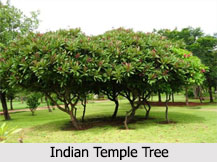
 Scientifically known as Plumeria Rubra, the Indian temple Tree is a perfect example of what is called copious beauty. Belonging to the Apocynaceae family of the Plumeria genus, the India Temple Tree is widely cultivated in subtropical and tropical climates worldwide. The Indian Temple Tree is a popular garden and park plant, as well as being used in temples and cemeteries.
Common Names of Indian Temple Tree
The Indian Temple Tree is known by different names in different languages. In Hindi, it is called as `Gulachin`, `Gobur champ`, `Chameli` or `Golanchi`. In the eastern states, the people of Bengal know it as `Dalana Phul` or `Gorurchampa`. In Tamil, it is called `Llattelari`, `Kallimandarai` and `Perungalli`. The Telugu people named it as `Arhataganneru` or `Nuruvarahalu`. Singhalese know it as `Avariya`, while in English it is known as `Jasmine Tree`, `Dead Man`s Flower`, `Life Tree`, `Frangipani`, `Crimson Temple Tree` or the `Pagoda Tree`.
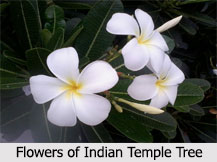 There are other species of the Indian Temple Tree known as the Plumeria Alba which is a native of the West Indies. It has yellow-eyed white flowers and long leaves that do not have the typical marginal vein. Then there is the Plumeria Obtus which is an evergreen species with large and dark leaves. These leaves are blunt ended and also have margins tending to roll under. The pure white flowers of these trees are much larger than any of the other species described and are less funnel-shaped. Lastly is the Plumeria Kubra which is also known as the Red Frangipani and Red Jasmine. This is a smaller tree that has leaves not more than 22.5 cm long. The red flowers have glowing yellow centres with an exhilarating perfume.
Legend of Indian Temple Tree
The Indian Temple Tree is possibly the most recognizable and broadly grown amongst all the trees that can be found in India. These trees have some very sweet-scented exotic flowers. The flowers remain in these trees for almost throughout the year. Because of its amazing power of blossoming leaves and flowers even after being uprooted from the soil, both the Buddhists and Islamic people think the tree as a symbol of immortality. Hence, the Indian Temple Tree is repeatedly planted near temples and in graveyards.
Description of Indian Temple Tree
The Hindus use the flowers of the Indian Temple Tree to worship and to dedicate offerings to their Gods. Indian Temple Tree is a low and spreading tree with large plants. It rarely attains more than 6 m in height. From the month of December till the rainy season, the tree remains leafless. Though very rare, but sometimes it becomes flowerless as well. These things only happen to the older mature trees. The young trees never lose their flowers or leaves and remain at the top of their beauty throughout the year.
If someone injures any part of the tree, then a white, latex-like juice flows from that part. In Sanskrit, this characteristic is called as `Kashira- champa` that means "milky champa". From the end of the branch graceful and rose-tinted stalks arise that are fleshy but fragile. Each and every funnel-shaped flower of the tree grows up to 5 cm across. The flowers have five overlapping petals each. They are generally oval with one margin curled under. The stamens are deeply inserted in the corollary tube and hence not quite visible clearly. The leaves of the Indian Temple Tree are unique and are normally about 30 cm in length and also smooth and narrow.
Uses of Indian Temple Tree
The Indian Temple Tree has numerous uses. To counter irritant for rheumatism, people use the milky sap of the tree. In conjunction with sandalwood oil and camphor this milky sap is also a cure for itch. People from different parts of the world also use the bark of the Indian Temple Tree to relieve fever, heal sores and to make plaster in order to reduce tumours. If heated, the leaves of the tree can relieve puffiness; and getting together with the flower buds, they can make a febrifuge as well. The tree does not have much timber value, as it is very small.