Papaya Tree is considered as a short lived tree of India. The scientific name of Papaya tree is `Carica Papaya` and this tree belongs to the family of `Cariaceae`. Moreover, Papaya tree has several other names in different regional languages of the country. Like for instance, in Hindi language and Bengali language it is called as Papaya or Papita. Tamil speaking people call it as Pappali and in Malayalam language, papaya tree is known as Omakka. Further, papaya tree also possesses other names in English too and these names are Papaw and Tree Melon. Papaya tree is a native of tropical America but today it has become common in most parts of the east.
Papaya tree is basically a massive plant of the country and it also lacks enduring woody stem. Interestingly, papay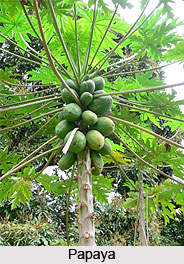 a tree has a remarkably quick growth. This tree usually bears fruits within a year of planting. It continues to bear them in great quantities that at times declining becomes necessary. Papaya tree is a small tree containing soft wood. Its leaves are huge and are of palm-shaped. These leaves stay on long, empty stems forming a palm like cluster at the top. The neutral Papaya trees are known for producing both male and female flowers and bearing good fruit.
The Botanists also proved that the pollen of hermaphrodite flowers does fertilise the female flowers. The flowers are of pale yellow colour. The male flowers grow in firm clusters of small and perfumed blossoms. The blossoms joined closely on to long, relaxed stems during flowering, the male papaya creates a gorgeous sight. This time some dozens of creamy sprays cascade from amongst the leaf stalks. The female and neutral flowers are larger in size and grow separately against the main stem. The fruits of the papaya tree are in general similar to a melon. They remain within a soft, slender, green coloured skin. Later, the skin turns orange-yellow in colour. The fruits are a mass of luscious, salmon-pink flesh. The fleshy mass is enclosed in a large and sometimes five-angled cavity. To the walls of this cavity, several round, wrinkled, black seeds remain attached. The size of the seeds is like a small pea. The leaves of this tree are large and smooth and about 30 to 60 cm in length. They are rectangular and pointed and also divided into eight crowded segments. Some of them are sub-divided and all the leaves are very deeply lobed.
Uses of Papaya Tree
Milky latex that is obtained from the unripe fruit of the papaya tree has numerous medicinal uses and people consider this as one of the best vermifuges. `Papain` is also made from the latex and is used as an ingredient in manufacturing the chewing gum. Some people claim that this milky juice has the exceptional property of hastening the decay of muscular fibres. All parts of the tree have some medicinal properties. The vapours of the papaya tree are also claimed to have separate muscular fibres. The mature fruit is considered to be good for digestive troubles and skin diseases. The seeds are also used as vermifuges. People use the unripe fruit in curries.