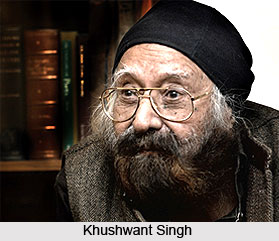
 Khushwant Singh was an illustrious storywriter, historian, political writer, essayist biographer, translator novelist and journalist. Since independence he has been the country`s most well- known English writer. In Indian literary history Khushwant Singh`s name is bound to evolve as one of the finest historians and novelists, a forthright political commentator, and an outstanding observer and social critic. He is attributed with freethinking. Kushwant Singh`s comparisons of social and behavioural characteristics of Indians and Westerners are the examples of his acid wit. He brought history to our doorsteps and quite ideally therefore India describes him as "The Capital`s best known living monument". Apart from his literary works, his roles as a lawyer, diplomat, critic, journalist, novelist, humorist, naturalist and politician made Khushwant Singh a man larger than life
Early Life of Khushwant Singh
Khushwant Singh was born on 2nd February, 1915 at Haldi in Punjab. This place is presently in Pakistan. His father, Sir Sobha Singh was a prominent builder in Lutyens` Delhi. He took his early education from The Modern High School and St. Stephen`s College, New Delhi. He passed his graduation from Government College, Lahore and then became barrister from King`s College, London. While he was practising in the Lahore High Court in 1947 he had to come to his family`s summer cottage at Kasauli in the foothills of the Himalayas following the partition of India and Pakistan.
 Career of Khushwant Singh
Khushwant Singh was practicing law in the High Court in Lahore before the partition of India and Pakistan. He joined the Indian Ministry of External Affairs in 1947 after the country became independent. Khushwant Singh became the Information Officer of the Government of India, stationed in Toronto, Canada. His trajectory soon led him to assume the pivotal roles of Press Attaché and Public Officer for the Indian High Commission, serving with distinction in both London and Ottawa for a span of four years. The year 1951 marked a significant juncture as Singh`s path intersected with the realm of journalism when he joined the All India Radio, contributing to the dissemination of information to the masses
Between 1954 and 1956, his career took an international stride as he engaged with the Department of Mass Communication under the auspices of UNESCO, headquartered in Paris. With the year 1956 ushering in a new phase, Singh pivoted towards editorial services, carving out a prominent niche for himself. His editorial prowess bore fruit in the form of Yojana, an official government journal, which he founded and edited during 1951–1953.
Among his significant contributions was the establishment and editorial oversight of "The Illustrated Weekly of India," a newsweekly that swiftly ascended to become the pre-eminent newsweekly in the nation. Singh`s astute leadership saw the publication`s circulation soar, transcending from 65,000 to an impressive 400,000. Singh also lent his editorial guidance to "The National Herald," leaving an indelible imprint on the Indian media.
Singh`s editorial acumen led him to become the editor of the prestigious "Hindustan Times," a position he assumed based on the personal recommendation of Prime Minister Indira Gandhi. During his tenure at the helm, "The Illustrated Weekly of India" attained unprecedented heights of influence and readership, becoming a stalwart in India`s media landscape.
However, the culmination of Singh`s tenure at "The Illustrated Weekly of India" in 1978 took an unexpected turn. Just a week prior to his planned retirement, the management abruptly requested Singh`s immediate departure, subsequently appointing a new editor on the same day. This abrupt transition had an adverse impact on the publication`s readership, leading to a substantial decline.
In 2016, Singh`s enduring contributions were recognized and immortalized when he found his name inscribed in the Limca Book of Records. This honor stood as a tribute to his remarkable legacy in the realm of Indian media. He also served UNESCO in Paris.
 Political Career of Khushwant Singh
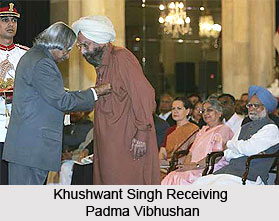
From 1980 to 1986, he was a member of Rajya Sabha. Although it covers a very small period of time yet it reflects his courageous spirit. Recognizing his valuable service to the nation, Singh was honored with the Padma Bhushan award in 1974. However, his principled convictions led him to take a remarkable step in 1984 when he returned the Padma Bhushan award as a mark of protest against the military operation at the Golden Temple by the Indian Army. In 2007, his enduring impact on Indian society and politics was further recognized through the conferment of the Padma Vibhushan by the Indian government.
Singh remained steadfast in his optimism about the potential of Indian democracy. He channeled his efforts through the Citizen`s Justice Committee, an initiative spearheaded by H. S. Phoolka, a senior advocate of the Delhi High Court. This dedication to justice and accountability underscored Singh`s commitment to upholding the principles of democratic governance.
Khushwant Singh`s advocacy extended to matters of international diplomacy as well. He emerged as an advocate for enhanced diplomatic relations with Israel, even at a time when India treaded carefully to maintain favorable relations with Arab nations, which were significant employers of Indian expatriates.
Literary Works of Khushwant Singh
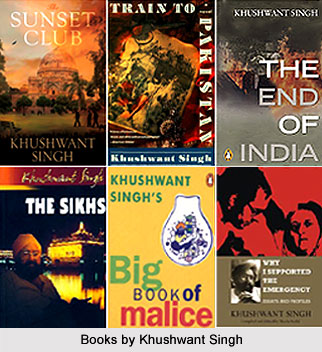
Khushwant Singh`s literary works strongly reflected contemporary satire and political commentary. Many of them are also the translations of Urdu poetry and Sikh religious texts. The experience of his journey to his family`s summer cottage at Kasauli in the foothills of the Himalayas later reflected into his write ups. He had narrated his arrival at Kausali in a jeep of armed Sikhs who were talking in a self-admiring way about the massacre of a Muslim village by them. His experience also resulted in the novel "Train to Pakistan" in 1956. He distilled his experience in the novel powerfully. This book won him the international fame and the Grove Press Award in 1954. His work "Maharaja Ranjit Singh" and comments on Bhagwat Gita reflect his secularist views. Other best-known novels of Singh are "Delhi" and "The Company of Women". He was also amongst the last remaining writers who personally knew the stalwarts of Urdu and Punjabi literature.
Personal Life of Khushwant Singh
Khushwant Singh was married to Kawal Malik and the couple was blessed with a son, Rahul Singh, and a daughter Mala. He resided at Sujan Singh Park in Delhi, which is credited as the first apartment complex and was constructed in 1945 by his father. It was named after his grandfather. His grandniece Tisca Chopra is a noted TV and film actress. Singh`s youngest brother was Delhi MLA Daljit Singh.
Death of Khushwant Singh
Khushwant Singh breathed his last on 20th March 2014, at the age of 99, at his Delhi residence. He was suffering from respiratory disorder.
Awards and Honours of Khushwant Singh
| Awards and Honours | Year |
| Rockfeller Grant, | 1966 |
| Padma Bhushan, Government of India (He returned the decoration in 1984 in protest against the Union government`s siege of the Golden Temple, Amritsar) | 1974 |
| Honest Man of the Year, Sulabh International | 2000 |
| Punjab Rattan Award, The Government of Punjab | 2006 |
| Padma Vibhushan, Government of India | 2007 |
| Sahitya academy fellowship award by Sahitya academy of India | 2010 |
| "All-India Minorities Forum Annual Fellowship Award by Uttar Pradesh Chief Minister Akhilesh Yadav | 2012 |
Books Written by Khushwant Singh
| Books | Year |
| Ghadar 1915: India`s first armed revolution | 1966 |
| A History of the Sikhs, (2nd edition) | 1966 |
| A Bride for the Sahib and Other Stories | 1967 |
| Black Jasmine, | 1971 |
| Tragedy of Punjab | 1984 |
| Delhi: A Novel | 1990 |
| Sex, Scotch and Scholarship: Selected Writings, | 1992 |
| Not a Nice Man to Know: The Best of Khushwant Singh | 1993 |
| We Indians | 1993 |
| Women and Men in My Life | 1995 |
| Uncertain Liaisons; Sex, Strife and Togetherness in Urban India | 1995 |
| Declaring Love in Four Languages, by Khushwant Singh and Sharda Kaushik | 1997 |
| The Company of Women | 1999 |
| Truth, Love and a Little Malice (an autobiography) | 2002 |
| With Malice towards One and All (Weekly Column) | |
| The End of India | 2003 |
| Burial at the Sea | 2004 |
| Paradise and Other Stories | 2004 |
| A History of the Sikhs: 1469-1838 | 2004 |
| Death at My Doorstep | 2005 |
| A History of the Sikhs: 1839-2004 | 2005 |
| The Illustrated History of the Sikhs | 2006 |
| Why I Supported the Emergency: Essays and Profiles | 2009 |
| The Sunset Club | 2010 |
| Agnostic Khushwant Singh, There is no GOD | 2012 |
| The Good, the Bad and the Ridiculous, (Co-authored with Humra Qureshi) | 2013 |
Short Stories by Khushwant Singh
| Short Stories |
| The Mark of Vishnu and Other Stories |
| The Voice of God and Other Stories |
| A Bride for the Sahib and Other Stories |
| Black Jasmine |
| The Collected Stories |
| The Portrait of a Lady |
| The Strain |
| Success Mantra |
| A Love Affair In London |