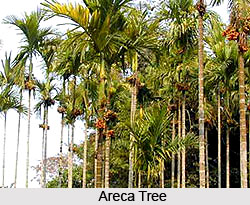
 The elegant and gracefully beautiful tree that is known as `Areca Catechu` to the world of scientists is the `Areca Tree`. The name `Areca` is a variation of the Tamil word that means "a cluster of nuts" and `Catechu` is a Malayan word. This tree belongs to the family of `Palmae`. It is known as `Supari` in both the languages of Hindi and Bengali. In Tamil, it is called as `Kamugu` and `Paku`. It is `Pokavakka` in Telugu. Except the `Areca`, the tree is also named as `Betel-Nut Pal`, `Supari Palm` and `Pinang Palm` in English.
There is a certain probability for the tree to be originated in Malaysia. However, it is now cultivated in all the hot, damp coastal regions of Asia and has a wide distribution in India. It is very common in South India. The `Areca Tree` can rise up to 18 or even 30 m. It has a girth of only 45 cm. It bears a crown of long, feathery leaves at the summit of its slender, branchless stem. The leaves surround the lovely, floppy clusters of shining red fruit. You can often see these palms in clumps of a couple of dozen plants together with the few small leaves of several new growths. The flowers appear early in the year. In the beginning, they are enclosed in soft, double sheaths. The bases of the sheaths partially enfold the trunk. Bursting from their sheaths the much-branched sprays reveal both male and female flowers. The female flowers are solitary at the axils and also at the bases of the branches and the male flowers remain in great numbers above them.
 The slim grey coloured stem is ridged with the scars of fallen leaves and crowned by a polished area of green or orange colour. From this area, the bunch of graceful, arched leaves rises. The leaves of the `Areca Tree` bear a large number of dark green leaflets on each side. The leaflets are long, narrow and pointed and lye in one plane like the coconut leaflets. However, they differ from those in some points as they are less rigid and are often seen with the tips bending downwards. The centre rib of the leaflets is so strong that, when it is dry and expanded, it forms an excellent ready-made splint.
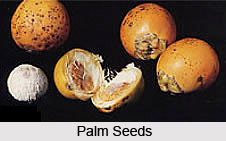
The chewing of the palm seeds is considered to sweeten the breath, strengthen the gums and tone the digestion. It also has a mildly narcotic effect and can produce a numerous flow of brick-red saliva that stains the teeth and gums. The gum known as `Cutch` is an extract from the red-heart-wood of the `Areca Tree`. The gum is extremely astringent. Another form, known as `Kath` is a pale, biscuit-like substance and it is obtained from the white heartwood of the same tree. People prepare this carefully and it carries comparatively high prices. A fibrous ring lies within a smooth, orange or scarlet outer covering. This ring bears the seed. A tree begins to bear fruits at the age of its five if it is grown in the open places. However, the other trees take much long time. A good specimen of the tree will produce as many as three hundred nuts annually and has the capability to continue to do so for about 25 years. There are some other uses for these prolific nuts as well. If you burn them to charcoal and they are powdered, they make a good dentifrice. A preparation made from them in powder form checks dysentery arising from debility. They are also used in making necklaces, the knobs of walking sticks and in other small articles. The wood of the tree can make bows and spear handles and the trunk forms a good staging pole. The sheaths that enfold the young leaves are used by the people as wrapping like brown paper and also as writing paper.