 Lucknow is known as the `City of Nawabs". It is the capital city of Uttar Pradesh, the most populous state of India. The city served as the capital of the Nawabs for a long time and they have been responsible for bestowing on the city a fine culture, superb architecture and delectable cuisine. Lucknow city is the administrative headquarters of Lucknow District and Lucknow Division.
Location of Lucknow
Lucknow is located in the historical region known as the Awadh along the banks of the Gomti River and has been the capital of the Nawabs since its foundation by Nawab Asaf ud Daulah. It was the rule of the Nawabs which imparted to Lucknow the courteous culture as well as the mouth-watering delicacies for which it is famous today. Courtly manners, beautiful gardens, poetry, music, and fine cuisine promoted by the Persian-loving Shia Nawabs of the city are the common traits that depict the Indian city of Lucknow. Lucknow is a centre of Hindi literature and Urdu literature and is the second largest city in Uttar Pradesh, after Kanpur. Lucknow is also the administrative headquarters of Lucknow District and Lucknow Division.
History of Lucknow
The ancient history of Lucknow is believed to begin after Lord Rama decreed his younger brother Lakshmana to establish a town at the present site of Lakshman Tila. Lucknow was named Lakshmanpuri, Lakhanpuri, or Laknamau after him. Slowly the name Lakhanpuri became `Lakhnau` and was then re-named `Lucknow` by the British. Since 1350, Lucknow and parts of the Awadh region have been under the rule of the Delhi Sultanate, the Mughal Empire, the Nawabs of Awadh, the British East India Company and the British Raj. Lucknow has been one of the major centres of the Sepoy Mutiny, 1857, participated actively in Indian Freedom Struggle, and after Independence has emerged as an important city of North India.
Geography of Lucknow
 Lucknow is located in the heart of the Indo Gangetic plain and surrounded by rural towns and villages. It is bounded on the east by the Barabanki District, on the west by the Unnao District, on the south by the Rae Bareli District and on the north by the Sitapur district and Hardoi district. The Gomti river runs a meandering course through the city and divides it into the Trans-Gomti and Cis-Gomti regions. The city enjoys warm subtropical climate with cool, dry winters from December to February and dry, hot summers from April to June. The rainy season starts from mid-June to mid-September, when Lucknow experiences an average rainfall of 1010 mm mostly from the southwest monsoon winds. In winter the maximum temperature is around 21 degrees Celsius and the minimum is in the 3 to 4 degrees Celsius range. The majority of Lucknow`s population includes people from eastern Uttar Pradesh.
Administration of Lucknow
Lucknow is the political and administrative capital of Uttar Pradesh. The city falls under the jurisdiction of the District Collector who is an IAS. The Collectors are in charge of property records and revenue collection for the Central Government, and oversee the national elections held in the city. The Collector is also responsible for maintaining law and order in the city. The city is administered by the Lucknow Municipal Corporation with executive power vested in the Municipal Commissioner of Lucknow also called the City Mayor. An Assistant Municipal Commissioner oversees each ward for administrative purposes. The Police Department of Lucknow is headed by an Inspector General, who is an Indian Police Service (IPS) officer. The Lucknow Police comes under the state Home Ministry.
The city elects members to the Lok Sabha as well as the Uttar Pradesh Vidhan Sabha (State Assembly). Lucknow has two Lok Sabha Constituencies named Lucknow and Mohanlalganj.
Demography of Lucknow
The census of 2011 shows Lucknow has a total population of 4,588,455. Out of them male and female were 2,407,897 and 2,180,558 respectively. The majority of Lucknow`s population comprise people from Central and Eastern Uttar Pradesh. However, Bengalis, Punjabis and Anglo-Indians have also settled in large numbers. Hindus comprise about 71% and Muslims about 26%. Rest 3% are small groups of Sikhs, Jains, Christians and Buddhists.
 Economy of Lucknow
Lucknow is a major market and trading city in northern India as well as an emerging hub for the producers of goods and services. Since Lucknow is the capital of the state of Uttar Pradesh, the majority of the people are engaged in Government Departments and Public Sector undertakings. A number of personnel from the IT companies are recruited from the city. The city is the headquarters of a number of business-promoting institutions such as the Small Industries Development Bank of India (SIDBI) and the Pradeshiya Industrial and Investment Corporation of Uttar Pradesh (PICUP). Liberalisation has created a lot of opportunities in the business and service sector and the number of self-employed professionals is on the rise in the city.
Tourism in Lucknow
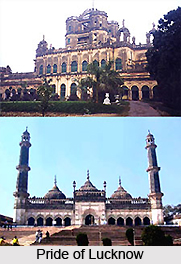
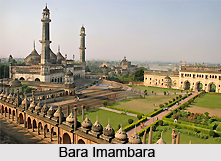
There are a number of tourist attractions located in the city of Lucknow. Most of these monuments and constructions have been the endowments of the various Nawabs of Awadh who held sway here in the city. The Bara Imambara, the Chhota Imambara, The Residency and Shah Najaf Imambara are the popular monuments of architectural importance drawing thousands of tourists round the year. The famous `Bhool Bhulaiyan` (Labyrinth) is part of Bada Imambara complex. Some other places of interest are the Chattar Manzil, Picture Gallery, Lucknow Zoo, Shaheed Smarak, Planetarium, Ambedkar Memorial, Dilkusha Palace, Baradari and Ram Krishna Math.
Lucknow has succeeded in retaining the old world charm while at the same time supporting a modern lifestyle. Regarded as one of the finest cities of India, Lucknow represents a culture that includes emotional warmth, a high degree of class, courtesy, and a love for gracious living. This sublime cultural richness famous as Lakhnawi Tehzeeb combines the cultures of two communities living side by side for many centuries, thus sharing similar interests and speaking a common language. Lucknow is also known as the Golden City of the East, Shiraz-i-Hind and The Constantinople of India.
Lucknow - Uttar Pradesh
Lucknow, the capital city of Uttar Pradesh is regarded as the City of Nawabs