Hindu Gods, Hinduism - Informative & researched article on Hindu Gods, Hinduism
  Indianetzone: Largest Free Encyclopedia of India with thousand of articles Indian Religion


in  
Art & Culture | Entertainment | Health | Reference | Sports | Society | Travel
Forum  | Free E-magazine
Indian Religion : Vastu Shastra l Indian Religions l Indian Myths l Indian Mythology l Gods of India l Goddesses Of India l Religious Thinkers of India l Types of Religion in India l History of Indian Religion l Indian Yogis l Ajivikas l Sacred Scriptures in Indian Religion l Tantrism l Shaivism l Indian Communities l Sacred Animals in India l Roman Impact on South Indian Art and Society l Bhattacharyas l Indian Classical Terms
Home > Society > Indian Religion > Types of Religion in India > Hinduism > Hindu Gods
Hindu Gods, Hinduism
Hindu Gods concept evolved in accord to the cosmic activity of the Supreme Being. The Hindus declare that there is only one Supreme Being and He is the God of all religions.
  Lord Agni   Lord Brahma   Gautama Buddha
  Lord Dhanwantari   Lord Ganesha   Lord Hanuman
  Lord Jagannath   Lord Kartikeya   Lord Krishna
  Lord Kuber   Lord Narad   Lord Rama
  Lord Shiva   Lord Surya   Lord Vishnu in Rig Veda
  Lord Vishwakarma   Lord Yama   Kama Deva
  Lord Budha   Chandra   Chaturmurti
  Chitragupta   Lord Indra   Lord Hayagriva
  Lord Dakshinamurti   Krishna Gopala   Adyas
  Lord Ayanar   Chakshushas   Marichigarbhas
  Vetal   Rudra   Sutapas
  Susravas   Bhrajiras   Kama Deva
  Dattatreya   Deva   Nilalohita
  Nirmanaratis   Nirrita   Upendra
  Dhritavrata   Parjanya   Dhata
  Padmanabha   Purandara   Pushan
  Ritadhwaja   Jayanta   Jayas
  Kamagamas   Kandarpa   Kanishtas
  Kartikeya   Kattan   Kuladevata
  Kusumayudha   Lohitas   Sadhyas
  Saktinath   Sakra   Sambhu
  Daityas   God Baldev   Apa
  Lord Varuna   Birappa   Charanas
  Lord Mahadeva   Manu   Nilalohita
  Lord Vayu   Infernal Deities    

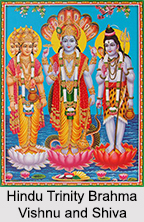
Hindu Gods, brahma vishnu shivaHindus throughout history have formulated many different names and forms for the Divine or Eternal. Among the various Hindu Gods, Lord Brahma brings forth the creation and represents the creative principle of the Supreme Being. Lord Vishnu is the representative of the universe and the eternal principle of preservation. Lord Shiva represents the principle of dissolution and recreation. The Hindu Trinity Brahma, Vishnu and Shiva are the main worshipped Gods in Hinduism.

Hindus have assigned many names to the Hindu Gods since time immemorial. The practice of giving many names indicates an intimate knowledge of the religion itself. The different deities of Hinduism reflect such an intimate realization of the Divine.

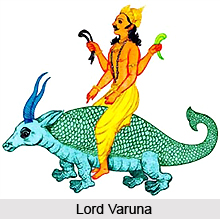
Lord Varuna
Furthermore, the people of India also worship the god of water and ocean called Lord Varuna. He is the source of water, which sustains life, the water in the rivers, sea and oceans, and even the rains that fall, and at times causes floods. Lord Varuna rides on Makara, his mount, or a type of holy sea-creature.

Lord Kartikeya
The origin of Lord Kartikeya, the symbol of masculine might, has link with the desperation of Gods for the birth of the much-awaited son of Shiva, who could obliterate the ghastly demon, Taraka.
Lord Brahma
He is the God of Creation, an important parivara or family deity among the Hindus. He is seen with four heads representing four Vedas, which is also called the four `Yugas`. Seated on a lotus, Lord Brahma`s `vahana` is the swan. It is believed that he was born from the naval of Lord Vishnu at the end of one cycle to start a fresh cycle. Myth has it that Lord Shiva cursed him that he would not be worshipped and it is evident from the fact that there are no temples to worship him.

Lord Vishnu
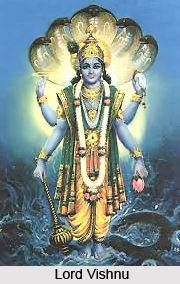
He is the God of maintenance, protection and sustenance among the Gods of India. He was instrumental in introducing the souls into the cycle of life by Brahma sustaining them. He has ten avatars or incarnations which are Matsya avatar, Kurma avatar or Turtle, Varaha avatar or Boar, Narashima avatar or Lion, Vamana avatar or the Dwarf incarnation, Parashurama avatar. Lord Vishnu`s seventh incarnation is Lord Rama who is highly worshipped among the Gods of India. The eighth incarnation is Lord Krishna who is an important god in Hindu religion and the next is the Buddha avatar. The Kalki avatar is the final and the tenth incarnation of Vishnu. The last incarnation is still to come with the end of the Kali Yuga or the present age of decline.

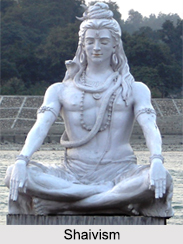
Lord Shiva
Lord Shiva is the God of destruction and is highly revered among the Gods of India. He is greatly worshipped in the form of `linga` or phallus that is built on a pedestal. Enormous energy of the creator is denoted by the `linga` which absorbs the creator Brahma, Vishnu and Gayatri Devi in its heart.
Lord Ganesha
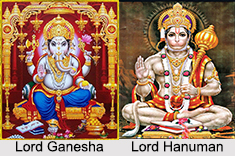
Lord Ganesha is one of the prime Gods of India who is worshipped at the commencement of any important action or venture, related with business or art. Known as Vigneshwara, he is known to remove all hindrances in the way. He is seen in the form of an elephant head in a human body, with four arms, a huge belly and a snake adorning it.

Lord Jagannath
This God is the name given to describe a deity form of Krishna. He is considered merciful and the oldest and renowned Jagannath deity at Puri in Orissa. The famous Rath Yatra or car festival is organized every year to mark Krishna`s home coming in Mathura. This acquires a huge dimension in Orissa where the wooden cart is pulled by thousands of pilgrims.
Lord Hanuman
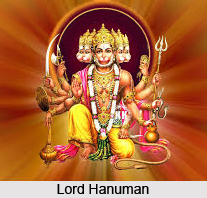
He is also known as Anjaneya and is among the most important Gods and Goddesses in the Indian epic Ramayana. He assisted Rama in recovering Sita from the captivity of Ravana and was blessed with enormous energy and power by the Gods.

Lord Indra
Another most important God of India is Indra who is known as the king of the Gods and the ruler of the heavens. He is a great warrior and he is also regarded as the God of rain and thunder.

Some of the major Goddesses of India includes Goddess Parvati, Goddess Kali, Goddess Durga, etc.

Goddess Parvati
Goddess Parvati is the most widely worshipped Goddess in India who is the manifestation of Shakti and is the Female Creative Energy of the Universe. Shakti is also related to Prakriti, the `material-nature` of Ishwara, which unites with Brahma, to give birth to everything around. Shiva, the Purusha or Male Productive Principle of the Universe, is believed to be in conjunction with the Prakriti, expressed in Parvati, which sustains the flow of life.

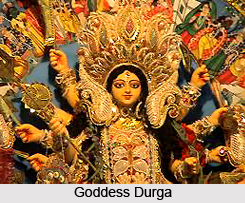
Goddess Durga
She is one of the shades of Parvati, and an expression of Shakti or Prakriti. Goddess Durga Universes Kind Mother and she is also Destroyer of Evil. This Goddess holds the Trishul, sometimes the sword, in her different images. One of the hands of this Goddess is displayed in Varadaa-Mudra or in a stance of giving boon to her true devotees. In the state of West Bengal, she is projected as an idol with ten arms. Each of the arms is carrying the weapons and articles, furnished to her by the other gods, for squelching the demon, Mahishasura.

Goddess Saraswati
Goddess Saraswati is the conferrer of wisdom and knowledge. The stringed musical instrument, called Veena, and the book, which she holds in her hands, attests her as the celestial Mistress of all kinds of learning, be it the creative arts (music) and scientific research, talent and skills.

Lord Agni
In India several natural objects are also worshipped and some of the natural objects are considered as the forms of Indian Gods and Goddesses. Lord Agni or Fire-god is a Hindu and Vedic Deva. This God is beneficent as well as destructive.

Lord of Wind
Pavan or Vayu, the god of wind or air, in Hinduism is mainly a deity which is worshipped. Similar to Agni, the God forms a part of the five tatvas or elements which are known as the Panchamahabhutas. In Sanskrit language, the word Vayu is related to the Latin word `Vita`, which means life.

(Last Updated on : 2/07/2011)
  More Articles in Hinduism
 
Aghora Vaishnavism Nath Siddhas
Sarvam Khalvidam Brahma Aham Brahmasmi Ayam Atma Brahma
Ekam Evadvitiyam Brahma Tat Tvam Asi Prajnaman Brahman
Brahma Satyam Jagan Mithya Mahavakyas Mahavidya Goddesses
Theory Of Creation Hindu Gods Hindu Goddesses
Shraadh Yajna Havan
Gotra Aarti Agnihotra
Devadasis Ishvara In Hinduism Devi
Grihya Sutras Dvija Hiranyagarbha
Brahman Cremation Puja
Janmotsava Shradh Anteshti Kriya
Homa Hindu Vrata Days of the Week
Ahalya Kachwaha Jyotirlinga
Brahmin Castes in India Panchangam Ashta Dikpalas
Astomi Brahmaloka Sannyasi
Samakara Hindu Sacred Places Origin of Hinduism
Hindu Religious Texts Hindu religious leaders Marudeva
Sarvesvara Lokas Papa
Maharudra Swahaakaar Yagna Conch Shell Punarjanam
Aghori Heaven Parting with money after sunset
Shraavana Sashtanga Kshama
Agrasya Sanskaras Libation
Kerari Kusha Maharajas
Chandrayana Bhagat Jiva
Devarshis Months of Hindu Calendar Varna System in Ancient India
Purohitas Hindu Rituals Pancharatra
Gorakhnathis Citta Ramanandi Sampraday
Omkara Cult of Draupadi in South India Development of Hinduism
Shaktism Places of Worship Mantra
Hindu Iconography Teachings of Hinduism Kalpa Sutras
Saura Goddess Tara in Hinduism Vaikhanasa
Recently Updated Articles in Indian Religion
  • Life of the building
    Vastu Shastra provides exhaustive information about the life of a building.
  •  
  • Basement
    Vastu shastra recommends certain tips for the construction of the basement.
  •  
     
  • Tips for Purchasing a Flat
    Tips for Purchasing a Flat, as suggested by Vastu Shastra, an ancient Indian science for construction, will lead to prosperity and pleasure
  •  
  • West-North-West Extended Plot
    The residents of these buildings will experience a steady increase in the wealth.
  •  
  • Upper Floor
    According to this ancient architectural form, the upper floor needs special attention whiles constructing.
  •  
    E-mail this Article | Post a Comment
    RSS Feeds
    Forum
    Forum on Indian Religion

    Free E-magazine
    Subscribe to Free
    E-Magazine on Indian Crafts
     
     
    Hindu Gods, Hinduism - Informative & researched article on Hindu Gods, Hinduism
    Sitemap
    Contact Us   |   RSS Feeds
    Copyright © 2008 Jupiter Infomedia Pvt. Ltd. All rights reserved including the right to reproduce the contents in whole or in part in any form or medium without the express written permission of Jupiter Infomedia Pvt. Ltd.