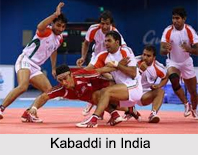
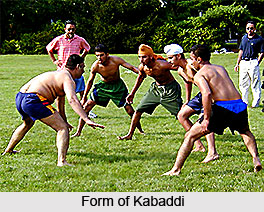
 Kabaddi in India is recognised as a traditional and one of the most popular sports. Kabaddi is played quite extensively all over the country. The game has passed a long way since its inception in India, during the pre-historic period. The Indian people love to play the game very much, as it does not need many kinds of equipments to play. Another reason is that, the game helps one to be physically fit and also teaches about how to defend and attack at the same time.
Different Forms of Kabaddi in India
There are various forms of Kabaddi in India. These forms atre played in different regions in India.
Amar
This form of Kabaddi is played based on points scored by both sides. Here, the play field has no specific measurements and 9 to 11 players constitute each of the teams. In this form of Kabaddi, there is no out and revival system or Lona (a bonus of two points awarded to the team that gets all opponents out). However, it is a time bound game. According to the rules of this form of Kabaddi, all the players are bound to remain within the court throughout the match. By this, the players can give their best, without the fear of having to miss out a great deal of action.
Gemini / Gaminee
In this form of Kabaddi, each of the sides comprises nine players and this form brings with it an inherent fear. The fear is of being called "out", as it literally means that the player has to go out of the court and wait there until all his opponents face the same fate or inflict the same consequence on his team-mates. The team that becomes successful in getting all the opponents out is awarded a point. This system is being used in the modern version of Kabaddi also; however, there is a slight variation. In the modern version, a team successful in getting all the opponents out is awarded a bonus of two points called the Lona. In the Gemini or Gaminee form of Kabaddi, a team is revived once all its members are dismissed, and the game continues till five or seven such points are gained by either of the teams. This game is not time bound, and sometimes it can be quite frustrating for a player who is out early, to wait until a Lona is achieved.
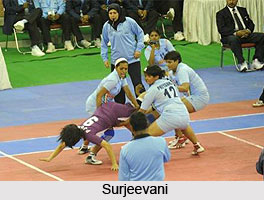 Surjeevani
This is one of the forms of Kabaddi that has a lot of resemblance with the modern version of the game. In this form, the players who are out are instantly revived and the game lasts for 40 minutes with a 5-minute break in between. Each of the team comprises nine players in this form, and a Lona is usually awarded to the team that succeeds in getting all the opponent team members out. The team that earns the maximum points, after the limited duration of the game, is declared the winner. The Surjeevani form of Kabaddi is played on a bigger field in comparison to the other two forms of the game. The rules of this form of Kabaddi regarding out and revival system of a player, have great resemblance with that of Modern Kabaddi.
Modern Kabaddi
This is the latest of all the forms of Kabaddi and it is actually a synthesis of all the other three forms, with notable changes with regards to rules and regulations. Here, each team consists of 12 players, out of which seven are on court at a time, and five in reserve. The two teams collect points by either touching or capturing an opponent member. Both the teams aim for higher points within the time limit of 40 minutes, by alternating in defence and offence. There are two halves, each of 20 minutes in this form of Kabaddi, with a break of five minutes. In modern form of Kabaddi, the playground is required to be level and soft and is also required to be made of earth, manure or saw dust. The measurement of the playing area is 12.50 mteres x 10mters, divided by a line into two halves. Each half of the ground measures 10 meters x 6.25 meters and there shall be strip of one meter wide on each side of the play field that is called lobby. The side that wins the toss first sends a `raider`, who enters the opponents` court chanting, `kabaddi-kabaddi`. The repeated clear sound of Kabaddi within the course of one"s respiration is called cant.
In the modern form of Kabaddi, the main objective of a raider is to touch any or all players on the opposing side, and return to his court in one breathe. During this course, the person, whom the raider touches, is called out. On the other hand, the defending team always tries to hold the raider, and stop him from returning to his own court, until he takes another breath. If the raider fails to return to his court in the same breath while chanting `Kabaddi`, he is declared out. Each team alternates in sending a player into the opponents` court.
A player can be declared out, if he goes out of the boundary line during the course of the play, or if any part of his body touches the ground outside the boundary, except during a struggle. A struggle means the situation when a raider touches a defender or a defender touches a raider.