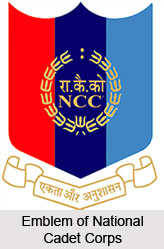
 National Cadet Corps or NCC is the Indian military group that is open to school and college students on voluntary basis. The National Cadet Corps recruits cadets from high schools and colleges. The Cadets are given fundamental military training in small arms and parades and the officers have no liability for active military service. The motto of NCC is `Ekta aur Anushasan` that means the training of unity and discipline. The National Cadet Corps was formed with the National Cadet Corps Act of 1948. It was established on 15th of July, 1948 as a successor of the University Officers Training Corps (UOTC), which was established by the British in 1942. During the Second World War, the University Officers Training Corps never came up to the expectations set by the British. Later, NCC was formed to train more young men in a better way. A committee supervised by Pandit H.N. Kunzru recommended a cadet organisation to be established in schools and colleges at a national level. The Governor General accepted the National Cadet Corps Act and on 15 July 1948 thus the National Cadet Corps came into existence.
National Cadet Corps had been the second line of defence during the 1965 and 1971 wars with Pakistan. They organised camps to support the artillery factories, supplying arms and ammunition to the front, and also were used as patrol groups to capture the enemy paratroopers. The National Cadet Corps also worked in close co-operation with the Civil Defence authorities and actively participated in rescue work and traffic control.
Aims and Objectives of National Cadet Corps
The primary aims of National Cadet Corps are as follows -
* To develop qualities of Character, Leadership, Comradeship, Courage, Discipline, Spirit of Adventure, Secular Outlook and the ideals of Selfless Service amid the Youth of the Country
* To create a Human Resource of Well Organised, Skilled and Motivated Youth, to endow with leadership in all walks of life and always be ready to serve the nation
* To provide an apt environment and encourage the youth to choose a career in the armed forces
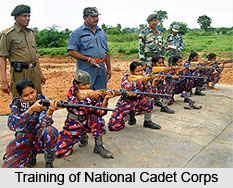 Training of National Cadet Corps
Training forms the basic idea of National Cadet Corps, which not only gives shape and form to the corps but also controls all the susceptible and crucial nerves of the organisation. Training in National Cadet Corps is conducted through a three-tier system of training staff, consisting of Whole Time Officers, Regular Officers, Whole Time Lady Officers, Junior Commissioned Officers (JCOs), Associate NCC Officers (ANOs), Non-Commissioned Officers (NCOs) and their correspondents from the Navy and the Air Force as Permanent Instructor Staff, Gliding Instructors (CGIs), Girl Cadet Instructors (GCIs), Civil Ship Modelling Instructors (SMIs) and Aero Modelling Instructors (AMIs).
The representative from the Armed forces trains the army wing of the National Cadet Corps on the junior and senior level. They are considered as future officers, army personals, or possible reserve in the case of the national emergency. Navy wing cadets receive their training according to the naval rules and discipline on the senior as well as on junior level. The Air Force wing cadets are trained as per regulations and guidelines of the Air Force.
Division of National Cadet Corps
The uniform of National Cadet Corps is according to the respective wing. Army cadets wear khaki uniform, while the Navy cadets wear white uniform of navy and the Air Force Cadets were blue uniform similar to the air force. There are four divisions of National Cadet Corps, namely Senior Division for boys (SD), Junior Division for boys (JD), Senior Wing for girls (SW) and Junior Wing for girls (JW). The divisions are further categorised into Army, Navy and Air Force wings. The National Cadet Corps is further divided into regional directorates as part of its organisational structure that is state-wise. Officers and cadets have no liability for active military service. The army units include infantry, armoured corps, artillery, engineers, signals, medical and electrical and mechanical engineers. Air Force and naval units have also been organised. The Junior Division caters for the high school boys. The Girls Division is imparted physical training, drill, driving and care and maintenance of motor vehicles, signalling duties and first aid.
The National Cadet Corps conducts different kinds of camps, such as the Republic Day Camp, Basic Leadership Camp, Annual Training Camps, Vayu Sainik Camp, Army Attachment Camp, Nau Sainik Camp, National Integration Camps, Rock Climbing Camps and many others. The certificates provided by the National Cadet Corps have special recognition in other national agencies. The Auxiliary Cadet Corps is a supplement of the NCC and enrols boys and girls between the ages of thirteen and sixteen. Like the NCC this also aims to equip them mentally, morally and physically by developing their character and capacity for leadership, a sense of patriotism, team spirit, corporate life and self confidence and above all the dignity of labour.
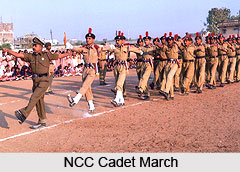 With that aim in view social service camps are held every year and students have to undertake work on road-building, planting of trees, erection of huts, and distillation of tanks, construction of children`s parks and play-grounds and literacy campaigns in the villages. To give an impetus to the popular scheme the NCC Rifles is a recent addition to the corps.
The Youth Exchange Programmes of National Cadet Corps is a new inclusion in the curriculum that allows the exchange of outstanding cadets to represent the country for a short duration with similar organisations of other countries. The senior division of National Cadet Corps has officers like Company Sergeant Major, Senior under Officer, Sergeant, Corporal, Lance Corporal and Cadet. The Junior Wing has the Troop Sergeant, Company Quarter Master Sergeant, Regimental Quarter Master Sergeant and Associate NCC Officer. National Cadet Corps has now become an organisation for the youth that not only trains of national discipline but also incorporates personal qualities of leadership and management; thus becoming an integral part of education in India.
National Cadet Corps
National Cadet Corps (NCC) is a voluntary organisation in India to recruit military aspirants from various schools. National Cadet Corps is open to all regular students of schools and colleges on a voluntary basis.