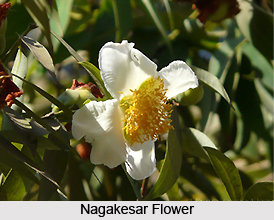
 Indian medicinal plant, Nagakesar is famed for its immense medicinal value. The Sanskrit term of the plant Nagakesar is "Punnaga" which bear the connotation of `Best among trees`. This plant is given the scientific name Mesua Ferrea Linn. The practitioners of Ayurveda as well as other practitioners of medicine hugely admire this plant for its immense medicinal properties. This plant is commonly named differently in different languages. This plant is well acknowledged by the name of `Nagakesar` and `Punnag`. Apart from these names this plant is known as `Suragi` in Kannada, `Surongi` in Konkani, `Surampunna` in Malayalam, `Nagchampa` in Marathi, `Ponnang` in Oriya, `Punnagam` in Tamil and `Suraponna` in Telugu. In India Nagakesar is found in the coastal forests of Maharashtra, Karnataka, Kerala, Tamilnadu, Andhra Pradesh, Orissa and the Andaman Islands. This plant thrives on sandy soils. It is often grown as an ornamental tree.
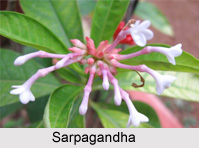
The shape of the plant varies from medium to large that grows up to 20 metre tall with a crooked trunk. This is an evergreen tree with sharp simple leaves and the bark is pale grey to dark brown, smooth with boat shaped fissures. The leaves are 10cm to 18 cm long and 7.5cm to10 cm wide, are broadly elliptic oblong or obovate, apex rounded, often emarginated with wavy margins and very close lateral nerves and base is acute. The petioles are 0.9cm to 1.5 cm long, stout and flat. Flowers are 1.9cm to 2.5cm in diameter, pleasant marble white in colour, have a nice fragrance, borne in lax few flowered axillary racemes that are 10cm to 15cm long. The floral leaves are four in number, ovate orbicular, concave and reflexed. The flowers have only four petals that are oblong, obtuse and spreading and have a number of stamens that are golden yellow tinted. Fruits are globose, 2.5cm to 3.8cm in diameter, smooth. The colour of the fruits gets light yellow to pale reddish orange when the time of ripening comes. The pericarp of the fruit is thick and has globose, smooth seeds that are as large as the fruit.
The Nagakesar plant has immense medicinal values that are admired all over India as well as overseas. The bark of the plant has the properties of astringent bark and is used in Ayurveda to heal ulcers and inflammations of the eye, and in preparations for improving the complexion. The astringent properties of the plant are used to treat internal haemorrhage. The juice of the bark is used as purgative. The oil obtained by steeping the greenish yellow gum (latex exuded from the cut branches or stem) mixed with strips of bark and leaves are used as an application to relieve sore eyes. This is also reckoned to be a useful remedy for indolent ulcers. The oil pressed out from the seed kernels has strong antibacterial properties and is useful for treating scabies and other cutaneous diseases, gonorrhoea and gleet. The oil extracted from the seeds is also reported to possess anti inflammatory properties and is considered a useful embrocation in the treatment of rheumatism and gout. The watery paste expressed from the seed kernels is considered as a useful deputise for the seed oil for relieving joint pains.
This plant is best reckoned for its haemostatic properties. To treat bleeding piles and dysentery, the powder of the flower of the plant is taken along with butter and sugar twice a day daily until the bleeding stops. The practitioners of medicine use the pasted flower of the Nagakesar plant with curd to treat leucorhhoea. In Ayurveda, a decoction of the flowers is prescribed to the patient to take with sugar to treat painful or burning urination, difficult urination or blood in urine. A teaspoon of the powder of the flower mixed with buttermilk to check excessive bleeding per vagina or any other sort of bleeding.
In modern study, the phenolic constituents of the seeds of Nagakesar plant have been reportedly said to own anti asthmatic effects in experimental studies. The bark of the plant has the properties to lessen down temperature and so the powder of the bark is used to prepare a decoction.