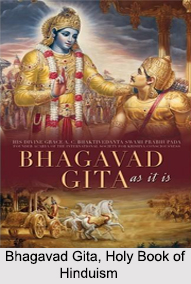
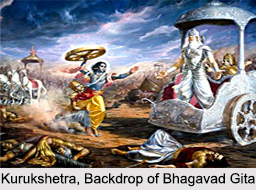
 Lord Krishna`s invaluable discourses delivered to Arjuna while in the battleground of Kurukshetra, has today made up the Bhagavad Gita in its colossal form. The Gita with its 700 verses tries in several forms to explain perhaps one single notion, attaining a godly status by following a righteous path. Arjuna`s utter miserable state, his desperateness, his vulnerability in the battlefield was entirely covered up by Lord Krishna, his charioteer. Krishna`s preachings, sermons or his admonitions, leading to his cosmic vision, the Vishvarupa, made Arjuna realise the truth of life, divinity and performance. Krishna had once before, in the Gita context, explained to Arjuna the three basic qualities of purity, passion and ignorance and its outcome in daily existence. In the present context, threefold faith in Bhagavad Gita are described as those three qualities and its effect upon a man`s faith.
Arjuna then enquired from his Lord, "Those who do acts of sacrifice, not according to the scriptures but nevertheless with implicit faith, what is their condition? Is it one of Purity, of Passion or of Ignorance?" Shri Krishna explained to his companion that humans are born with an inherent faith in one or other of the Qualities of Purity, Passion and Ignorance. According to the threefold faith in Bhagavad Gita, the faith of every man go in accordance with his nature. By nature he is full of faith. He is in fact what his faith makes him. The Pure worship the true God; the Passionate crave for the powers of wealth and magic; the Ignorant yearn for the spirits of the dead and of the lower orders of nature. Those who practise asceticisms not dominated by scripture, who are slaves to hypocrisy and self-centredness, who are carried away by the wrath of desire and passion, they comprise the bunch of ignorant. They torture the organs of the body; and they harass Him (the Almighty) also, Who lives within each. Krishna wanted Arjuna to know that they are dedicated to evil only. The food which men enjoy is also threefold, like the ways of sacrifice, asceticism and alms-giving. A distinction always prevails among the threefold faith of existence.
Threefold faith in Bhagavad Gita, comprising the three qualities, share a diverse existence related to every domain of life. For instance, the foods that prolong life and step-up purity, vitality, health, cheeriness and happiness are those that are scrumptious, soothing, substantial and agreeable. These are loved by the Pure. Those in whom Passion is overriding prefer foods that are bitter, sour, salt, over-hot, pungent, dry and burning. These give rise to unhappiness, penitence and disease. The Ignorant love food that is stale, not wholesome, decaying and corrupt, the leavings of others and unclean. Sacrifice is Pure, when it is offered by one who does not yearn for the fruit thereof, when it is done abiding by the commands of scripture and with unspoken faith, that sacrifice is a duty. "Sacrifice which is performed for the sake of its results, or for self-glorification-that, O best of Aryans! is the product of Passion."
Sacrifice that stands in opposing views to scriptural command, that is unaccompanied by prayers or gifts of food or money and is without faith, that is the product of Ignorance. Veneration for God and the Master, deference for the preacher and the philosopher; purity, morality, continence and harmlessness, all come under physical austerity. Speech that bruises none, that is honest, is pleasing to the ears and beneficial and the constant study of the scriptures, comprise the austerity in speech. Serenity, kindness, silence, self-discipline and purity are grouped under the austerity of mind. These threefold faiths in Bhagavad Gita when performed with faith and without thought of pay back, can honestly be accounted as Pure. Austerity coupled with hypocrisy or performed for the sake of self-glorification, reputation or vanity, comes from Passion and its outcome is always dubious and temporary. Austerity performed under delusion and accompanied with necromancy or torture to oneself or another, can be accepted to spring from Ignorance.
The gift which is given without thought of any reward, in the belief that it needs must be made, in a fit place, at a favourable time and to a deserving person, such a gift is definitely regarded as Pure. That which is given for the sake of the consequences it will give up, or with the hope of pay back, or unwillingly, that can rightfully be said to have sprung from Passion. A gift that is given at an inappropriate place or time or to one who is undeserving, or with disregard or contempt, such a gift is the result of Ignorance. As told by Lord Krishna to Arjuna in the context of threefold faith in Bhagavad Gita, "Om Tat Sat" is the triple designation of the Eternal Spirit, by which the old Vedic scriptures, the ceremonials and the sacrifices were ordained. Hence, every act of sacrifice, gift and austerity, prescribed by the scriptures, are always begun by those who comprehend the Spirit with the word Om. Those who wish for deliverance, they start their acts of sacrifice, austerity or gift with the word "Tat" (standing for "That"), without any worry about reward. "Sat" stands for Reality or the highest Good and also is used to refer to an action of incomparable merit. Fervour in sacrifice, in austerity and in giving is also referred to as "Sat". "Sat" is also referred to an action performed only for the Lord`s sake. Whatever is performed without faith, whether it be sacrifice, austerity or gift or anything else, is called "Asat" (standing for "Unreal"), because it stands as a negation to "Sat". Such an act is hardly of any significance, here or hereafter.