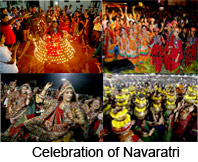
 Navaratri is a Hindu festival celebrated every year in the month of October, according to the Hindu calendar.
Beginning of Navaratri
The beginning of Navaratri of power or "shakti" seems to lurk behind-Tasmadvira ajayata virajo adhipurua, sa jato atyaricyata pascadbhumimatho pura ("He became the All. He was the All, is the All, and shall be the All in the future. He, being All, created Himself through Himself,")
Concept of Ardhanarishvara
This is the core Concept of Ardhanarishvara, in the religious parlance. Lord Shiva is the epitome of androgyny; rather conspicuous androgynous totality. It is his energy, which cannot be dissociated from himself. The manner in which the origin of things operates in this world and our religious interpretation of this cosmic activity is in the form of the worship of Shiva or the worship of Shakti. This mystery indeed is what lies at the back of our irresistible urge to worship Mahakali, Durga Mahasaraswati every year, whether or not we understand what we are doing.
Dedication to Goddess Durga
Navaratri is dedicated to the goddess of Power, Durga. In ancient mythology, it is alleged that gods contributed Devi Durga with ten deadly weapons to save the world from evil in her battle with Asura. Lord Brahma granted Kamandal (water pot), Chakra was given by Vishnu,Shiva gave Trishul, the Vajra (lightning) was given by Indra,the kuthar(axe) by Lord Viwakarma, the kaladanda (rod)was bestowed on Durga by Yama, the naga (serpent) by Vasuki. The kharga and dhal (shield) was gifted by Surya and the dhanuswar (bow and arrow) by Vayu and these weapons were empowered by the mantras recited by the persons who were seeking Durga to succeed. The ten armed Durga is also named as Kali, Bhavani, Amba and Chandika. It is believed that the mantras have a power to protect human beings from any detrimental forces. Devi Durga, the goddess of power is offered red hibiscus as it is the colour of power following which it has become a custom to offer one hundred and eight lotuses on her daily puja.
Celebration of Navaratri
Navaratri comes twice a year, the Sukhla paksha(waxing moon) of the lunar month of Ashwin , being the first, in September or October in the Autumn, and the second occurs during the first nine days of the bright two weeks of the Sukla Paksha of the lunar month of Chaitra, in mid March to mid April, the Spring time. The nine days of Navaratri are the most consecrated time of the year as in this period Maa Durga can be invoked and her blessings can remove all the evils of adverse karmas and procreate prosperity, health and wealth to her devotees and de- stain the vagaries of impure minds. Parvati, Laksmi and Saraswati are worshipped throughout these nine nights.
Gods worshipped in Navaratri
In the Navaratri festival, the first three nights are dedicated to the goddess of action and energy through her various manifestations of Kumari, Parvati and Kali. Laxmi, the goddess of wealth, peace and abundance, is worshipped during the next three days in her various aspects. Lakshmi having four hands denotes four aims of human life. In one hand she holds a lotus flower which symbolizes the never ending life and the permanence of soul. The second hand, holding another lotus specifies detachment from worldly power or maya. The lotus symbolizes the opening up of soul or charka. The third hand of Lakshmi spreads blessings to everyone with fortune and affluence. Another hand of her is open and points towards the earth, giving the support to human beings. Moreover there resides an interesting anecdote that Navaratri is celebrated at night so as to abolish the dormant ignorance of tomoguna (the inner mahishasura or lazy buffalo.) The blessing of Saraswati, the Goddess of Knowledge, is invoked as Lalita Panchami, on the fifth day of Navaratri. During the last three days of Navaratri, the Goddess of knowledge is worshipped where people of culture and art seek her consecration for their higher artistic skill and success. One achieves spiritual knowledge which she contributes, to free one from the bind of Maya or material world. 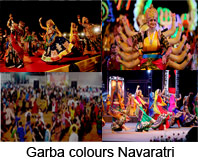 Yagnas, the final act of farewell and gratitude are performed on the eighth and the ninth day of Navaratri. Navaratri allows one to devotionally feel the unanimous sacred existence of the Goddess while assimilating the spiritual energy and inner spirit to free the souls from Maya of the worldly existence and to make the entire year consecrated. Shakti worship-Devi worship, Durga Puja-is not a female deity`s worship, rather in actuality; Goddess Durga, Goddess Lakshmi and Goddess Saraswati are not mortal femme fatale. Rather the power of cosmos rooted in absolutes. One would paint this very Shakti as is portrayed to one and all in the Devi Mahatmya: Narasimhi, Rudrani, Kumari, and all sorts of names. She appeared as Skanda with spear in hand, as Narasimha with roaring lion`s mouth, as Lord Vishnu with Sudarshana in hand, as Rudra with Pasupata in hand :Ya va veda, ya va na veda (he may know or he may not know).