Langar
|
Langar is basically a summary of three interrelated concepts of Sikh religion. It literally means free kitchen.
|
|
|
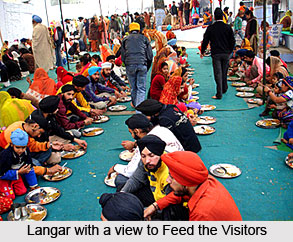 Langar is an open expression of Vand chhako. Sikh giving in the form of daswand, supports the concept of langar. Daswand, vand chhako and langar are the practical expressions of the life of a Gurmukh. Langar was commenced by Guru Nanak Dev as a token of human brotherhood or sisterhood as well as to help those who are in need. Angad Dev who was the second Guru followed this practice. However the third Guru Amar Dasji institutionalized this. The tenth Guru Gobind Singh ordered his followers to start at a personal level. This would ensure that nobody may go hungry. Langar is an open expression of Vand chhako. Sikh giving in the form of daswand, supports the concept of langar. Daswand, vand chhako and langar are the practical expressions of the life of a Gurmukh. Langar was commenced by Guru Nanak Dev as a token of human brotherhood or sisterhood as well as to help those who are in need. Angad Dev who was the second Guru followed this practice. However the third Guru Amar Dasji institutionalized this. The tenth Guru Gobind Singh ordered his followers to start at a personal level. This would ensure that nobody may go hungry.
In a Langar sharing of food is taken while sitting in a pangat. Guru Amar Das had ordered his followers that the food should be served to the congregation first and then assemble for prayers. Pangat in present times has become a synonym for Langar. This practice has been made a part of Sikh service in every Gurdwara. It is the direct corporate responsibility of the Sikh community in general as it does not depend on philanthropy of outsiders. Langar is practical expression of social equality as well as training centre for voluntary service. It is also the practice of generosity and equality. Collection of fuel and rations, cooking of food, cutting vegetables, serving of drinking water, distribution of meals, washing of utensils and dishes, and the cleaning of dining halls are all considered as service.
The concept of Langar can be identified as one of the most successful and effective aspects of the way through which the founder of Sikhism, Guru Nanak has spread his idealism. It was also a way for Guru Nanak to serve the poor and needy people of the society.
Guru Nanak mainly organised the Langar with a view to feed the visitors' and also the members of the Sikh community. He had the realisation that hunger is a great leveller and he also demolished distinctions that had been artificially imposed on man by their fellow beings. Guru Nanak has actually used the Langar, along with Sangat as a weapon to fight against the caste system that was prevailing in the Indian society at that time. In fact, Sangat and Langar symbolised equality, fraternity and brotherhood. In a Langar, there was no difference made between anyone. The high and the low, the rich and the poor, the learned and the ignorant, the king and the pauper, all used to share the same food sitting together in one row.
Guru Nanak made arrangements to run Langar by contributions from the followers of the Sikh faith. The contributions could be in the form of provisions or voluntary service in preparing and serving the meals. The Langar did offer two square meals to every visitor, especially to the destitute and the homeless, travellers and pilgrims, everyday. The mother of Guru Nanak, Mata Tripta and his wife, Mata Sulakhni actively engaged themselves in the sewa of Langar. The wife of the second Guru of Sikhs, Guru Angad, Mata Khivi also played an active role in distributing and supervising the preparation of food for Langar. The Sikh followers have successfully kept alive the tradition of Langar in the gurdwaras till today.
|
|
|
|





