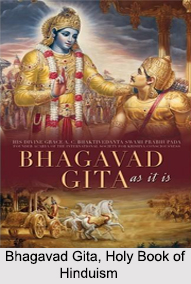
 Bhagavad Gita, the gospel text for Hinduism, comprises 700 verses, with an illustrious and legendary background of its coming into being. According to the Mahabharata, composed by rishi Ved Vyas, the pivotal plot of Gita`s slokas was subject of the much talked-about war between brothers Pandavas and the Kauravas. The battle of Kurukshetra took place as a culmination of the prolonged cold war that had existed between the bands of brothers. And yet, when the climactic combat was about to begin, Arjuna, the third Pandava and a master in archery, had suddenly denied raging against his own kin, brothers, elders and teachers. The debonair was crest-fallen after witnessing his opponents, with all pride giving way to sadness and sense of defeat. It was then that Lord Krishna, Arjuna`s charioteer and the primary politician in the Kurukshetra war, had taken initiative to make Arjuna comprehend the true meaning of war and life in general. Amongst Krishna`s several discourses preached, knowledge and experience had also administered prime importance, explained in Bhagavad Gita.
Knowledge and experience in Bhagavad Gita is governed deep within the principles of Krishna, a cardinal issue to gain supreme sublimity. Shri Krishna thus, went underway to explain to Arjuna how would he recognise Him in His full perfection, practising meditation with his mind devoted to Him and having Him for his own refuge. Krishna also wished to reveal the secret of this knowledge to Arjuna and how it actually could be realised. Once such sublime knowledge has been accomplished, there remains nothing else worth having in the present life. Among thousands of men there exists hardly one who strives towards perfection and even amongst those who gain mystical powers, rarely but one gets to know Lord Krishna in truth.
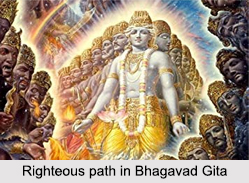
According to knowledge and experience gained from Bhagavad Gita, earth, water, fire, air, ether, mind, intellect and personality comprises the eightfold division of the Lord`s Manifested Nature. This is counted as Krishna`s inferior Nature; but distinct from this, there exists also another of the Lord`s Superior Nature, which comprises the very Life that sustains the universe. It is the womb of all being. This is sole truth of life, because Krishna is the one by Whom the worlds were created and shall be dissolved within Him again. By Krishna`s revelations, one gets to know that there is nothing higher than Him; all is strung upon Him as are rows of pearls upon a thread. Arjuna is being enlightened that his Lord and charioteer is everywhere, he is in the Fluidity in water, he is the Light in the sun and in the moon; He is the mystic syllable Om in the Vedic scriptures, he is present in the sound in ether, he is the virility in man. Krishna is in actuality omnipresent in the Fragrance of earth, the Brilliance of fire; He is the Life force in all beings and He is also the Austerity of the ascetics. The Lord is the eternal Seed of being; He is the Intelligence of the intelligent, the Splendour of the resplendent. He is the Strength of the strong, Krishna personifies that strength for men who are free from attachment and desire; he is the Desire for righteousness.
Whatever be the nature of an individual`s life, whether it is pure or passionate or ignorant, they all are derived from Krishna. They are abiding within Him, but He is not within them. In order to achieve such a state, it is necessary to go by the scriptures of knowledge and experience, referred by Bhagavad Gita. The inhabitants of the physical world, misguided by those natures which the Qualities have spawned, are unaware that He is higher than them all and that He is ever unchangeable. In truth, this Divine Illusion of Phenomenon manifesting itself in the Qualities is difficult to outmatch. Only they who devote themselves to the Lord and to Him alone, can attain it. The sinner, the ignorant, the loathsome, deprived of spiritual perception by the charm of Illusion and he who pursues a godless life can never be successful to find Him. Krishna goes forward to express to Arjuna that the righteous who worship Him are grouped into stages: first they who suffer, next they who crave knowledge, then they who hanker after truth and lastly they who accomplish wisdom. Of all these, he who has derived wisdom, who meditates on Him without ceasing, devoting himself only onto Him, he is the best; because, "by the wise man I am exceedingly beloved and the wise man, too, is beloved by Me." Though Krishna exemplifies each one as noble-minded, yet, the wise man is the one he holds dear as His own Self; "for he, remaining always at peace with Me, makes Me his final goal."
After many lives, after gaining much knowledge and experience from the Bhagavad Gita, at last the wise man can realise Krishna as who he actually is. A man thus enlightened, who is capable of perceiving God everywhere, is indeed very difficult to find. Lord Krishna delineates to Arjuna, fans out his foggy mind by stating that "they in whom wisdom is obscured by one desire or the other, worship the lesser Powers, practising many rites which vary according to their temperaments." But whatever is the form of worship one takes recourse to, if the devotee possesses faith, then upon that faith and in that worship Krishna rests his benedictions and seal. If that individual worships one form alone with real faith, then shall his desires be fulfilled through that only; because such was the pattern of ordainment made by the Lord. The fruit that comes to men of restricted insight is, nevertheless, finite. Men who worship the Lower Powers attain them; but those who worship Krishna, gains the path to reach him alone. The ignorant cognise about Krishna as the Unmanifested Spirit, as if He really was in human form. They do not comprehend that His Supreme Nature is after all immutable and most excellent. He is not visible to all, for he is enwrapped within the illusion of Phenomenon. This deluding world does not and never can recognise Him as the Unborn and the Imperishable.
Krishna`s discourses and sermons to Arjuna describes that He knows and is aware of all beings in the past, the present and the future; but, they are absolutely unaware and unknowledgeable about Him. Man is a dweller of a fairy world, led astray by the charm of reverse sensations, enamoured by desire and repugnance. But those who act righteously, in whom sin have been demolished, who are liberated from the infatuation of the contradictory emotions, they worship Him with firm resolution. This is cogently and potently explicated through knowledge and experience, detailed in Bhagavad Gita. Those who make Krishna, the Almighty their refuge, who strive for liberation from decay and death; they realise the Supreme Spirit, which is their own real Self and in which all action finds its culmination. "Those who see Me in the life of the world, in the universal sacrifice, and as pure Divinity, keeping their minds steady, they live in Me, even in the crucial hour of death."