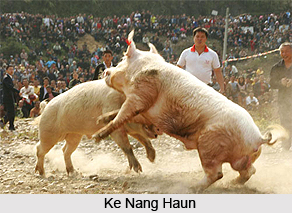
 Ke Nang Haun is a popular game in India, especially concentrated among the original inhabitants of Andaman and Nicobar Islands. The Nicobarese tribal people of India are quite fond of various kinds of sports and the game named Ke Nang Haun is among one of the most popular sports among them. The game Ke Nang Haun is actually the pig fight that is an essential part of various festivals of the Nicobarese tribe. The male members of the tribe mainly participate in the game of Ke Nang Haun and the women are usually not allowed there.
In the game of Ke Nang Haun, first the male members of the Nicobarese put most of the pigs, both wild and tame into a cage that is made of bamboo. They tie one leg of the pig with a long nylon rope and they get ready for the action after the cage is smashed with an axe. Usually there are two contestants in a game of Ke Nang Haun and they position themselves in front of the cage, at a distance of 5 - 6 metres. When the cage is smashed with an axe, the pig emerges out of the broken cage, and as it is in a rather terrified and hostile state of mind, it naturally charges at anybody it sees. A number of two to three experts in pig - fighting in Ke Nang Haun get appointed for controlling the movement of the pig by the rope.
According to the rules and regulations of the game of Ke Nang Haun, two men at a time are asked to fight the contest. The fighter is required to grab both the ears of the pig and control it, as soon as the pig charges at him. If the fighter becomes successful in doing this, he is declared as the ace fighter of the island. Ke Nang Haun or pig fights are mainly held in wide, open spaces, so that the pig can have a lot of space to run around easily and the fighter also does not get hampered in any manner. Nicobarese tribal people always organise the game after sunrise and on clear, sunny days.