 Palaces in Jaipur are probably the most interesting sites to venture in the city. Jaipur is a land of several historical constructions and majority of them are magnificent palaces. Built over the hilltops, in the middle of enormous deserts, these palaces showcase close association between the ruling kings and their close possessions. Many of these palaces look rugged and rough from their exteriors; but their interiors project a different world of heritage and glory. The palaces in Jaipur are the blend of royal past and modern world and the authorities have still managed to keep alive the magic of the fierce culture and traditions of city through the decor of these palaces.
Most remarkable palaces in Jaipur
Among several beautiful palaces in Jaipur, the most remarkable ones are:
The City Palace:
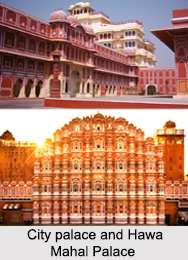
The City Palace of Jaipur is the main palace and also the seat of the government. Construction of this palace complex started in 1732, but work continued into the late 19th century as changes were made to the internal decor, and several structures were added. One of the last structures added to the City Palace is the Mubarak Mahal built in 1890. It was used as the guesthouse for visiting dignitaries of Maharaja. However, now it is included in the Maharaja Sawai Man Singh II Museum. The Jantar Mantar Astronomical Observatory is in the premise of this palace. City Palace has become the location for many film shootings from Hindi movies to American movies.
 Chandra Mahal is popular as the Palace of the Moon and belongs to an integral section of the City Palace that was built between 1727 and 1734. Chandra Mahal is one of the earliest buildings of the palace complex. From outside it appears to have seven storeys. The first and second floors are one high-ceilinged hall, in reality which are known as the Sukh Niwas (House of pleasure) and above the Sukh Niwas is the Rang Mandir (Temple of Color). Above the Rang Mandir is the Sobha Niwas or the House of beauty. Above the Sobha Niwas lies the mirror palace or the Chavi Niwas and finally the topmost storey is the small open marble pavilion, the Mukut Niwas (House of the Crown). The Chandra Mahal comprises the private apartments of the Maharaja of Jaipur. To the left of this building is the zenana, or the women`s quarters of the Palace. The Chandra Mahal is a heritage house and continues to be the home of the current royal family of Jaipur.
The Hawa Mahal (Palace of the Winds): The Hawa Mahal sits on the edge of the City Palace and extends to the Zenana or the women"s chambers. The palace was built in 1798 by Maharaja Sawai Pratap Singh. It was used for the ladies of the royal family to maintain the tradition of purdah (veil) where they could easily observe the activities in the streets below without being seen themselves. The architecture of this palace is astonishing and is considered as one of the most attractive tourists` spots.
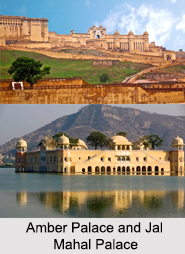
Amber Palace: Amber Palace is one of the most popular fort palaces in Jaipur, which is located at a distance of 24 km from Jaipur airport. The palace is built with red sandstone and marbles. Amber palace is mostly famous for its tremendous picturesque landscape, the beauty of which has been taken to the next level by the Maota Lake as its backdrop. The palace showcases the lifestyle of the Rajput royals.
Jal Mahal: Jal Mahal is placed in the middle of the Man Sagar Lake. The palace and the lake were renovated and enlarged in the 18th century by Maharaja Jai Singh II of Amber. The location around the Jal Mahal is decorated with royal chhatris and cenotaphs that make the spot a picturesque one to attract its visitors.
 Jaipur Heritage Palace Hotels
Some of the palaces in Jaipur have been converted to hotels and accommodation units, and they are:
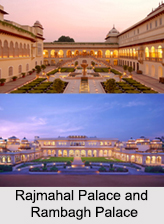
Rambagh Palace: Rambagh Palace, one among the well known Palaces in Jaipur, is situated around 8 km from the city. The palace of Maharaja of Jaipur is today changed over into one of the best Taj hotels. Although primary construction in the year 1835 was just a garden house for the wet nurse of prince Ram Singh, later on by 1887 it was changed over into a hunting lodge. Later on in the 20th century it was changed over into the official home of Maharaja Sawai Man Singh II with extra rooms and imperial suites.
Rajmahal Palace: This palace was built by Maharaja Sawai Jai Singh II in the year 1729 for his beloved wife.
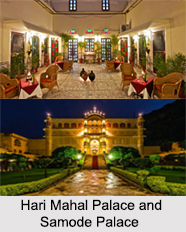 Hari Mahal Palace: It was the city residence of Rajadhiraj Hari Singh of Achrol family, which was built in 1930.
Samode Palace: Samode Palace, mainly belonged to Zamindars, was built in 16th century. In the early 19th century a conversion with fusion of Rajput and Muslim architectural style was made to this palace by Rawal Berisal.
The palaces in Jaipur are some of the superb constructions ever made in India. The ancient culture and heritage of the nation is well maintained in these foundations till date. The unique decor and elegant poise of Jaipur palaces bring a stately charm in the city.