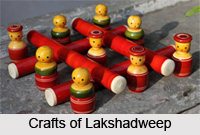
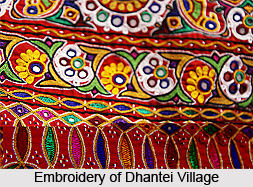
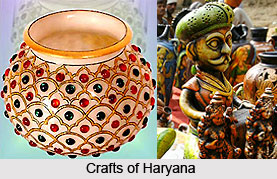
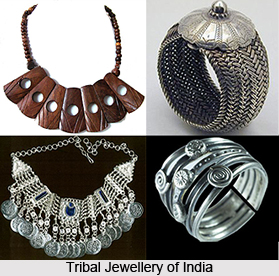
 Indian tribal craft is an astounding section in modern Indian times, which slowly has taken in a cosmopolitan appearance. The final get-up that such tribal crafts receive to adorn and deck sophisticated Indian city homes, can perhaps only be described after a thorough admiration. Indian tribal crafts are available in every area of decoration and embellishment, with numerous irresistible choices, heightening one`s urge to buy tribal goods. Crafted to perfection, such tribal crafts leaves one spoilt for choice. The amount of pressure and physical exertion that goes to make an item look dazzling is manifest through the daily lives of tribal aborigines.
Types of Tribal Crafts in India
Indian tribal crafts verily mirror the lives of their users, their food and its source, their observances to pacify indefinite forces, which incorporate their arts and crafts, music and dance. Majority of Indian tribals inhabited in far-off forests, and had kept distance from the nearby agricultural villages.
Some of the numerous tribal crafts manufactured in India include: Art, Baskets, Papier Mache, Ceramics, Clock Making, Embroidery, Block Printing, Decorative Painting, Glass Work, Fabric, Furniture, Gifts, Home Décor, Jewellery, Leather Crafts, Metal Crafts, Paper Crafts, Pottery, Puppets, Stone and Wood works.
Influences on Tribal Crafts in India
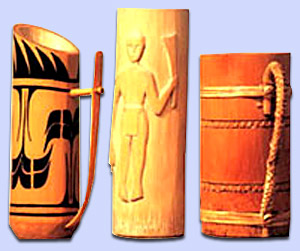
Religion plays a thrusting role in tribal day-to-day life. It is wholly expressed through art and reflects its use in their crafts. Indian tribal craft is generally ritualistic, rubbing off a distinct line between the artist and the art lover. It is encased within the consciousness of the tribe and transforms according to developments in the tribe. Tribal crafts are dependent on the local plant ecosystem. For instance, the use of bamboo for making bows, arrows, vessels and habitations doubtlessly lent to the conservation of bamboo grass. Implements, like the digging stick and bow and arrow, canoes and boats, dwelling houses, each an essential craft item, were dependent on plants and trees.
The other popular raw material used by Indian tribals in their craft-making is mud. Mud is in fact utilized in umpteen artifacts, like, pottery, storage jars, figures of deities, votive offerings, decorations and burial urns and other objects. One of the bare essentials, tribal habitations are constructed with mud. Fascinatingly, clay images are moulded not for the deity but as offerings to the deity. Terracotta is yet another material that can be seen in regular usage in tribal crafts in India. The figures are a central part of a total ritualistic portrayal of the rites of passage.
What tells apart Indian tribal craft is the quality of usefulness which is integral to its creation. Whether it is a pot to carry water, a storage jar, a bow and arrow, a basket to carry goods or a votive offering, the object always has a role to play, a purpose intrinsic to its creation and existence. The shapes and forms of tribal crafts are, fascinatingly, deduced from basketry, as are the ornamentations on pottery. Basketry is the most popular and available of tribal crafts, being highly diverse, with its origins impossible to outline.
Tribal crafts can be assorted into definite classes:
Habitation units
Basketry, mats, cane work
Tools for hunting, fishing and agriculture
Musical instruments
Clothes
Pottery
Iron smithy and metal work
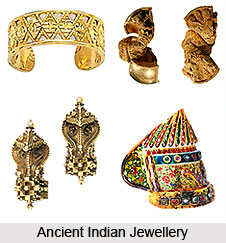
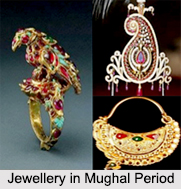
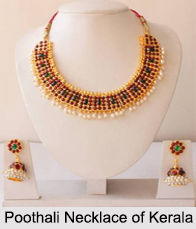
Jewellery
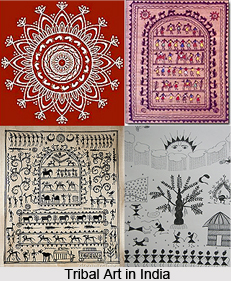 Crafts of the Todas
Indian tribes have rich craft traditions which are as diversified as the basketry of Arunachal Pradesh, metal casting of Madhya Pradesh, terracotta votive offerings and decorations of Gujarat. In this regard, the tribes of the Nilgiri Hills deserve a special mention with their astonishing crafty works. Although each tribe of the Nilgiris is fully integrated, there is a distinct delineation in their craft production, making them essentially dependent on each other.
The Todas are the most enthralling and captivating tribe of the Nilgiris. The Toda women are expert in coiffing intricate embroidery on the surface of plain cotton material. Their embroidery consists of geometrical designs such as zigzag bands, triangles, squares and dots. The embroidered cloth is utilized as a shawl and is named as a putkuli. Todas also wear intricately patterned silver jewellery. The Todas serve as the leading band in Indian tribal crafts, with expertise in cane crafting. The most noteworthy is the multi-forked churning stick used in their dairy-based traditions. One end of a long cane is split into multiple forks and covered with a bud-like structure. Used in their funeral rites, they mould a cane twig into a non-figurative buffalo head as a substitute for buffalo sacrifice.
Crafts of the Kotas
Indian tribal crafts rests heavily on the Kotas, legendary as musicians and serving as essential manufacturers of musical instruments like hard drum, tambourine and brass cymbals resembling oboes. This particular instrument is beaten with a stick and pipes. Kotas are expert musicians and the only artisans in the Nilgiris. They are professional blacksmiths who make iron implements both for household as well as agricultural usage. The Kotas also manufacture iron knives and bill hooks. They manufacture ropes and umbrellas from buffalo hide, jewellery like anklets, rings and necklaces out of brass and necklaces from glass beads and cowry shells.
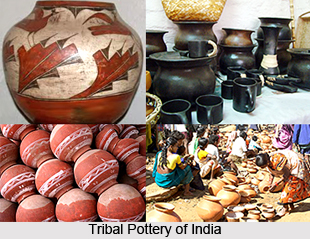 Kotas are also expert potters who use the wheel to develop clay vessels out of the locally offered black clay. To this they add white clay in equal proportions to create masterpiece. Sometimes they glaze the end product to develop glazed pottery. In comparison to the Kotas who are the most crafty people amongst all the Nilgiris tribes and receive payment in kind, the others sink into irrelevance.
Crafts of the Irulas
The Irulas, yet another tribe creating history in Indian tribal crafts, make and use the conch, drum, dwarf pipe (kwale), long flute (buhin) and nagasore in their dances for rain and fine harvest. While they manufacture glass bead necklaces and brass earrings and anklets, their striking craft is the plaited palm leaf straw ornaments, used as necklaces and anklets.
Crafts of Other Aboriginal Tribes in India
The Paniya tribe possess very few crafts, music or dance. They use the drum (thudi) and musical horn (cheemam) for ritualistic ceremonies. They are the labour caste among the Nilgiri tribals. The Kurumbas and Mulla Kurumbas are hunter-gatherers, also noted for their basketry. The Kattunayakan, another hunting tribe, are collectors of wild honey and wax.
With the exception of the Todas who are lacto-vegetarians, all the others are devoted hunters. The common weapon is the bow, manufactured from bent bamboo and rope and arrow. Other implements encompass wooden ground-digging sticks and plain tools. The basketry items include woven triangular head cover (as a defend from rains), carry-baskets with handles for gathering minor forest productions and bulky baskets for storage.
In northern India, metal and cane craft are popular among the tribes. These materials are mostly used for making daily utility items like kitchen utensils and hunting items. Bamboo is the most important material, followed by clay, wood, palm leaf and metal in the north-east India. The tribes of east India are mostly into clay crafts. Driven by their culture and tradition tribes create colorful clay masks and utensils for performing at festivals.
Tribal crafts of India are as diversified as it is unique. Following their common lifestyle and day-to-day requirements, tribes have crafted unique items that became popular for their rustic beauty and utility.