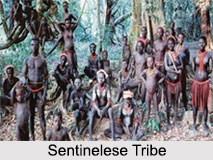
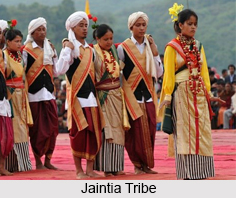
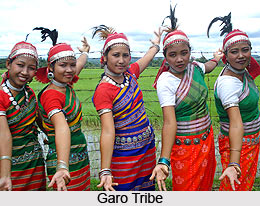
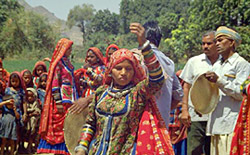
Indian Aboriginal Tribes are the ethnic inhabitants of the country, who have been termed as "Scheduled Tribes" in the Indian Constitution and are scattered throughout India. The aboriginal tribes of India have been following their individual series of ancient traditions, cultures and customs since times immemorial. Presently, they constitute about 105 of the aggregate population of India, numbering over 700 distinct groups.
They reside in various portions of the nation, concentrated towards the Central India, the north-eastern Indian states, the Indian Union Territories and several other parts of India. Some of the native tribes are found concentrated in the belt along the Himalayas stretching through Jammu and Kashmir, Himachal Pradesh, and Uttar Pradesh in the west, to Assam, Meghalaya, Tripura, Arunachal Pradesh, Mizoram, Manipur, and Nagaland in the northeast. There are no Scheduled Tribes in states like Punjab, Delhi, Chandigarh, Puducherry and Haryana.
Aboriginal Tribes of Northern India
The Jaunsari in Uttarakhand or the Kinnaura in Himachal Pradesh have been enlisted as Scheduled Tribe. They are deprived of basic education and health care facilities which puts them on a back foot. The life, culture, customs, traditions, manners and the heritage of the people of Kinnaura is a world in itself.
Aboriginal Tribes of Central and Western India
The Gondi tribe is one of the aboriginal tribes of central India. The Gondi, or Gond Tribe live across the states of Madhya Pradesh, eastern Maharashtra (Vidarbha), Chhattisgarh, northern Andhra Pradesh, and western Odisha. They make up the largest tribe in Central India.

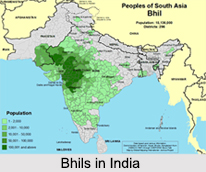
Bhil Tribe are the native tribes of Central India who are found in the states of Gujarat, Madhya Pradesh, Chhattisgarh, Maharashtra and Rajasthan in western and central India, as well as in Tripura in far-eastern India, on the border with Bangladesh. The Ghoomar dance is one of the oldest and most popular aspects of Bhil culture.
Aboriginal Tribes of North-Eastern India
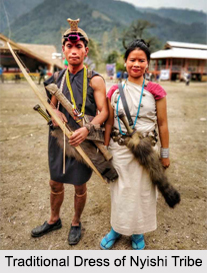
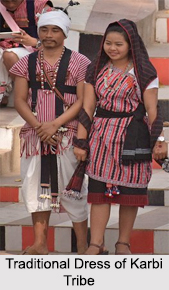
In the north-eastern states of Arunachal Pradesh, Meghalaya, Mizoram and Nagaland, upward of 90 percent of the population is tribal. The Morans are considered as the aboriginal people of Assam. The Mishing people are an aboriginal tribal group, the second largest tribal group in North- East India, first being the Bodos in Assam.
Aboriginal Tribes of Eastern India
The `Kol` caste is a generic name for the Munda Tribe, Ho and Oraon tribes who are the aboriginal groups of eastern India. These tribes live in the states of Jharkhand, Odisha and West Bengal, and spread over into parts of Bihar, Chhattisgarh, Madhya Pradesh, Assam and Tripura. The Munda tribe is an aboriginal tribe of Austro-Asiatic physical type and in 1901 they inhabited the Chota Nagpur Division. The majority of the Kol people thought themselves to be Hindus with a syncretism admixture of innovative animistic beliefs. The village community in its ancient structure still exists among the Mundas. The `Santhal` Tribes are the largest tribal community in India, found mainly in the states of West Bengal, Bihar, Jharkhand, Assam and Odisha.
Aboriginal Tribes of Southern India
The Kota tribe, also called Kotas is a community of indigenous peoples who inhabit areas on the slopes of the Nilgiri hills in Tamil Nadu in South India. The Kotas are the experts at the occupation of traditional artisans and arts of pottery and terracotta baking in the Nilgiris and their associated community, the Todas, are the agriculturists of the Nilgiris.
The aboriginal tribes of India were much less in number during the primitive times. However, with the passing decades, they have considerably grown in number. The extent of the tribal population varies considerably from state to state. The Aboriginal Tribes in India form the largest proportion of the total population in Lakshadweep and Mizoram followed by Nagaland and Meghalaya.