|
Purushottam Laxman Deshpande, was popularly known as Pu. La. He was born in 1919. Deshpande was a doyen of Marathi theatre, playwright, director, actor, composer, filmmaker, humorist, and travelogue writer. Born in Bombay, and deeply interested in classical music, he started his theatre career by acting in musicals and prose drama with Chintamanrao Kolhatkar, and wrote, directed, acted, and scored music in many Marathi films during the 1940s and early 1950s before joining All India Radio. He trained in television production in the UK and joined as the first television producer when Delhi Doordarshan started in 1959. However, he prided in calling himself primarily a performer, insisting that even his writing always involved performing. He has written nine plays, of which the most discussed and performed is his first, Uddhwasta dharmashala i.e. 'Desolate Dharmashala' in 1974, translated as Man in Dark Times. As a matter of fact it staged a so-called academic inquiry that is an inquisition brought on by the protagonist's left-wing politics.
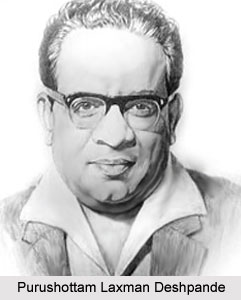 Deshpande was a unique presence in Marathi theatre. Unlike other playwrights, he was not interested in the psychological and familial problems of the middle class, but in exploring the effect that ideas and ideologies have on human life, in which the middle class receives special attention. Two other issues contour his writing. It can be mentioned as the correct representation of politicians, largely demonized or ridiculed in Marathi literature and drama, and the recovery of a language of discourse lost through lack of use. He strongly criticized theatre that neglects dialogue.
His early full-length plays were Tuka mhane ata i.e. 'Now Tuka Says' in 1948, Pudharipahije i.e. 'Wanted, a Leader' in 1951, and Bhagyavan i.e. 'Fortunate' in 1953. He adapted his first major playwriting and directorial success, Ammaldar i.e. 'Officer' in 1952, from Gogol's Inspector General. His one-act works, strong on parody and satire, carved a new path for the genre, Sadu ani Dadu i.e. 'Sadu and Dadu' in 1957 especially valuable for its experimental technique. Tujhe ahe tujapashi i.e. 'To Each His Own' in 1957, which he wrote and directed for Mumbai Marathi Sahitya Sangh, was a runaway success and brought audiences back to the flagging mainstream theatre. It dealt with the conflict between asceticism and hedonism as well. The former depicted by a celibate Gandhian social worker and the latter by a connoisseur of music, cricket, and poetry who loves life. Sundar mi honar i.e. 'I Shall Be Beautiful' in 1958, inspired by Rudolf Besier's The Barretts of Wimpole Street, featured a tyrannical father's obsessive love for his eldest daughter, and highlighted the concept of individual freedom that runs through most of Pu. La.'s work.
Batatyachi chal i.e. 'Potato Chawl' in 1961 introduced a form of minimalist monodrama where he acted multiple roles, in a humorous but compassionate tour de force that showcased the urban Marathi middle class. Varyavarchi varat i.e. 'Procession in the Air' in 1962 introduced the musical revue, a form unknown to Maharashtrian audiences. Tiphularani i.e. 'Flower Queen' in 1975 was also directed by Pu. La. That was influenced by Shaw's Pygmalion and Alan Jay Lerner's My Fair Lady. That was one of the longest-running Marathi productions. He also adapted Tinpaishacha tamasha i.e. 'Three-paisa Tamasha' in 1978 from Brecht's Threepenny Opera. Although a large number of his dramatic works were adaptations, they effortlessly blended with the Maharashtrian ethos. He acted the lead in several films, notably as the migrant to the city in Pudhacha paid i.e. 'Next Step' in 1950, Gogol's hero in Ammaldar in 1953, and the villager in Gulacha Ganapati i.e. 'Useless Fellow' in 1953, which he scripted, scored, and directed. Ratnakar Matkari dramatized Pu. La.'s Vyakti ani valli i.e. 'People and Eccentrics' in 1962. This was a collection of character sketches, and Asa miasami i.e. 'The Person I Am' in 1964, humorous writings with a social message. Pu. La. served as Vice-Chairman of the Sangeet Natak Akademi and Honorary Director of the National Centre for the Performing Arts. Govind Purushottam Deshpande died in the year 2000.
|





