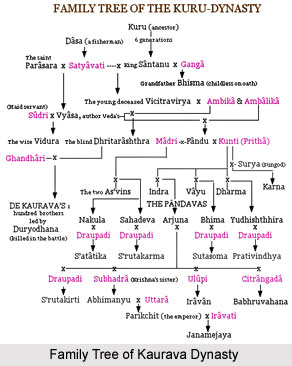
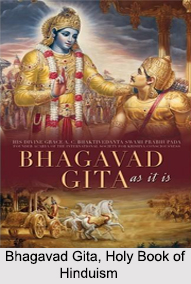
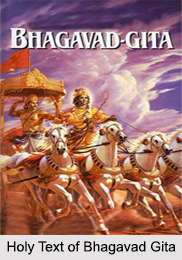
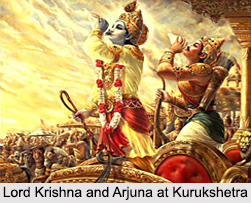
 The concept of God, the Almighty or the Omnipotent is explicated in various ways in Bhagavad Gita, with Lord Krishna taking centre-stage in each occasion. Bhagavad Gita`s coming into being is attributed to the historic Kurukshetra war between the fighting kin, Kauravas and Pandavas in the epic Mahabharata. After much pacifications, pleadings, antagonisms and hot words, the brothers had decided to take to the battlefield to seize the Hastinapur throne. However, prior to battle, Arjuna, third in line from the Pandavas, a master in archery, was overwhelmed with grief, shame and depression, that he had to fight and come face to face with his elders, teachers and brothers. Dead against the matter, he entirely declined to battle, laying down his weapons. Lord Krishna, Arjuna`s companion and charioteer, then interfered to take hold of the situation, making Arjuna understand the meaning of duty, performance, righteous work and death. It was then that subjects related to death, after life, godless existence and unfaithfulness were taken up. According to Bhagavad Gita, Godless existence was of prime importance, contrary to which, man would incur the wrath of Almighty.
Lord Shri Krishna then continued his lectures on godless existence, as stated in Bhagavad Gita that, "Fearlessness, clean living, unceasing concentration on wisdom, readiness to give, self-control, a spirit of sacrifice, regular study of the scriptures, austerities, candour, harmlessness, truth, absence of wrath, renunciation, contentment, straightforwardness, compassion towards all, un-covetousness, courtesy, modesty, constancy, valour, forgiveness, fortitude, purity, freedom from hate and vanity; these are his who possesses the Godly Qualities, O Arjuna!" On the other hand, hypocrisy, pride, audacity, unkindness, ignorance, belong to him who is born of the godless qualities. Godly qualities lead to deliverance, whereas godless existence invariably leads one to bondage. However, in fear that Arjuna might get intimidated, Krishna assures the Prince to not turn anxious, because he very much was born with the Godly qualities. All beings are born of two classes: Godly and godless. The Godly borns are endowed with several benevolent and moralistic qualities. The godless ones, as stated in Gita speak that they are unaware how to act, or how to abdicate. They have neither purity nor trueness. They fail to realise the right principles of conduct. They are of the feel that the universe is an accident without any purpose and no God. "Life is created by sexual union, a product of lust and nothing else."
 Thinking thus, such corrupted souls, such enemies to mankind, whose intelligence is barely visible and whose deeds are grotesque, come into the world with the sole aim to annihilate. Godless existence, godless individuals described in Bhagavad Gita, surrender themselves to unquenchable passions; hypocritical, self-sufficient and arrogant as they are, they cherish false conceptions established on delusion; the denigrated work only to carry out their own diabolical purposes. Concentrating anxiously over evil resolutions, which end in nothing but death, they seek only the satiation of desire as the highest goal and considering nothing beyond. Caught within the travails of a hundred worthless hopes, the slaves of passion and of wrath, they amass hoards of unjust wealth, only to indulge into their sensual pleasures. The sub-conscious thoughts of such godless men are described by Krishna as, "This have I gained to-day, to-morrow I will gratify another desire; this wealth is mine now, the rest shall be mine ere long; I have slain one enemy, I will slay the others also; I am worthy to enjoy, I am the Almighty, I am perfect, powerful and happy; I am rich, I am well-bred; who is there to compare with me? I will sacrifice, I will give, I will pay-and I will enjoy." Thus blinded by ignorance, bewildered by inharmonic thoughts, entrapped within the nooses of desire, infatuated by passion, they sink into the horrors of hell.
The godless existence, ungodly men as depicted in Bhagavad Gita, are basically egotistical, obstinate, rich, proud and audacious; they make a show-off of their patronage, snubbing the rules of decency. Swelled up by power and inordinate conceit, swayed by lust and wrath, these wicked people hate Him (Lord Krishna) Who is always within them, as He is within all. Those who thus hate Him, who are pitiless, the scum of mankind, are outright condemned by Krishna to a continuous, miserable and godless rebirth. Thus reborn, they spend life after life, enwrapped within hallucinations. And, the fact remains that they never reach the Omnipotent, but degenerate into still lower forms of life. Krishna thus advises Arjuna that there exists three gates to hell: lust, wrath and avarice; they annihilate the Self and is best that one avoid them. These are the three gates which lead to darkness. If a man carelessly averts them, he will secure his own welfare and in the end will attain his liberation. But he who disregards the commands of the scriptures, and follows the promptings of passion, he does not achieve perfection, happiness, or the final goal. "Therefore whenever there is a doubt whether thou shouldst do a thing or not, let the scriptures guide thy conduct. In the light of the scriptures shouldst thou labour the whole of thy life."